Outreach Best Practices
Sales Outreach Best Practices: Complete Guide for SDRs [2026]
Multi-channel outreach gets 287% higher response rates. Personalized messages convert 2-3x better. Signal-based targeting improves conversion 58%. Learn 15 proven SDR outreach tactics with benchmarks and frameworks.
![Sales Outreach Best Practices: Complete Guide for SDRs [2026]](/resources/sales-outreach-best-practices-hero.webp)
LeadSpark AI Team
15 min read
Sales outreach has fundamentally changed. The spray-and-pray approach that worked five years ago now yields roughly 91% zero-response rates. Average cold email reply rates hover around 5.1%, and only about 1% of cold outreach converts into meetings.
But here's the opportunity: the best-performing SDR teams are achieving 12-18% reply rates and 3-5x higher conversion by following proven best practices that most teams ignore.
In 2026, successful sales outreach isn't about sending more emails—it's about sending the right messages, to the right people, at the right time, through the right channels.
This guide covers 15 proven sales outreach best practices that separate top-performing SDRs from the rest, complete with benchmarks, frameworks, and real-world tactics you can implement immediately.
The Fundamental Shift: Quality Over Quantity
Before diving into specific tactics, understand this critical shift happening in 2026:
Old approach (pre-2024): Send 200-500 cold emails per day. Hit activity metrics. Hope 1-2% respond.
New approach (2026): Send 50-100 highly targeted, personalized messages per day across multiple channels. Achieve 10-20% response rates.
The data backs this up:
- Multi-channel outreach: 287% higher response rates vs single-channel
- Advanced personalization: 2-3x higher reply rates vs generic templates
- Signal-based targeting: 58% higher conversion when timing aligns with buying signals
- Hybrid AI-SDR model: 45% of teams using it, cutting research time by 90%
One consistent trend across high-performing teams: lower send volume, higher engagement.
2026 Sales Outreach Benchmarks
Before implementing best practices, know what "good" looks like:
Email Outreach Benchmarks
- Open rate: 15-25% average, 27.2% across Outreach customers
- Reply rate: 5-12% average, 12%+ for well-executed campaigns
- Positive reply rate: 1-5% typical, 8-15% for top performers
- Conversion to meeting: 1% average, 3-8% for best-in-class
- Cold outreach conversion (contact to customer): 0.2-2%
Multi-Channel Benchmarks
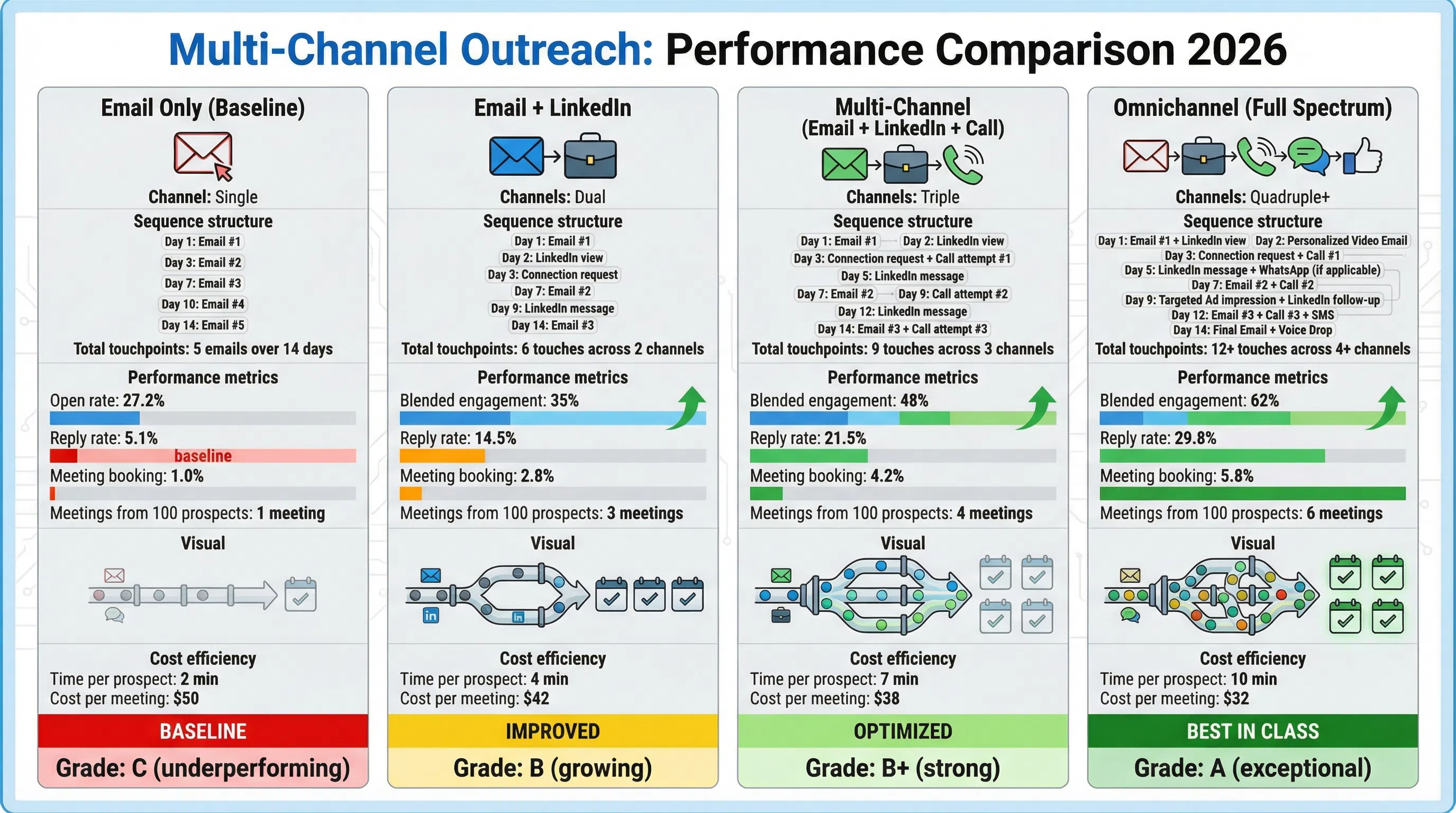
- Email + LinkedIn: 40% higher response vs email alone
- Email + LinkedIn + Phone: 287% higher response vs single-channel
- Multi-channel meeting booking: 32% higher than single-channel
Personalization Impact
- Basic personalization (first name, company): 5-8% reply rate
- Advanced personalization (pain points, recent activity): 12-18% reply rate
- AI-powered hyper-personalization: 14.2-25% reply rate
Now, let's dive into the 15 best practices that drive these results.
Best Practice #1: Use Signal-Based Outreach
Signal-based outreach means prioritizing prospects based on real buying signals instead of static lists. This is the single biggest shift in SDR strategy for 2026.
Why It Works
When you reach prospects actively showing buying signals, response rates increase 58% and sales cycles shorten by 22%. You're reaching them when they're already thinking about the problem you solve.
Top Buying Signals to Monitor
Company Signals:
- Hiring activity: Hiring SDRs, AEs, RevOps, or sales leaders signals operational pain
- Funding announcements: New capital means budget for new tools
- Leadership changes: New CRO, VP Sales often brings process changes
- Technology changes: Adopting complementary tools signals readiness
- Rapid growth: Fast headcount expansion creates operational challenges
Individual Signals:
- Job changes: New role means new problems to solve (first 90 days critical)
- Content engagement: Downloaded your content, attended webinar, visited pricing
- Competitor research: Viewing competitor pages on G2, Capterra
- LinkedIn activity: Posting about challenges your product solves
- Intent topics: Researching product category keywords
How to Implement
Step 1: Set Up Signal Tracking
Use intent data platforms:
- Bombora: Company-level intent topics
- G2/Capterra: Competitor research activity
- Leadfeeder/Leadinfo: Website visitor identification
- LinkedIn Sales Navigator: Job changes, company updates
- First-party data: Your website behavior, content downloads
Step 2: Create Signal-Specific Messaging
Tailor your outreach to the specific signal:
Hiring signal example:
"Saw you're hiring 3 new SDRs this quarter. Most teams hit a productivity wall when scaling SDR teams—reps spend 40% of time on research instead of conversations. Here's how [similar company] cut that to 10%..."
Funding signal example:
"Congrats on the Series B! Having just closed $20M, you're likely focused on accelerating growth. When [similar company] scaled from 10 to 50 AEs post-funding, they..."
Job change signal example:
"Saw you just joined as VP Sales—congrats! The first 90 days are critical. Most new sales leaders tell us their biggest challenge is..."
Step 3: Prioritize High-Signal Prospects
Create signal-based tiers:
- Tier 1 (Hot): 3+ signals (e.g., funding + hiring + job change) → Immediate outreach, phone + email + LinkedIn
- Tier 2 (Warm): 1-2 signals → Multi-channel sequence within 48 hours
- Tier 3 (Cold): 0 signals but strong ICP fit → Standard sequence
Best Practice #2: Master Multi-Channel Outreach
Single-channel outreach is dead. Multi-channel is now the baseline for effective sales outreach.
Why It Works
Multi-channel outreach achieves 287% higher response rates because:
- Increased touchpoints: 7 touches across 3 channels vs 5 touches on email feels fresher
- Channel preferences: Prospects have different preferred communication channels
- Credibility signals: Seeing you on LinkedIn + email + phone signals legitimacy
- Fresh conversations: Each new channel feels like a new conversation, not persistent follow-up
The Optimal Channel Mix
Essential channels (use all three):
- Email: Scale and initial reach (primary channel)
- LinkedIn: Social proof and relationship building (secondary)
- Phone: Personal touch and urgency (tertiary)
Optional additions:
- Video: Personalized Loom/Vidyard for high-value accounts
- Direct mail: Physical packages for top 20 dream accounts
- SMS: Only for opt-in or existing relationships
Proven Multi-Channel Sequence (14 Days)
Day 1: Personalized cold email (value-focused)
Day 2: LinkedIn profile view (awareness touch)
Day 3: LinkedIn connection request (personalized note)
Day 4: Phone call attempt #1 + voicemail
Day 7: Follow-up email (different value prop)
Day 9: LinkedIn message or comment on recent post
Day 11: Phone call attempt #2
Day 14: Breakup email or final touch
Key principles:
- Space touches 2-3 days apart (avoid overwhelming)
- Different message/value prop per channel
- Track which channel drives response for optimization
- 7-10 total touches optimal (3 follow-ups minimum)
Best Practice #3: Personalize Beyond First Name
Generic templates get generic results. Advanced personalization drives 2-3x higher reply rates.
Personalization Tiers
Tier 1: Basic (5-8% reply rate)
- First name
- Company name
- Job title
This is table stakes in 2026—not real personalization.
Tier 2: Advanced (12-18% reply rate)
- Specific pain point for their role/industry
- Recent company news (funding, product launch, hiring)
- Mutual connections or shared background
- Relevant case study (similar company/industry/size)
Tier 3: Hyper-Personalization (18-25% reply rate)
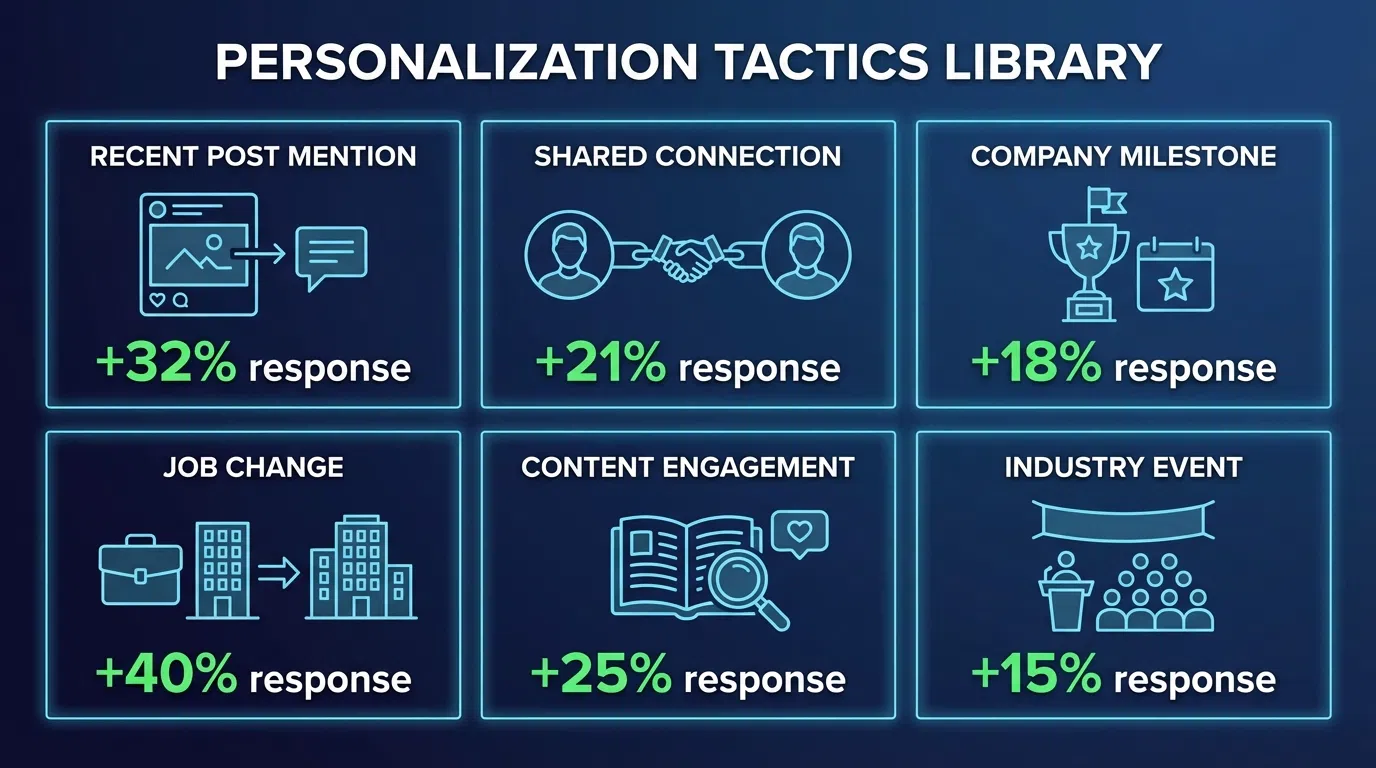
- Reference specific LinkedIn post they wrote
- Comment on their podcast appearance or article
- Mention their recent promotion or job change
- Cite specific challenge they mentioned publicly
- Offer unique insight related to their situation
Personalization at Scale
Manual hyper-personalization doesn't scale beyond 20-30 prospects per day. Here's how top SDRs personalize at scale:
Option 1: Categorize and Customize
Group prospects by persona, industry, or use case, then create semi-custom templates:
- 5-7 industry-specific templates
- 3-4 persona-specific pain points per industry
- 2-3 use case variations
Mix and match for semi-custom messages at scale.
Option 2: AI-Powered Personalization
Tools like LeadSpark AI analyze LinkedIn profiles and recent posts to generate contextual personalization at scale:
- Analyzes 50-100 prospects in minutes
- Finds recent posts, company news, and personalization hooks
- Generates context-specific messages
- Achieves 70-90% response rates (vs 5-12% manual)
This lets you maintain hyper-personalization quality while reaching 500+ prospects per week.
Option 3: Hybrid Approach
- Tier 1 accounts (top 20): Full manual personalization (15-20 min per prospect)
- Tier 2 accounts (100-200): AI-generated + human review (2-3 min per prospect)
- Tier 3 accounts (500+): AI-automated with spot checking (30 sec per prospect)
Best Practice #4: Lead with Value, Not Features
The fastest way to kill a cold outreach message is talking about yourself, your product, or your features.
Why It Fails
Prospects don't care about your product—they care about their problems. Leading with features flags you as a salesperson trying to sell something.
The Value-First Framework
Bad approach (feature-first):
"Hi [Name], I'm reaching out from [Company]. We offer an AI-powered platform that helps sales teams automate personalization with advanced machine learning and..."
Response rate: 1-3%
Good approach (value-first):
"Hi [Name], saw you're hiring 5 new SDRs this quarter. Most teams we talk to find their new reps spend 40% of their time on research instead of conversations in the first 90 days. Is that something you're seeing?"
Response rate: 12-18%
Value-First Message Structure
- Relevant observation: Show you've done research
- Common pain point: Surface a problem they likely have
- Proof point: Brief evidence this matters (stat, customer result)
- Soft CTA: Ask a question, don't pitch a meeting
Example:
"[Observation]: Saw [Company] just raised Series B and is scaling from 10 to 50 AEs.
[Pain point]: Most teams scaling that fast hit a personalization wall—reps can't research 100+ prospects daily while hitting activity targets.
[Proof]: When [Similar Company] scaled from 15 to 60 AEs, they saw response rates drop from 22% to 8% until they fixed this.
[CTA]: Curious—how are you thinking about maintaining outreach quality as you scale?"
Best Practice #5: Nail Your Subject Lines and Opening Lines
The best message in the world fails if it's never opened. Subject lines and opening lines are make-or-break.
Subject Line Best Practices
Length: 25-40 characters performs best (fits mobile preview)
Avoid these:
- ❌ "Quick question"
- ❌ "Following up"
- ❌ "Reaching out"
- ❌ "Just checking in"
- ❌ All caps or excessive punctuation!!!
Use these approaches:
- ✅ Ask a specific question: "[Company] scaling SDR team?"
- ✅ Reference a trigger: "Congrats on the Series B"
- ✅ Name-drop mutual connection: "[Mutual Connection] suggested I reach out"
- ✅ Offer specific value: "30% faster ramp time for new reps"
- ✅ Create curiosity without clickbait: "Noticed something about [Company]"
Opening Line Framework
Bad opening line:
"My name is [Name] and I work at [Company]. We help sales teams..."
Good opening line:
"Saw you just hired 3 new SDRs—congrats on the growth!"
"Quick question: how are you handling personalization at scale?"
"[Mutual Connection] mentioned you might be interested in..."
The rule: First sentence must be about THEM, not you.
Best Practice #6: Master the Follow-Up
80% of sales require at least 5 follow-ups, yet 44% of SDRs give up after one attempt. Follow-up persistence separates top performers from everyone else.
The Data on Follow-Ups
- 3 follow-ups: +28% response rate increase
- 5-7 touchpoints: Optimal for most B2B sequences
- 9-12 touchpoints: For high-value enterprise accounts
Follow-Up Best Practices
1. Add new value each time
Don't just say "checking in" or "circling back." Each follow-up should provide something new:
- Different pain point/use case
- New case study or customer story
- Industry insight or data point
- Relevant content (article, guide, benchmark report)
2. Change the angle
If the first email focused on efficiency, follow-up on quality. If email #2 was about ROI, email #3 covers risk mitigation.
3. Use the breakup email
Final email in sequence should be a soft close-out:
"[Name], I've reached out a few times about [topic] but haven't heard back. I'll assume it's not a priority right now and will close your file. If anything changes, feel free to reach out. Best of luck with the SDR team scaling!"
Breakup emails often generate 33% response rates because they create urgency and remove pressure.
4. Vary send times
Don't send all emails at 9am Tuesday. Test different days/times:
- Email 1: Tuesday 10am
- Email 2: Thursday 2pm
- Email 3: Monday 11am
Some prospects check email mornings, others afternoons. Varying times increases chances they see it.
Best Practice #7: Use Phone Strategically
About 1% or less of SDRs actually call prospects. This is a massive missed opportunity.
Why Phone Works
- Higher response quality: Phone conversations convert to meetings 2-3x more than email responses
- Cuts through noise: No spam filters, no crowded inbox
- Human connection: Voice builds rapport faster than text
- Urgency: Phone implies importance and timely value
When to Call
Always call for:
- High-signal prospects (job change, funding, hiring, hot intent signals)
- Tier 1 accounts (top 50 dream accounts)
- Prospects who engaged (opened 3+ emails, clicked links, visited pricing)
- Quick follow-up to content downloads or demo requests (call within 5 minutes)
Skip calling for:
- Very early in sequence (let email/LinkedIn warm them up first)
- Low-fit prospects
- Extremely cold lists with no signals
Call Best Practices
1. Call at the right times
Best times to call (highest connect rates):
- Wednesday-Thursday
- 8-9am or 4-5pm (before/after core work hours)
- Avoid Monday mornings and Friday afternoons
2. Leave strategic voicemails
Keep voicemails under 30 seconds:
"Hi [Name], [Your Name] from [Company]. Saw you're [specific observation]. Quick question about [relevant topic]—call me at [number] or I'll send an email. Thanks!"
3. Combine with email
Send email immediately after voicemail:
"Just left you a voicemail about [topic]. Here's what I mentioned..."
This gives them multiple ways to respond and reinforces your message.
Best Practice #8: Optimize Send Timing
When you send matters almost as much as what you send.
Best Days to Send
- Tuesday-Thursday: Highest open and response rates
- Monday: Lower open rates (busy catching up)
- Friday: Lower response rates (weekend focus)
Best Times to Send
Email:
- 8-10am: High open rates (checking email at start of day)
- 1-2pm: Moderate open rates (post-lunch email check)
- 4-5pm: Lower open but higher response (end-of-day wrap-up)
LinkedIn:
- 7-9am: Before work commute/start of day
- 12-1pm: Lunch break browsing
- 5-7pm: After work/evening
Phone:
- 8-9am: Before meetings start
- 4-5pm: After meetings end
- 12-1pm: Lunch break
Timing Optimization
Test different send times for your specific audience. Enterprise executives might check email earlier (6-7am), while SMB owners might respond better later (6-8pm).
Best Practice #9: Write Concisely
Long emails get skipped. Concise messages get read and responded to.
The Data
- Under 200 words: Optimal email length (12% reply rate)
- 50-125 words: Best performing range
- Under 400 characters: +22% response rate for LinkedIn messages
Concise Writing Framework
Good email structure:
- Opening line (1 sentence): Personalized observation
- Value prop (2-3 sentences): Problem + proof point
- CTA (1 sentence): Simple, low-friction ask
Total: 4-5 sentences, 75-125 words
Example:
"[Name], saw [Company] raised Series B last month—congrats!
Most teams scaling from 10 to 50 AEs post-funding hit a personalization bottleneck. Reps can't research 100+ prospects daily while hitting targets, so response rates drop 40-60%.
[Similar Company] solved this by [approach], and saw response rates climb from 8% back to 25%.
Worth a 15-min conversation?"
Total: 63 words
Best Practice #10: Use Social Proof Strategically
Generic social proof sounds like bragging. Specific, relevant social proof builds credibility.
Bad Social Proof
"We work with hundreds of companies and have a 95% satisfaction rate."
Why it fails: Vague, unverifiable, sounds like marketing copy.
Good Social Proof
"When [Competitor/Similar Company] was scaling their SDR team from 10 to 30 reps last year, they used [our approach] and saw new rep ramp time drop from 120 days to 45 days."
Why it works: Specific, relevant, similar situation to prospect.
Social Proof That Converts
1. Name-drop similar companies
"[Similar Company in Their Industry] faced this same challenge when they scaled..."
2. Use specific metrics
"Helped [Company] increase response rates from 12% to 28% in 90 days"
3. Reference mutual connections
"[Mutual Connection] mentioned you might be working on [challenge]. When they faced this..."
4. Cite industry data
"75% of SaaS companies scaling past $10M ARR hit this challenge" (positions you as expert)
Best Practice #11: Optimize Your CTAs
The call-to-action can make or break response rates. Most SDRs ask for too much, too soon.
CTA Hierarchy (Least to Most Friction)
Lowest friction:
- Answer a question: "Curious—is this a challenge for your team?"
- Provide feedback: "Does this resonate with your situation?"
- Soft interest check: "Worth exploring?"
Medium friction:
- Continue conversation: "Happy to share how [Similar Company] solved this."
- Share resource: "Want me to send the benchmark report?"
High friction:
- Book a meeting: "Available for a 15-min call Tuesday?"
CTA Best Practices
Early touches (emails 1-3):
Use low-friction CTAs (questions, feedback requests). You're building interest, not closing meetings.
Mid-sequence (emails 4-6):
Medium-friction CTAs (offering value, case studies, resources).
Late sequence (emails 7+):
High-friction CTAs (meeting requests) are appropriate once they've engaged.
The magic question CTA:
"Is [specific challenge] something you're actively working on?"
This works because:
- Yes = they have the problem (qualified)
- No = saves everyone time
- "Not right now" = timing signal for future follow-up
Best Practice #12: A/B Test Everything
Top-performing SDRs treat outreach like a science experiment. They test, measure, and optimize constantly.
What to Test
High-impact tests:
- Subject lines: Test 3-4 variations per campaign
- Opening lines: Personalization approach vs pain point vs question
- Value props: Different pain points or benefits
- CTAs: Question vs meeting request vs resource offer
- Send times: Morning vs afternoon, Tuesday vs Thursday
- Sequence length: 7 touches vs 10 touches vs 14 touches
Medium-impact tests:
- Email length: 75 words vs 150 words
- Social proof: Customer story vs industry data
- Tone: Casual vs professional
- Personalization level: Basic vs advanced
Testing Framework
Step 1: Pick ONE variable to test (never test multiple things simultaneously)
Step 2: Create 2 variations (A and B)
Step 3: Send to equal, randomized segments (minimum 50 prospects per variation)
Step 4: Measure results (reply rate, meeting booking rate)
Step 5: Implement winner, test next variable
Best Practice #13: Avoid Common Outreach Mistakes
Knowing what NOT to do is as important as best practices.
Top 10 Outreach Mistakes
1. Sounding too much like a salesperson
Avoid: "I'd love to hop on a quick call to show you our revolutionary platform..."
Instead: "Quick question about how you're handling [challenge]..."
2. Trying to close too early
The next step isn't a sale—it's a conversation. Don't push for meetings in email #1.
3. Talking about your product/features
Lead with their problems and results, not your features.
4. Using clickbait subject lines
"You won't believe this..." or "URGENT!" destroy credibility.
5. Inconsistent tone
Shifting from casual to formal mid-email confuses prospects. Pick a tone and maintain it.
6. Not including an unsubscribe link
Better they unsubscribe than mark you as spam (destroys deliverability).
7. Sending identical messages across channels
If your email and LinkedIn message are identical, you're wasting touchpoints.
8. Giving up too soon
44% quit after one attempt. 80% of sales need 5+ touches. Persist strategically.
9. Not using the phone
Only 1% of SDRs call. This is free competitive advantage.
10. Ignoring deliverability
Focusing only on open rates while ignoring deliverability (spam scores, bounce rates) undermines everything.
Best Practice #14: Maintain Email Deliverability
The best email in the world doesn't matter if it never reaches the inbox.
Email Deliverability Essentials
1. Warm up new domains
Don't send 500 emails day one from a new domain. Gradually increase volume:
- Week 1: 20-30 emails/day
- Week 2: 50-75 emails/day
- Week 3: 100-150 emails/day
- Week 4+: Full volume
2. Monitor deliverability metrics
Track these weekly:
- Bounce rate: Keep under 5% (ideally under 2%)
- Spam complaints: Keep under 0.1%
- Unsubscribe rate: 0.3-0.5% is normal
- Reply rate: Healthy engagement signals legitimacy
3. Use multiple sending domains
Don't put all eggs in one basket. Use 2-3 sending domains:
- Primary: yourcompany.com
- Secondary: email.yourcompany.com
- Tertiary: outreach.yourcompany.com
4. Always include unsubscribe links
It's better prospects unsubscribe than mark as spam. Spam complaints kill deliverability.
5. Avoid spam triggers
- Don't use all caps in subject lines
- Avoid excessive punctuation!!!
- Don't use spam words (FREE, GUARANTEE, ACT NOW)
- Keep HTML simple (no fancy designs)
- Don't send attachments in cold emails
Best Practice #15: Leverage AI for Scale, Keep Human for Quality
45% of teams now use hybrid AI-SDR models. AI cuts research and personalization time by 90%, but the best results come from combining AI efficiency with human judgment.
How to Use AI in Outreach
Use AI for:
- Research: Analyze 100 LinkedIn profiles in minutes instead of hours
- Personalization at scale: Find post references, company news, personalization hooks automatically
- First draft generation: Create personalized message templates based on prospect data
- Intent signal monitoring: Track buying signals across multiple data sources
- CRM updates: Automatically log activities and update records
Keep human for:
- Final review: AI sometimes misses context—always review before sending to Tier 1 accounts
- Voice and tone: Ensure messages sound like you, not a robot
- Strategy decisions: Which accounts to target, sequence structure, testing priorities
- Relationship building: Phone calls, video messages, high-touch accounts
AI-Powered Outreach Workflow
- Upload prospect list to AI tool (LinkedIn URLs or CRM export)
- AI analyzes profiles, recent posts, company news, job changes
- AI generates personalized messages referencing specific context
- Human reviews (Tier 1: detailed review, Tier 2: quick scan, Tier 3: spot check)
- Send and track responses, optimize based on data
Tools like LeadSpark AI enable this workflow, achieving 70-90% response rates while saving 20+ hours per week per SDR.
Putting It All Together: Your Outreach Framework
Here's how to combine these 15 best practices into a cohesive outreach system:
Weekly Outreach Workflow
Monday (Planning & List Building):
- Identify 100-150 prospects with buying signals
- Segment into Tiers 1-3 based on fit and signals
- Research Tier 1 accounts (20-30 prospects, 10-15 min each)
Tuesday-Thursday (Outreach Execution):
- Send 40-60 emails/day (personalized)
- Make 15-20 calls/day (high-signal prospects)
- Send 20-30 LinkedIn connection requests
- Record 3-5 personalized videos (Tier 1 accounts)
Friday (Follow-Up & Optimization):
- Follow up on opened emails
- Respond to replies
- Analyze metrics (open rate, reply rate, meeting booking)
- Adjust next week's approach based on data
Recommended Tools Stack
Email:
- Outreach, SalesLoft, or Instantly.ai (sequencing)
- Warmup Inbox or Mailreach (deliverability)
LinkedIn:
- Sales Navigator (prospecting)
- LeadSpark AI (AI personalization at scale)
Phone:
- Apollo or Lusha (phone data)
- Aircall or Gong (call recording)
Intent & Signals:
- Bombora (intent data)
- G2/Capterra (competitor research)
- Leadfeeder (website visitors)
AI Research:
- LeadSpark AI (LinkedIn profile analysis)
- ChatGPT or Claude (message editing)
Measuring Success: Outreach KPIs
Track these metrics to optimize your outreach:
Activity Metrics
- Emails sent: 200-300/week
- Calls made: 75-100/week
- LinkedIn touches: 100-150/week
Engagement Metrics
- Email open rate: Target 15-25%
- Email reply rate: Target 8-15%
- Positive reply rate: Target 3-8%
- Call connect rate: Target 5-15%
- LinkedIn acceptance rate: Target 35-50%
Conversion Metrics
- Meetings booked: 8-15 per week (experienced SDR)
- Show-up rate: Target 70-80%
- Meetings to opportunities: Target 30-50%
Efficiency Metrics
- Time per prospect: 5-10 minutes (including research)
- Emails per hour: 8-12 (with personalization)
- Meetings per 100 prospects: 3-8 meetings
Conclusion: Quality Outreach Scales
The fundamentals of effective sales outreach in 2026 come down to this:
Do more of:
- Signal-based targeting (reach them when ready)
- Multi-channel coordination (email + LinkedIn + phone)
- Advanced personalization (beyond first name)
- Value-first messaging (their problems, not your features)
- Strategic persistence (5-7 touches, varied value)
- AI for research efficiency (scale the research)
Do less of:
- Spray-and-pray volume (quality over quantity)
- Feature-first pitching (nobody cares about your product... yet)
- Single-channel outreach (multi-channel wins)
- Giving up too soon (most quit after touch 1)
- Generic templates (personalization drives 2-3x results)
The SDR teams winning in 2026 aren't sending more emails—they're sending better emails, to better prospects, at better times, through better channels.
And with AI tools enabling research and personalization at scale, you can now achieve both quality AND quantity.
Scale Your Sales Outreach with AI-Powered Personalization
If you're ready to implement these best practices at scale, AI-powered personalization is the fastest path forward.
LeadSpark AI helps SDR teams achieve 70-90% response rates on LinkedIn by analyzing prospect profiles and recent posts to generate hyper-personalized messages at scale.
How it works:
- Upload your prospect list (from Sales Navigator, CRM, or CSV)
- AI analyzes LinkedIn profiles, recent posts, company news, and job changes
- Generate contextual messages referencing specific posts and developments
- Review (or auto-approve) and send through your preferred tool
- Track responses and optimize based on data
SDRs using LeadSpark AI save 20+ hours per week on research and personalization while increasing LinkedIn response rates from 5-12% (manual) to 70-90% (AI-personalized).
Start your free trial and see how AI-powered outreach compares to your current approach. No credit card required.
Ready to Generate Personalized Icebreakers?
Join sales professionals using LeadSpark AI to create hyper-personalized LinkedIn icebreakers in minutes.