Outreach Best Practices
Cold Outreach: The Complete Guide to Cold Outreach That Gets Replies
Master cold outreach in 2026 with proven strategies for email and LinkedIn. Learn how to achieve 10%+ reply rates with multi-channel sequences and authentic personalization.
LeadSpark AI Team
12 min read
Cold outreach isn't dead—but the old "spray and pray" approach absolutely is.
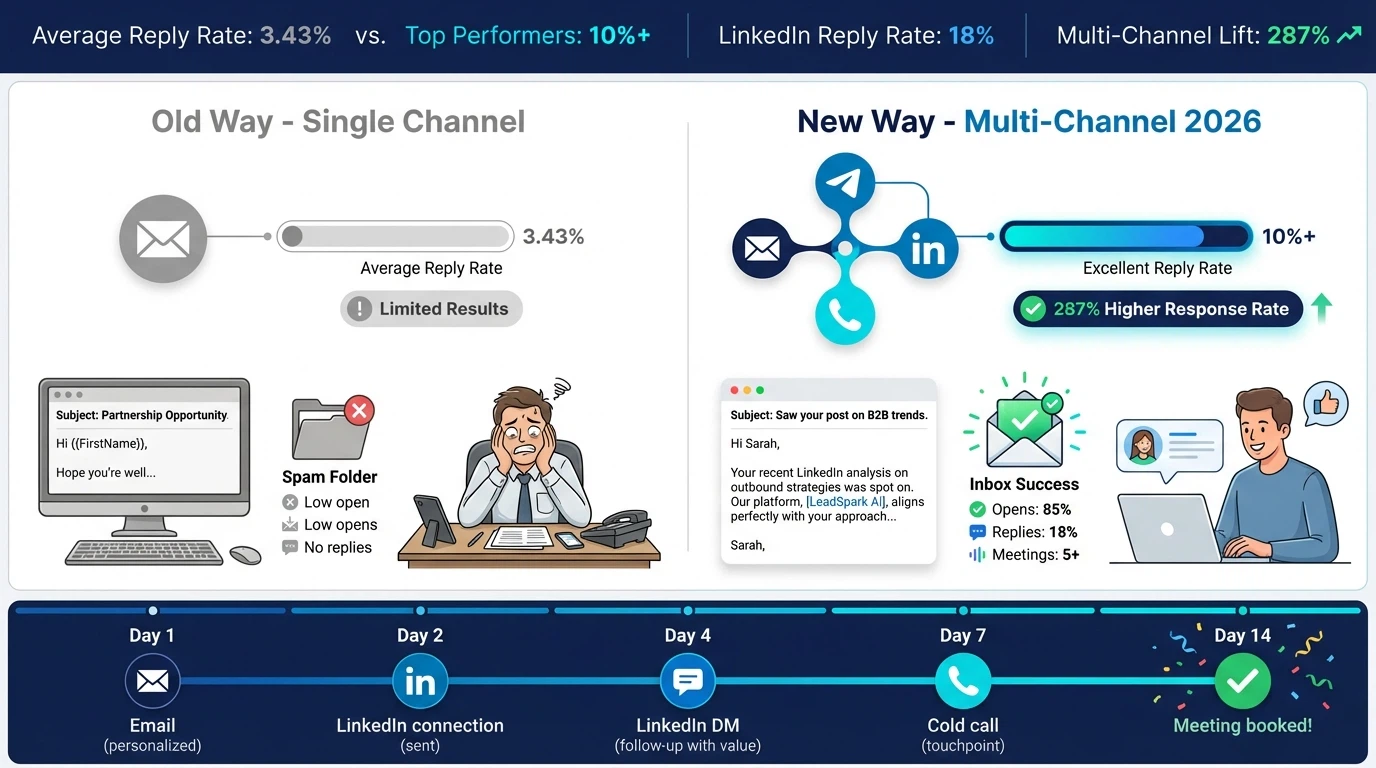
In 2026, the average cold email gets a 3.43% reply rate. But top performers achieve 10%+ reply rates—and some campaigns hit an astonishing 40-50%. The difference? They've mastered the new rules of cold outreach.
Here's the reality: Multi-channel outreach (email + phone + LinkedIn) increases response rates by 287% compared to single-channel efforts. Yet most sales teams still rely on cold email alone, wondering why their messages disappear into the void.
This guide shows you exactly how to build a modern cold outreach system that consistently generates qualified conversations—whether you're using email, LinkedIn, or both.
What is Cold Outreach?
Cold outreach is the practice of initiating contact with potential customers who haven't expressed prior interest in your product or service. Unlike warm outreach (following up with inbound leads) or referrals, cold outreach means reaching out to prospects "cold"—with no existing relationship.
Cold outreach happens across multiple channels:
- Cold email: Direct messages to business email addresses
- LinkedIn cold outreach: Connection requests and DMs on LinkedIn
- Cold calling: Phone calls to prospects
- Social media outreach: Twitter/X DMs, Instagram messages (less common in B2B)
For B2B sales teams, cold outreach remains one of the most scalable and predictable ways to fill the pipeline—when done correctly.
Why Cold Outreach Still Works in 2026
Despite countless "cold email is dead" articles, the data tells a different story:
The Numbers That Matter
- Average cold email open rate: 27.7% (40-60% for well-targeted campaigns)
- Average reply rate: 3.43% (but top performers achieve 10%+)
- LinkedIn message reply rate: 5-20% (LinkedIn InMail: 10-25%)
- Multi-channel outreach increases response rates by 287%
- 58% of replies come from the first message, 42% from follow-ups
- 2-email sequence drives highest response rate: 6.9%
- Conversion to closed deal: 0.2-2% (1-5% is considered good)
What Changed in 2026
The landscape has evolved dramatically:
What's Dead:
- Mass, untargeted outreach ("spray and pray")
- Generic templates with basic {{FirstName}} tokens
- Single-channel email-only campaigns
- Long, sales-heavy pitches
- Neglecting deliverability infrastructure
What's Alive:
- Intent-based targeting (reaching prospects actively researching solutions)
- Deep, authentic personalization at scale
- Multi-channel sequences (email + LinkedIn + phone)
- Short, value-first messages (100-150 words)
- AI-powered personalization (when done right)
- Deliverability-first infrastructure
The companies winning with cold outreach in 2026 treat it like a science: systems instead of shortcuts, strong deliverability, narrow ICPs, high-quality lists, clear offers, thoughtful follow-ups, and smart multi-channel sequencing.
Cold Email vs LinkedIn Cold Outreach: Which is Better?
The answer: Both. But they serve different purposes.
Cold Email: Best for Scale
Advantages:
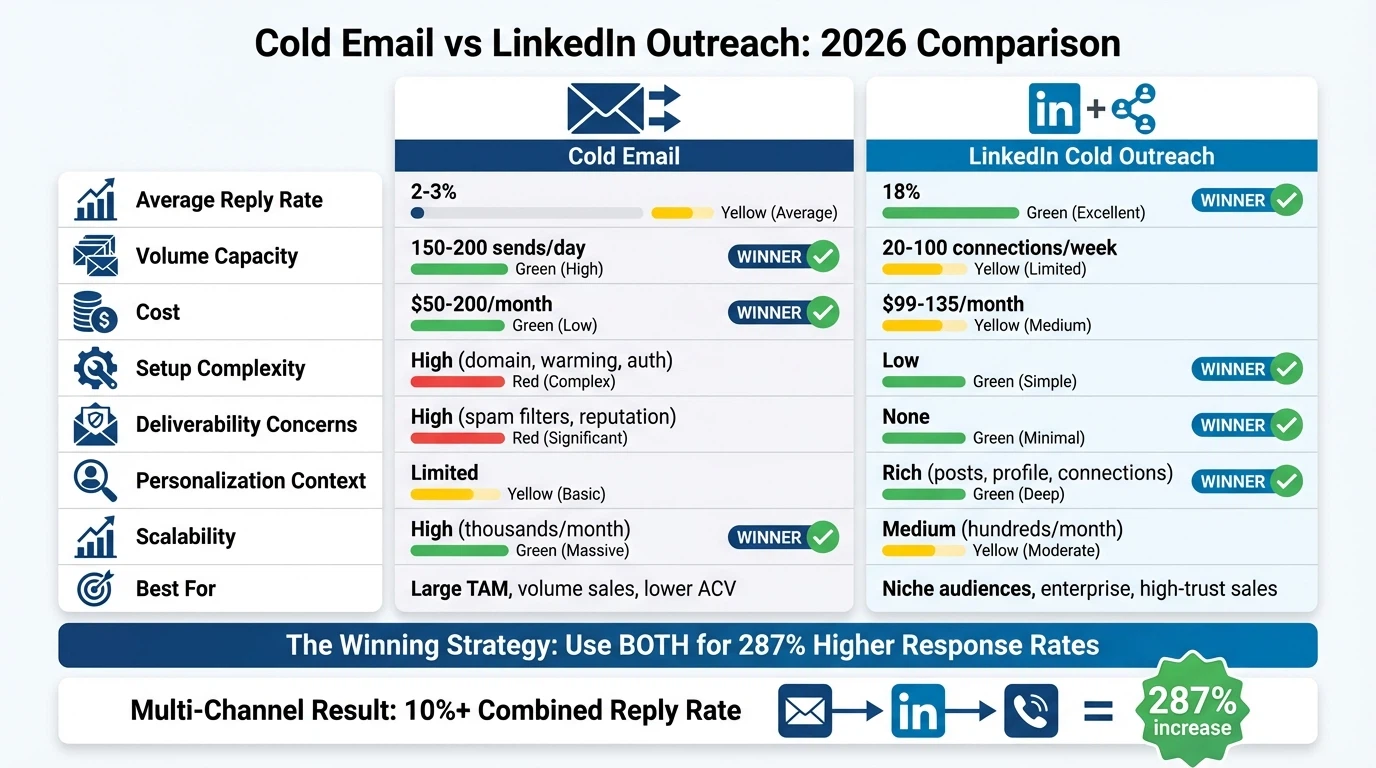
- Volume: Send 150-200 emails per day safely (vs 20-100 LinkedIn connections per week)
- Scalability: Reach thousands of prospects monthly
- Automation: Full sequence automation with tools like Instantly, Lemlist, Reply.io
- Deliverability control: You own your infrastructure
- Lower cost: $50-200/month for email tools vs $99-135/month for LinkedIn Sales Navigator
Disadvantages:
- Lower engagement: 2-3% average reply rate (vs LinkedIn's 18%)
- Deliverability challenges: Spam filters, domain reputation, warming required
- Less context: No profile, posts, or social proof visible
- Inbox competition: Prospects receive 100+ cold emails weekly
- Infrastructure required: Separate domains, warm-up, SPF/DKIM/DMARC setup
When to Choose Email:
- Large TAM (Total Addressable Market) with proven offers
- Volume-based sales motion (many small deals vs few large deals)
- Lower price point products ($1K-$10K ACV)
- Prospects who aren't active on LinkedIn
- You have proper deliverability infrastructure
LinkedIn Cold Outreach: Best for Relationships
Advantages:
- Higher engagement: 18% average reply rate for messages, 10-25% for InMail
- Built-in credibility: Profile, recommendations, mutual connections visible
- Context-rich: See prospects' posts, activity, interests
- Less spam: Lower competition in LinkedIn inbox
- No deliverability concerns: No domain reputation to protect
- Easier personalization: Posts and profile provide conversation starters
Disadvantages:
- Volume limits: 20-100 connection requests per week, 50 InMails/month with Sales Navigator
- Acceptance rate: Only 40% accept connection requests (must connect before messaging)
- Higher cost: $99-135/month for Sales Navigator + time investment
- Platform risk: Account restrictions if you violate LinkedIn's policies
- More time-intensive: Harder to automate at scale
When to Choose LinkedIn:
- Niche, high-value audiences (enterprise, executives)
- Relationship-driven sales cycles (6-12 month deals)
- Executive-level outreach (C-suite is hard to reach via email)
- Strong social proof and thought leadership positioning
- Complex products requiring trust and credibility
The Winning Strategy: Multi-Channel Outreach
The data is clear: combining email and LinkedIn increases response rates by 287%.
Here's how top-performing sales teams structure multi-channel cold outreach:
Week 1:
- Day 1: LinkedIn connection request (personalized, no pitch)
- Day 2: Cold email #1 (value-focused, problem-aware)
- Day 4: LinkedIn DM (if they accepted connection)
- Day 7: Cold call attempt #1
Week 2:
- Day 8: Cold email #2 (case study or social proof)
- Day 10: LinkedIn engagement (comment on their post)
- Day 12: Cold call attempt #2
- Day 14: Cold email #3 ("breakup email")
This approach uses email for direct, scalable outreach and LinkedIn for credibility, context, and light-touch follow-ups. Each channel reinforces the others, increasing familiarity and trust.
For LinkedIn personalization at scale, tools like LeadSpark AI automatically analyze prospects' recent posts and generate authentic icebreakers—cutting research time from 30 minutes to under 30 seconds per prospect while maintaining quality that drives 40-70% response rates.
Cold Outreach Strategies That Work in 2026
1. Intent-Based Targeting
Stop reaching out to everyone who "might" need your solution. Focus on prospects actively showing buying signals:
High-Intent Signals:
- Visited your website 3+ times in the past week
- Downloaded competitor comparison content
- Posted on LinkedIn about the problem you solve
- Recently raised funding (expansion signals)
- Hired for roles that indicate need (e.g., hired SDR manager = likely buying sales tools)
- Changed to a role where they'll need your solution
Tools for Intent Data:
- 6sense and Bombora for B2B intent signals
- Clearbit Reveal for website visitor tracking
- LinkedIn Sales Navigator for job changes and company updates
- Google Alerts for company news
Prospects showing intent are 3-5x more likely to respond than cold prospects. When you reach out at the right moment with relevant context, cold outreach becomes your hottest lead source.
2. Deep Personalization (Not Templates)
The old template approach is dead:
Bad Personalization (2020):
`
Hi {{FirstName}},
I noticed {{Company}} is growing fast. We help companies like yours improve their sales process.
Can we chat?
`
This is "personalization" in name only. Prospects can spot templates instantly.
Good Personalization (2026):
`
Hi Sarah,
Your post about SDR response rates dropping hit home—we saw the same thing at TechCorp last year.
We solved it by using LinkedIn post analysis to personalize outreach at scale (jumped from 4% to 12% reply rate in 6 weeks).
Worth 15 minutes to show you the exact playbook?
`
Notice the differences:
- References specific content they created (their LinkedIn post)
- Shows genuine understanding of their problem
- Provides concrete, believable results
- Asks for a small commitment (15 minutes, not "chat")
How to Personalize at Scale:
Without tools, this level of personalization takes 5-10 minutes per prospect. Here's how to scale it:
- Segment by persona/pain point: Create 5-8 core message frameworks for different ICPs
- Trigger-based customization: Customize the intro based on what triggered your outreach
- AI-powered research: Use AI tools like LeadSpark AI to automatically analyze LinkedIn posts and generate personalized openers
- Video for high-value targets: Record 30-60 second personalized videos for top-tier accounts
3. Short, Value-First Messages
In 2026, a concise email of 100-200 words is likely to have the most impact. Prospects spend an average of 11 seconds reading cold emails.
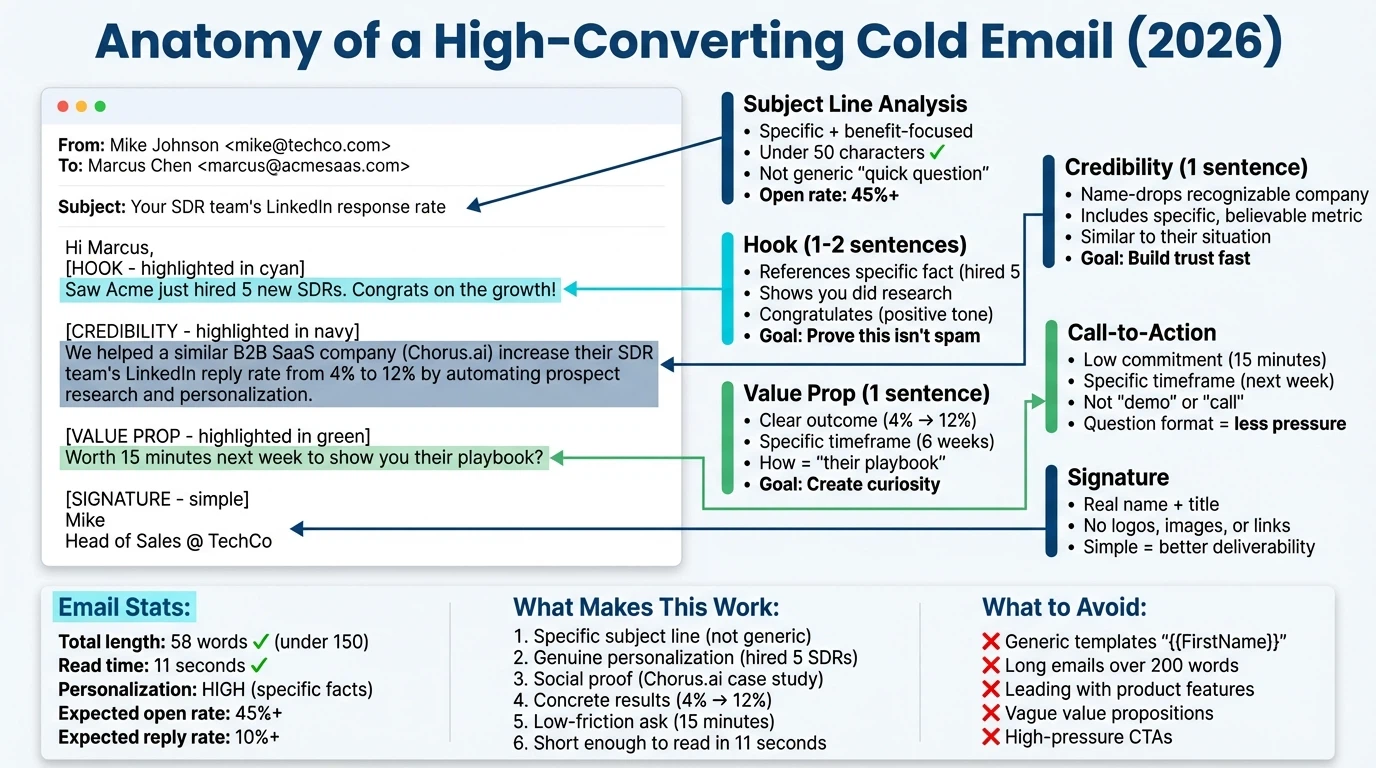
Effective Cold Email Structure:
`
Subject: [Specific, curiosity-driven, under 50 characters]
Hi [First Name],
[HOOK: 1-2 sentences referencing something specific about them]
[CREDIBILITY: 1 sentence showing you've helped similar companies]
[VALUE PROP: 1 sentence on the specific outcome you deliver]
[EASY ASK: Low-friction next step]
Best,
[Your Name]
`
Real Example:
`
Subject: Your SDR team's LinkedIn response rate
Hi Marcus,
Saw Acme just hired 5 new SDRs. Congrats on the growth!
We helped a similar B2B SaaS company (Chorus.ai) increase their SDR team's LinkedIn reply rate from 4% to 12% by automating prospect research and personalization.
Worth 15 minutes next week to show you their playbook?
Mike
Head of Sales @ TechCo
`
Why this works:
- Subject line is specific and benefit-focused
- Hook references real information (their hiring)
- Credibility name-drops a recognizable company
- Value prop includes a specific, believable metric
- Ask is low-commitment (15 minutes, not "demo" or "call")
- Total length: 58 words
4. Strategic Follow-Up Sequences
Most SDRs give up too early. 58% of replies come from the first email, but 42% come from follow-ups. The magic happens between touches 2-7.
Optimal Cold Email Sequence:
Email 1 (Day 1): Value-focused introduction
- Goal: Start a conversation
- Focus: Their problem + your solution
- Length: 100-150 words
Email 2 (Day 4): Case study or social proof
- Goal: Build credibility
- Focus: How you've helped similar companies
- Length: 125-175 words
- Include: Specific results, ideally with company name
Email 3 (Day 8): Alternative approach or resource
- Goal: Provide value even if they don't buy
- Focus: Share a helpful resource (guide, tool, framework)
- Length: 75-100 words
Email 4 (Day 14): "Breakup email"
- Goal: Final attempt before moving on
- Focus: "Should I stop reaching out?"
- Length: 50-75 words
Example Breakup Email:
`
Subject: Should I stop emailing you?
Hi Marcus,
I've reached out a few times about improving LinkedIn response rates for your SDR team, but haven't heard back.
Should I take that as a "not interested" and stop emailing?
If the timing's just not right, let me know when would be better to circle back.
Mike
`
Breakup emails often get 30-40% higher response rates than regular follow-ups because they:
- Acknowledge the prospect's silence (shows respect)
- Give an easy way to opt out (reduces pressure)
- Create urgency (last chance to respond)
- Stand out from typical follow-ups
5. Multi-Channel Coordination
Email alone: 3% reply rate
LinkedIn alone: 10% reply rate
Email + LinkedIn + Phone: 287% increase
The key is coordination, not just doing more. Each touchpoint should:
- Reference the channel (e.g., "I sent you an email last week...")
- Add new value (don't repeat the same pitch)
- Feel like a consistent conversation (not disconnected spam)
Multi-Channel Sequence Example:
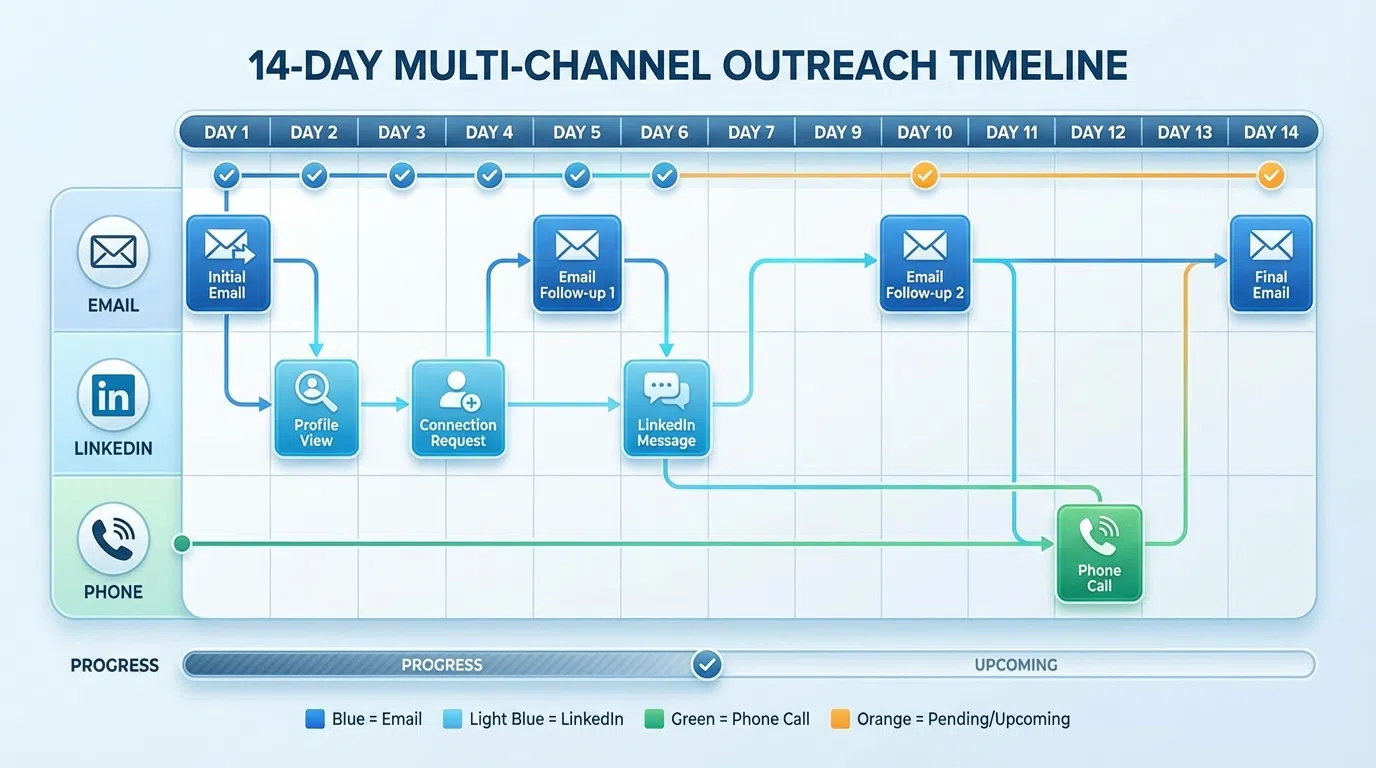
Day 1 - LinkedIn: Connection request
"Hi Marcus—saw you're hiring SDRs at Acme. I work with B2B SaaS sales leaders on improving SDR productivity. Would love to connect."
Day 2 - Email #1: Initial value pitch
[Full email about SDR LinkedIn response rates]
Day 4 - LinkedIn DM: (If they accepted connection)
"Thanks for connecting, Marcus. I know you're busy ramping up your SDR team. If improving LinkedIn response rates is a priority this quarter, I'd love to share what's working for similar teams. No pressure either way!"
Day 7 - Cold Call: Leave voicemail
"Hi Marcus, Mike from TechCo. I sent you an email and LinkedIn message about your SDR team's LinkedIn prospecting. Worth a 15-minute chat? My number is..."
Day 8 - Email #2: Case study
"Hi Marcus—following up on my email from Tuesday. Wanted to share how Chorus.ai's SDR team increased their LinkedIn reply rate from 4% to 12%..."
Each message acknowledges previous attempts, adds new information, and maintains a helpful (not pushy) tone.
Step-by-Step Cold Outreach Process
Here's the exact workflow top sales teams use:
Step 1: Build Your Target List (2-3 hours/week)
Don't just pull 10,000 contacts from a database and start emailing. That's the path to spam.
Do build a highly targeted list of 50-100 prospects per week who fit your ICP perfectly.
Where to Get Contacts:
- Apollo.io: 250M+ contacts, $49/month, great for startups
- ZoomInfo: 500M+ contacts, $15K/year, best data quality
- LinkedIn Sales Navigator: $99-135/month, best for LinkedIn outreach
- Hunter.io: Email finder, $49/month
- Cognism: International data, GDPR-compliant
List Quality Checklist:
- ✅ Fits your ICP (company size, industry, role)
- ✅ Email verified (use NeverBounce, ZeroBounce)
- ✅ Currently in the role (check LinkedIn)
- ✅ Company is active/growing (not defunct)
- ✅ Showing buying signals (if possible)
Step 2: Research Your Prospects (30 sec - 5 min per prospect)
The level of research depends on deal size:
For High-Volume, Low-ACV ($1K-$10K deals):
- 30 seconds per prospect
- Check their LinkedIn headline and last 2 posts
- Note any trigger events (new job, funding, hiring)
- Use LeadSpark AI to automatically analyze LinkedIn activity and generate personalized icebreakers
For Mid-Market ($10K-$50K deals):
- 2-3 minutes per prospect
- Read their last 3-5 LinkedIn posts
- Check company news (recent funding, product launches)
- Identify mutual connections
- Note specific pain points they've mentioned
For Enterprise ($50K+ deals):
- 5-10 minutes per prospect
- Deep dive on their background and career path
- Research company priorities and strategic initiatives
- Find podcast appearances or blog posts they've written
- Map their buying committee
Step 3: Craft Your Outreach (3-5 min per message)
Use the frameworks from the "Strategies" section above:
Cold Email:
- Subject line: Specific + benefit-focused, under 50 characters
- Body: 100-150 words, value-first, one CTA
- Personalization: Reference something specific about them
LinkedIn Connection Request:
- 300 characters max
- Reference something you have in common
- NO pitching in the connection request
- Make it about them, not you
LinkedIn DM (after they accept):
- 75-100 words
- Start with appreciation for connecting
- Ask an engaging question or share quick value
- Soft transition to your offer
Step 4: Set Up Your Infrastructure
For Cold Email:
- Separate sending domain: Use a subdomain (e.g., outreach.yourcompany.com) to protect your main domain
- Email authentication: Set up SPF, DKIM, and DMARC records properly
- Warm-up period: Warm up new email addresses for 14-21 days before sending cold outreach
- Daily send limits: Max 50-70 emails per inbox per day to start
- Email rotation: Use 3-5 sending addresses to increase volume safely
Tools for Email Deliverability:
- Instantly.ai: Email warmup + sending
- Lemlist: Sequences with personalization
- Mailshake: Email campaigns
- Warmbox: Email warm-up service
For LinkedIn:
- Optimize your profile: Professional photo, compelling headline, detailed About section
- Build credibility: Post 2-3x per week on relevant topics
- Sales Navigator: Required for serious prospecting ($99-135/month)
- Daily limits: 20-100 connection requests per week (LinkedIn varies these limits)
- Avoid automation tools: Most violate LinkedIn's ToS and risk account suspension
Step 5: Launch and Monitor
Week 1: Start Small
- Send 10-20 emails per day per inbox
- Send 5-10 LinkedIn connection requests per day
- Monitor deliverability: Open rates should be 40%+
- Check spam rates: Under 0.3% is good
Week 2-3: Scale Gradually
- Increase to 50-70 emails per day per inbox if deliverability is good
- Increase to 20-30 LinkedIn connections per day
- A/B test subject lines and message variations
- Track reply rates by segment
Week 4+: Optimize
- Double down on what's working (segments, messages, offers)
- Cut what's not working (under 2% reply rate = stop)
- Test new angles and value propositions
- Refine your ICP based on who actually responds
Step 6: Respond Fast and Follow Up
Response Time Matters:
- Respond within 5 minutes if possible (while you're top of mind)
- Leads contacted within 5 minutes are 100x more likely to convert
- Set up Slack/email notifications for replies
Follow-Up on Non-Responders:
- Continue your sequence for 2-4 weeks (6-12 touches)
- Space emails 3-5 days apart
- Vary your value propositions
- Use "breakup email" as final attempt
Track What Works:
- Which subject lines get highest open rates?
- Which messages get highest reply rates?
- Which segments/personas respond best?
- Which offers drive the most meetings?
Common Cold Outreach Mistakes (And How to Fix Them)
Mistake #1: Spray and Pray
The Problem: Sending 1,000 generic emails to anyone remotely in your target market.
Why It Fails: In 2026, relevance is the real deliverability hack. Mass untargeted outreach gets flagged by spam filters and ignored by prospects.
The Fix:
- Build smaller, higher-quality lists (50-100 per week)
- Segment by persona, industry, and pain point
- Personalize based on real research
- Target prospects showing buying signals
Mistake #2: Leading with Your Product
The Problem: "We're an AI-powered SaaS platform that helps companies streamline their..."
Why It Fails: Prospects don't care about your product. They care about solving their problems.
The Fix:
- Start with their problem, not your solution
- Lead with outcomes: "Increase LinkedIn response rates by 150%"
- Share results from similar companies
- Product details come after they're interested
Mistake #3: Writing Long Emails
The Problem: 400-word emails explaining every feature and benefit.
Why It Fails: Prospects spend 11 seconds reading cold emails. Long emails never get read.
The Fix:
- Keep emails under 150 words (100 is ideal)
- One problem, one solution, one CTA
- Use short paragraphs (2-3 lines max)
- Save the details for after they reply
Mistake #4: Terrible Subject Lines
The Problem:
- "Quick question" (vague)
- "Partnership opportunity" (sounds like spam)
- "Following up" (on what?)
Why It Fails: If they don't open, nothing else matters.
The Fix:
Good subject lines are:
- Specific: "Your SDR team's LinkedIn response rate"
- Benefit-focused: "12% reply rate in 6 weeks"
- Curiosity-driven: "The SDR playbook Chorus.ai used"
- Short: Under 50 characters
Mistake #5: Ignoring Deliverability
The Problem: Sending cold emails from your main company domain with no warm-up.
Why It Fails: Your emails go straight to spam. You tank your domain reputation. Support emails start getting blocked.
The Fix:
- Use a separate domain for cold outreach
- Warm up new email addresses for 14-21 days
- Set up SPF, DKIM, and DMARC properly
- Monitor your sender reputation with tools like Google Postmaster
Mistake #6: Giving Up Too Early
The Problem: Sending 1-2 emails and moving on.
Why It Fails: 80% of sales require 5+ follow-ups, yet most reps quit after 1-2 attempts.
The Fix:
- Plan 6-12 touch sequences over 2-4 weeks
- Each follow-up should add new value
- Use multiple channels (email + LinkedIn + phone)
- Send a "breakup email" as your final attempt
Mistake #7: Single-Channel Outreach
The Problem: "I only do cold email" or "I only use LinkedIn"
Why It Fails: You're leaving 287% of potential responses on the table.
The Fix:
- Implement coordinated multi-channel sequences
- Use email for scale, LinkedIn for credibility
- Each channel should reference and reinforce the others
- Track which combinations work best for your ICP
Measuring Cold Outreach Success
Track the right metrics at each stage:
Email Metrics
Deliverability (Technical):
- Inbox placement rate: Target 95%+ (use seed lists to test)
- Bounce rate: Under 2% (clean your list)
- Spam complaint rate: Under 0.3%
Engagement (Campaign):
- Open rate: 27.7% average, 45%+ excellent
- Reply rate: 3.43% average, 10%+ excellent
- Positive reply rate: 50%+ of replies should be positive/interested
Conversion (Revenue):
- Meeting booked rate: 20-40% of positive replies
- Show rate: 70%+ of booked meetings
- Opportunity rate: 30-40% of held meetings
- Close rate: Track but don't expect SDRs to own this
LinkedIn Metrics
Connection Activity:
- Connection requests sent: 20-100 per week
- Connection acceptance rate: 40%+ average, 60%+ excellent
- Pending connections: Keep under 100
Messaging:
- Messages sent: 20-30 per day
- Reply rate: 10-18% average, 20%+ excellent
- Conversation rate: 50%+ of replies turn into conversations
InMail (if using Sales Navigator):
- InMails sent: Max 50/month with premium
- InMail response rate: 10-25%
- InMail acceptance rate: Higher than regular messages
Multi-Channel Metrics
Overall Campaign:
- Prospects entered: How many entered your sequence
- Total touchpoints delivered: Email + LinkedIn + calls
- Overall response rate: Across all channels
- Channel contribution: Which channel drove the reply?
Benchmarks to Hit:
- 8-12 qualified meetings booked per SDR per week
- 10%+ combined reply rate (all channels)
- 70%+ meeting show rate
- 6-8 average touches per booked meeting
Frequently Asked Questions
What's a good reply rate for cold outreach in 2026?
A 3.43% reply rate is average for cold email in 2026, but top performers achieve 10%+ reply rates. For LinkedIn cold outreach, average reply rates are 10-18%, with LinkedIn InMail averaging 10-25%. However, these numbers vary by industry—legal services can hit 10%, while software sector averages under 1%. The key is multi-channel: combining email, LinkedIn, and phone increases response rates by 287% compared to single-channel efforts.
How many follow-ups should I send in a cold outreach sequence?
Send 6-12 touches over 2-4 weeks across multiple channels. Research shows 58% of replies come from the first message, but 42% come from follow-ups, and 80% of sales require 5+ follow-ups. The most effective approach: Email #1 (Day 1) → LinkedIn connection (Day 2) → Email #2 (Day 4) → LinkedIn DM (Day 7) → Email #3 (Day 10) → Call attempt (Day 12) → Final "breakup" email (Day 14). Space touches 2-4 days apart and add new value in each message.
Should I use cold email or LinkedIn for B2B cold outreach?
Use both—multi-channel outreach increases response rates by 287%. Choose cold email for volume (150-200 sends/day), lower cost ($50-200/month), and large TAM with proven offers. Choose LinkedIn for higher engagement (18% reply rate vs 2-3% for email), relationship-driven enterprise sales, and executive outreach. Cold email excels at scale and conversions, while LinkedIn leads in engagement and trust. The winning strategy: use email for direct, scalable outreach and LinkedIn for credibility and relationship building.
How do I personalize cold outreach at scale?
Scale personalization through segmentation and AI tools. First, segment your list by persona, industry, and pain point—create 5-8 core message frameworks. Then personalize the intro based on triggers: job changes, funding, company news, or LinkedIn posts. For speed, use AI tools like LeadSpark AI to automatically analyze prospects' LinkedIn activity and generate personalized icebreakers (reduces research from 30 minutes to 30 seconds per prospect). For high-value accounts, record 30-60 second personalized videos. The key: make personalization specific and relevant, not just {{FirstName}} tokens.
What are the biggest cold outreach mistakes to avoid?
The 7 deadly mistakes: 1) Spray and pray—sending generic messages to massive lists (fix: target 50-100 highly qualified prospects per week), 2) Leading with your product instead of their problem (fix: start with outcomes, not features), 3) Writing long emails over 200 words (fix: keep under 150 words), 4) Terrible subject lines like "Quick question" (fix: be specific and benefit-focused), 5) Ignoring deliverability infrastructure (fix: separate domain, proper warm-up), 6) Giving up after 1-2 attempts (fix: 6-12 touch sequences), 7) Single-channel outreach (fix: coordinate email + LinkedIn + phone for 287% better results).
How do I set up my email infrastructure for cold outreach?
Proper cold email infrastructure requires 5 key components: 1) Separate sending domain—use a subdomain (outreach.yourcompany.com) to protect your main domain, 2) Email authentication—configure SPF, DKIM, and DMARC records properly, 3) Warm-up period—warm up new addresses for 14-21 days before cold outreach using tools like Instantly or Warmbox, 4) Daily send limits—start with 50-70 emails per inbox per day, scale gradually, 5) Email rotation—use 3-5 sending addresses to increase safe volume. Monitor inbox placement (95%+ target), bounce rate (under 2%), and spam complaints (under 0.3%).
How long should my cold emails be?
100-150 words is optimal for cold emails in 2026—ideally closer to 100. Prospects spend an average of 11 seconds reading cold emails, so brevity wins. Your first email should include: 1-2 sentences referencing something specific about them (hook), 1 sentence of credibility (how you've helped similar companies), 1 sentence on the specific outcome you deliver (value prop), and one low-friction next step (ask). LinkedIn DMs should be even shorter at 75-100 words. The goal of your first message is not to sell—it's to get a reply.
What's the best cold email sequence structure?
The most effective cold email sequence is 4 touches over 14 days: Email 1 (Day 1) - Value-focused introduction focused on their problem + your solution, 100-150 words. Email 2 (Day 4) - Case study or social proof showing how you've helped similar companies with specific results, 125-175 words. Email 3 (Day 8) - Alternative approach sharing a helpful resource even if they don't buy, 75-100 words. Email 4 (Day 14) - "Breakup email" asking if you should stop reaching out, 50-75 words. Combine with LinkedIn and phone touches for 287% better results.
How do I improve my cold outreach response rate?
To increase cold outreach response rates above 10%: 1) Target prospects with buying intent—reach out when they're hiring, just raised funding, or posting about problems you solve (3-5x more likely to respond), 2) Personalize deeply—reference their specific LinkedIn posts, company news, or challenges (not just {{FirstName}}), 3) Keep messages short—100-150 words max for emails, 75-100 for LinkedIn, 4) Multi-channel approach—coordinate email + LinkedIn + phone for 287% lift, 5) Strategic follow-up—6-12 touches over 2-4 weeks with new value each time, 6) Optimize send time—Tuesday-Thursday, 8-10 AM in their timezone.
Start Getting Replies from Your Cold Outreach
Cold outreach works in 2026—but only if you adapt to the new rules.
The fundamentals:
- Target prospects showing buying intent, not random lists
- Personalize deeply based on real research, not templates
- Keep messages short and value-focused (100-150 words)
- Use multi-channel sequences (email + LinkedIn + phone)
- Follow up persistently with 6-12 touches over 2-4 weeks
- Build proper deliverability infrastructure
What separates the top 10% who achieve 10%+ reply rates:
- They research prospects thoroughly (5-10 minutes for high-value accounts)
- They reference specific, recent information (LinkedIn posts, company news)
- They lead with outcomes, not products
- They coordinate across multiple channels systematically
- They add new value in every follow-up
- They track and optimize relentlessly
The companies winning with cold outreach treat it like a science: systems over shortcuts, quality over quantity, relevance over volume.
Ready to scale personalization without sacrificing quality? Try LeadSpark AI free for 14 days. Automatically analyze prospects' LinkedIn posts and generate personalized icebreakers in under 30 seconds—achieving 40-70% response rates while spending 95% less time on research.
Sources:
- 15 Cold Email Outreach Best Practices That Work in 2026
- Cold Email Statistics & Benchmarks for 2026
- 2026 Sales Statistics: Cold Outreach, Pipeline, and Funnel Insights
- Cold Email vs. LinkedIn InMail: Which Works Better in 2026?
- The Dealfront Guide to Painless B2B Cold Outreach for 2026
- Mastering 15+ Cold Email Best Practices in 2026
Ready to Generate Personalized Icebreakers?
Join sales professionals using LeadSpark AI to create hyper-personalized LinkedIn icebreakers in minutes.