Linkedin Prospecting
B2B Prospecting: Complete Guide for Sales Development Reps
Master B2B prospecting with proven strategies, tools, and techniques. Learn how top SDRs use multi-channel approaches to achieve 10%+ response rates in 2026.
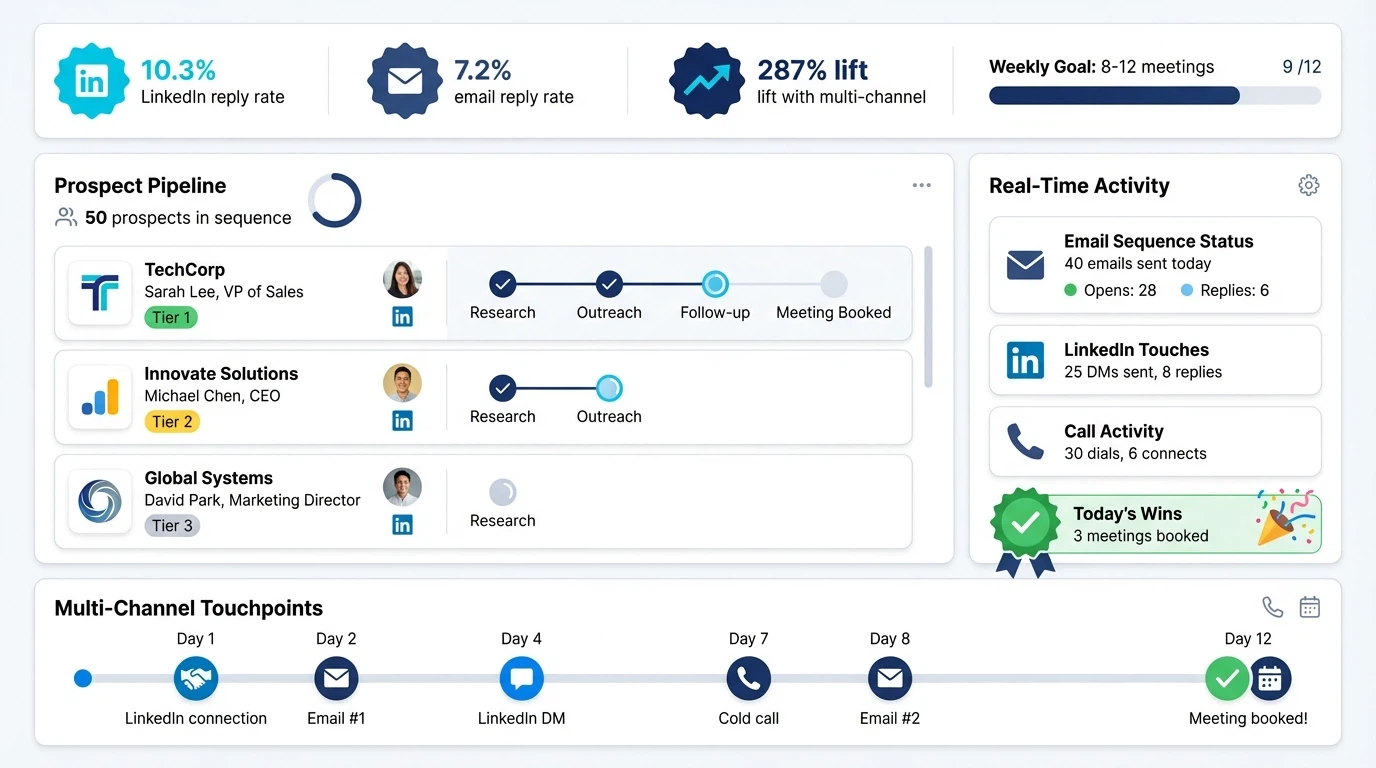
LeadSpark AI Team
13 min read
B2B prospecting isn't just about sending more emails and hoping something sticks. In 2026, successful SDRs achieve 10%+ response rates by combining strategic targeting, multi-channel outreach, and authentic personalization.
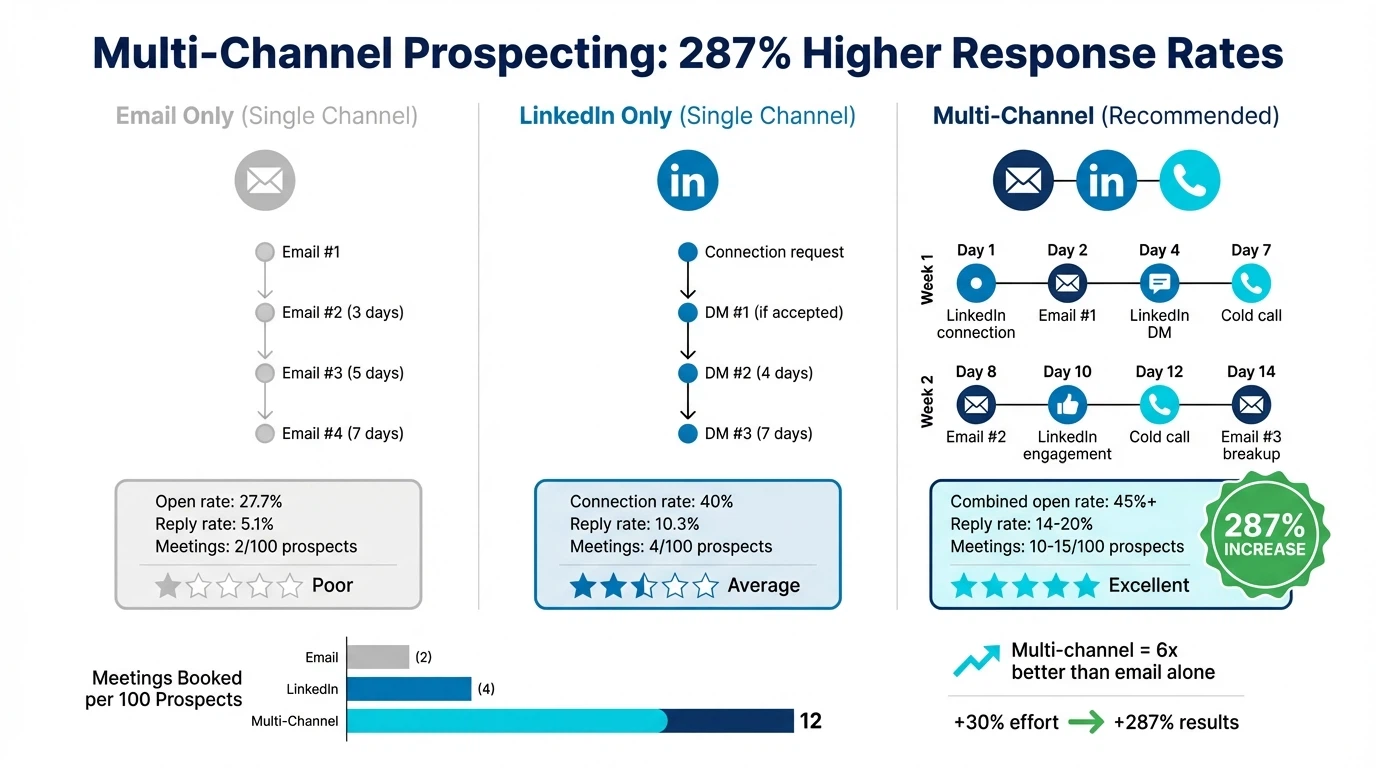
The data is clear: outreach using email, phone, and LinkedIn together increases response rates by 287% compared to single-channel efforts. Yet 91% of cold outreach emails still get zero response because most reps are stuck using outdated "spray and pray" tactics.
This guide shows you how to build a modern B2B prospecting system that consistently fills your pipeline with qualified conversations.
What is B2B Prospecting?
B2B prospecting is the systematic process of identifying and reaching out to potential business customers who match your ideal customer profile (ICP). For Sales Development Reps (SDRs), prospecting means researching target accounts, finding decision-makers, and initiating conversations that lead to qualified sales opportunities.
Unlike B2C prospecting, B2B involves:
- Longer sales cycles (3-9 months on average)
- Multiple decision-makers (6-10 stakeholders in enterprise deals)
- Higher deal values ($15K-$500K+ average contract values)
- Relationship-driven selling (trust and credibility matter more than discounts)
The goal isn't to close deals—it's to generate qualified meetings for your Account Executives by identifying prospects with genuine need, budget, and buying authority.
Why B2B Prospecting Matters in 2026
The B2B sales landscape has fundamentally shifted:
The Numbers That Matter
- Average cold email response rate: 5.1% (but top performers hit 10%+ with the right approach)
- Average cold email open rate: 27.7% in B2B (45%+ is considered excellent)
- First follow-up email improves reply rate by 50% (yet most SDRs give up after one attempt)
- Multi-channel outreach (email + phone + LinkedIn) increases response rates by 287%
- LinkedIn DMs achieve 10.3% response rate on average—nearly double traditional email
What Changed
The old "spray and pray" approach is completely dead. Here's why:
- Buyers are overwhelmed: Decision-makers receive 100+ prospecting messages weekly
- AI detection is everywhere: Generic templates get flagged and filtered automatically
- Personalization is table stakes: A 6% improvement in open rates comes from simple email personalization
- Data quality matters more than volume: One conversation with the right person beats 100 emails to wrong-fit prospects
- Social selling is mandatory: LinkedIn is now the #1 channel for B2B prospecting
Success in 2026 requires precision over volume, combining quality data, authentic personalization, and persistent multi-channel follow-up.
B2B Prospecting Strategies That Work
1. LinkedIn-First Prospecting
LinkedIn is the most powerful B2B prospecting channel in 2026. Here's the systematic approach:
Step 1: Optimize Your Profile
Your LinkedIn profile is your digital first impression. Before you start prospecting:
- Professional headshot and banner image
- Headline that speaks to your buyer's problems (not your job title)
- About section focused on how you help prospects (not company boilerplate)
- Regular posting (3-4x/week) to build credibility
Step 2: Advanced Search + Boolean
Use LinkedIn Sales Navigator to find your ICP:
- Filter by job title, company size, industry, location, and technology usage
- Save searches to monitor new prospects joining your target market
- Build lead lists organized by priority (hot, warm, cold)
Step 3: Warm-Up with Engagement
Before sending connection requests:
- Like and comment on prospects' posts (thoughtfully, not generic "Great post!")
- Share relevant content they'd find valuable
- Join the same LinkedIn Groups they're active in
Step 4: Personalized Connection Requests
Send connection requests with context (you have 300 characters):
- Reference something specific (their post, mutual connection, company news)
- Mention a shared interest or challenge
- NO pitching in the connection request
Step 5: Multi-Touch DM Sequence
After they accept:
- Day 1: Thank them for connecting + ask an engaging question
- Day 4: Share a valuable resource (article, tool, framework)
- Day 7: Soft pitch with personalized icebreaker
- Day 11: Final value-add or case study
Use tools like LeadSpark AI to automatically generate research-backed icebreakers by analyzing prospects' LinkedIn activity, saving 30+ minutes per prospect while maintaining authentic personalization.
2. Multi-Channel Sequencing
Single-channel prospecting is dead. Top-performing SDRs use coordinated sequences:
The 6-12 Touch Approach
Most B2B sequences perform best with 6-12 touchpoints spread across 2-4 weeks, mixing channels:
Week 1:
- Day 1: LinkedIn connection request (personalized)
- Day 2: Email #1 (value-focused, no pitch)
- Day 4: LinkedIn DM (if connected)
- Day 7: Cold call attempt #1
Week 2:
- Day 8: Email #2 (case study or social proof)
- Day 10: LinkedIn comment on their post
- Day 12: Cold call attempt #2
- Day 14: Email #3 (breakup email)
Week 3:
- Day 17: Value-add LinkedIn DM (share article/tool)
- Day 21: Final email (last attempt)
The key is adding value in each touch rather than repeating the same pitch. Each message should stand alone and provide something useful even if the prospect never responds.
3. Account-Based Prospecting (ABP)
For enterprise deals, target entire buying committees at priority accounts:
Step 1: Account Selection
- Choose 10-25 "dream accounts" where you can win
- Research company priorities, tech stack, recent funding, growth signals
- Map the buying committee (6-10 stakeholders typically)
Step 2: Multi-Threading
Simultaneously prospect:
- Economic buyer (VP/C-level who controls budget)
- Technical buyer (evaluates your solution)
- User buyer (day-to-day users)
- Coach/champion (internal advocate)
Step 3: Coordinated Campaigns
- LinkedIn engagement across all stakeholders
- Personalized emails referencing company-specific challenges
- Strategic content (case studies of similar companies)
- Executive-level outreach from your leadership
ABP requires more effort but drives 3x higher win rates and 40% shorter sales cycles in enterprise deals.
4. Video Prospecting
Reps who use video prospecting see:
- 16% increase in open rates
- 26% increase in reply rates
- 4x higher click-through rates compared to text-only emails
When to Use Video:
- High-value enterprise accounts (worth the extra effort)
- After several email attempts with no response (pattern interrupt)
- When showing a product demo or walkthrough
- To build rapport before an upcoming call
Video Best Practices:
- Keep it under 60 seconds
- Personalize the thumbnail (use prospect's name or company logo)
- Start with why you made the video specifically for them
- End with a clear, easy next step
- Tools: Loom, Vidyard, BombBomb
5. Trigger-Based Prospecting
Timing matters. Reach out when prospects are most likely to engage:
Strong Buying Signals:
- Funding announcements (company just raised Series A/B/C)
- Executive hires (new VP Sales/Marketing starting in 30 days)
- Company expansion (opening new office, new market entry)
- Technology changes (migrating from competitor's platform)
- Content engagement (downloaded your whitepaper, attended webinar)
- Website visits (visited pricing page 3+ times this week)
Set up alerts using:
- LinkedIn Sales Navigator (job changes, company updates)
- Google Alerts (company news)
- Sales intelligence tools (6sense, Bombora for intent data)
- CRM notifications (website visitor tracking)
Prospects are 3-5x more likely to respond when you reach out during active buying windows.
Step-by-Step B2B Prospecting Process
Here's the exact workflow top SDRs use:
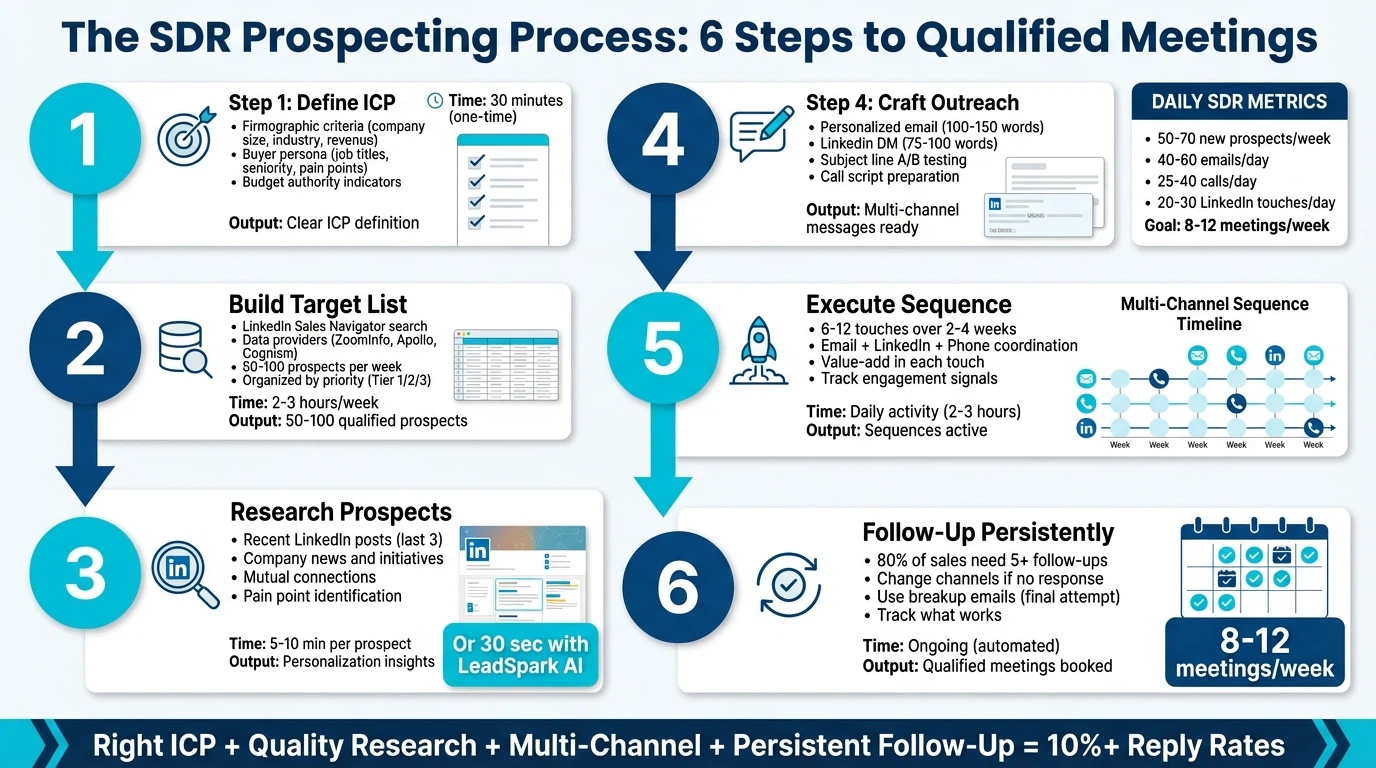
Step 1: Define Your ICP (30 minutes)
Don't prospect "everyone who might need this." Be ruthlessly specific:
Firmographic criteria:
- Company size (employees and revenue)
- Industry and sub-industry
- Geography
- Growth stage (startup vs enterprise)
- Technology stack
Buyer persona:
- Job titles (primary and secondary)
- Seniority level
- Department
- Responsibilities and pain points
- Buying authority and budget
Example ICP:
"Mid-market B2B SaaS companies (100-500 employees, $10M-$50M revenue) in North America, with SDR teams of 5-20 reps, using Salesforce CRM, focused on outbound sales, where the VP Sales or Head of Sales Development owns the budget for prospecting tools."
Step 2: Build Your Target List (2-3 hours/week)
Use multiple data sources for the best coverage:
Primary Sources:
- LinkedIn Sales Navigator (best for finding individual decision-makers)
- Apollo.io (250M+ contacts, good for startups/SMB)
- ZoomInfo (enterprise-grade data)
- Cognism (excellent international coverage)
Enrichment:
- Company data: Revenue, employee count, tech stack
- Contact data: Email, phone, social profiles
- Intent signals: Website visits, content downloads
List Size:
- 50-100 prospects per SDR per week (quality over quantity)
- Organize by priority: Tier 1 (hot), Tier 2 (warm), Tier 3 (cold)
Step 3: Research Your Prospects (5-10 minutes per high-value prospect)
You can't personalize without research. For each prospect:
Company Research:
- Recent news (funding, acquisitions, leadership changes)
- Company initiatives and strategic priorities
- Competitors and market position
- Recent job postings (indicate growth or pain)
Individual Research:
- Recent LinkedIn posts and activity
- Shared connections or interests
- Previous roles and career trajectory
- Content they've shared or engaged with
Pain Point Identification:
- What challenges is their company likely facing?
- What are their personal goals and metrics?
- How does your solution specifically help them?
For LinkedIn prospecting, tools like LeadSpark AI automate this research by scraping prospects' recent LinkedIn posts and generating personalized talking points—cutting your research time from 30 minutes to under 1 minute per prospect.
Step 4: Craft Personalized Outreach (3-5 minutes per message)
Your first message determines everything. Use this framework:
Effective Cold Email Structure:
`
Subject: [First Name], quick question about [their specific challenge]
Hi [First Name],
[PERSONALIZED OPENER - Reference something specific about them or their company]
[CREDIBILITY - Brief mention of similar companies you've helped]
[VALUE PROPOSITION - One specific benefit relevant to their situation]
[EASY ASK - Low-friction next step]
[Your Name]
[Title]
`
Example:
`
Subject: Sarah, quick question about your SDR team's LinkedIn outreach
Hi Sarah,
Saw your post about ramping up outbound at Acme Corp—congrats on the Series B!
We helped a similar B2B SaaS company (Chorus.ai) increase their LinkedIn response rates from 4% to 12% by helping their SDR team personalize outreach at scale without sacrificing quality.
Would 15 minutes next week make sense to show you how they're doing it? I can share their exact playbook.
Best,
Mike
`
LinkedIn DM Best Practices:
- Shorter than email (100-150 words max)
- Start with genuine interest in them (not your product)
- Reference their specific content or activity
- Ask engaging questions that prompt conversation
See our guide to writing LinkedIn icebreakers for 50+ examples.
Step 5: Execute Multi-Channel Sequences (Daily activity)
Daily Prospecting Routine:
- 8:00-9:00 AM: LinkedIn engagement (like, comment on prospects' posts)
- 9:00-10:30 AM: Cold calling block (25-30 dials)
- 10:30 AM-12:00 PM: Email prospecting (30-40 new emails)
- 2:00-3:00 PM: LinkedIn DM sequences (20-25 messages)
- 3:00-4:00 PM: Follow-up on responses, schedule meetings
Activity Benchmarks for SDRs:
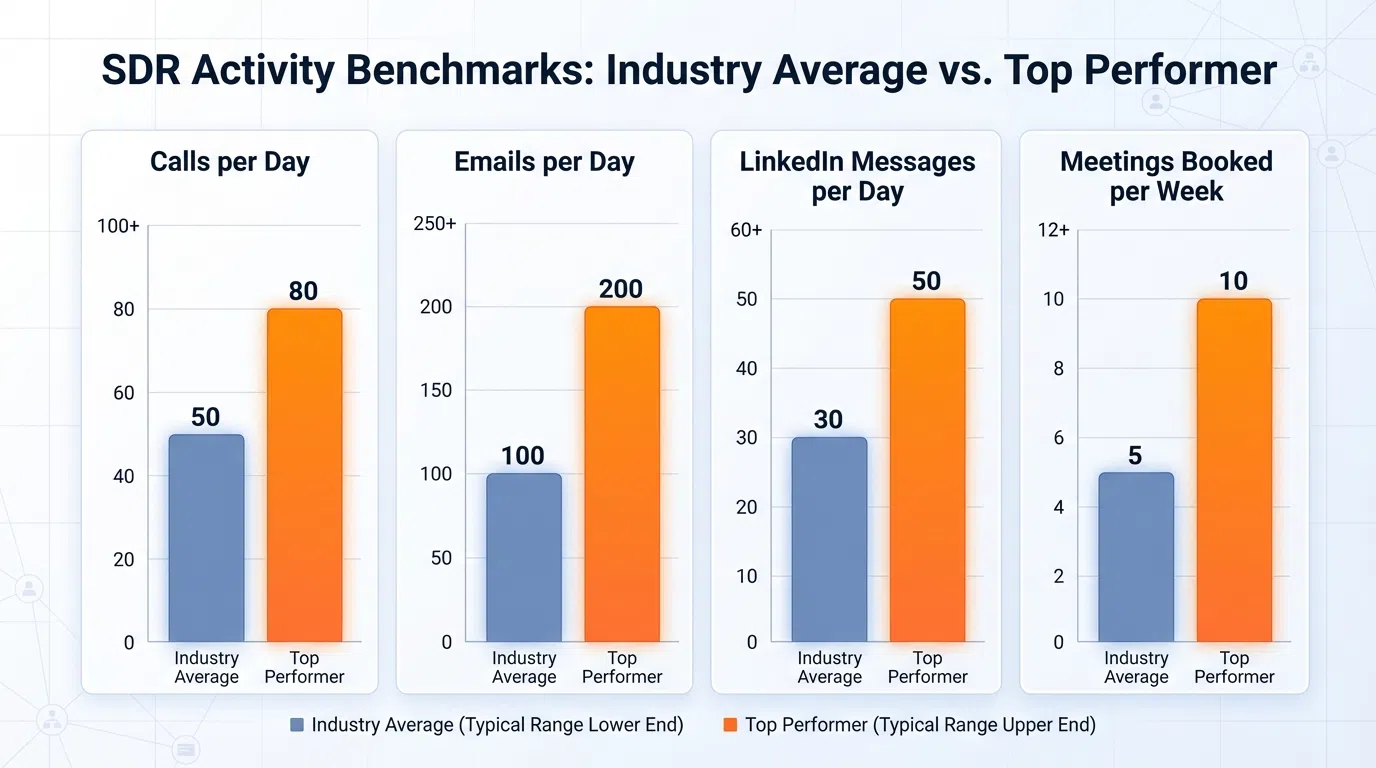
- 50-70 new prospects added weekly
- 40-60 emails sent daily
- 25-40 cold calls daily
- 20-30 LinkedIn touches daily (connections, DMs, engagement)
- Target: 8-12 qualified meetings booked weekly
Step 6: Persistent Follow-Up (The Fortune is in the Follow-Up)
Most opportunities come after the 4th-7th touch, yet most SDRs give up after 1-2 attempts:
Follow-Up Facts:
- 80% of sales require 5+ follow-ups
- 44% of salespeople give up after just 1 follow-up
- The first follow-up email improves overall reply rate by 50%
Effective Follow-Up Strategies:
- Add new value each time (case study, article, tool recommendation)
- Change the channel (tried email? Try LinkedIn or phone)
- Reference previous attempts ("I know you're busy—following up on my email from Tuesday")
- Use "breakup emails" ("Should I take you off my list?") as final attempt
- Space touches appropriately (2-4 days between emails, 7-10 days for LinkedIn)
When to Stop:
- After 8-12 touches with zero engagement
- After explicit "not interested" (respect their decision)
- After they've moved to a different role/company
B2B Prospecting Tools Comparison
Modern prospecting requires the right tech stack:
Data & Intelligence Tools
| Tool | Best For | Starting Price | Key Features |
|---|---|---|---|
| ZoomInfo | Enterprise teams | $15K/year | 65M+ companies, 174M+ contacts, intent data, org charts |
| Apollo.io | Startups/SMBs | $59/user/month | 250M+ contacts, built-in sequences, multichannel outreach |
| Cognism | International/EMEA | Custom | 98% phone accuracy, GDPR-compliant, Diamond Data® |
| LinkedIn Sales Navigator | LinkedIn prospecting | $99/month | 900M+ profiles, advanced search, InMail credits |
| Lusha | Solo reps/freelancers | $22/month | Simple contact finder, Chrome extension, CRM integration |
Outreach & Engagement Tools
| Tool | Best For | Starting Price | Key Features |
|---|---|---|---|
| Outreach.io | Enterprise SDR teams | Custom | Full sales engagement platform, AI-powered insights |
| SalesLoft | Mid-market teams | Custom | Cadences, call recording, pipeline analytics |
| Lemlist | Email sequences | $59/month | Video personalization, liquid syntax, deliverability tools |
| Reply.io | Multi-channel automation | $60/month | Email + LinkedIn + calls, AI assistant |
Personalization & Research Tools
| Tool | Best For | Starting Price | Key Features |
|---|---|---|---|
| LeadSpark AI | LinkedIn personalization | $49/month | AI icebreaker generation from LinkedIn posts, 10x faster research |
| Clay | Data enrichment | $149/month | 50+ data sources, AI research, waterfall enrichment |
| Warmly | Intent-based prospecting | Custom | Real-time website visitor tracking, autonomous outreach |
How to Build Your Stack
Starter Stack (Solo SDR or small team):
- LinkedIn Sales Navigator ($99/month)
- Apollo.io free plan → paid ($59/month when scaling)
- LeadSpark AI ($49/month) for LinkedIn personalization
- Gmail + Lemlist ($59/month) for email sequences
- Total: ~$260/month
Growth Stack (5-15 SDRs):
- ZoomInfo or Cognism for data
- Outreach.io or SalesLoft for sequences
- LeadSpark AI for LinkedIn personalization
- Clay for enrichment
- Total: ~$2K-5K/month
Enterprise Stack (20+ SDRs):
- ZoomInfo + 6sense for intent data
- Outreach.io or SalesLoft
- LeadSpark AI + Warmly
- Full CRM integration
- Total: ~$10K-25K/month
Common B2B Prospecting Mistakes (And How to Fix Them)
Mistake #1: Focusing on Volume Over Quality
The Problem: "I need to send 200 emails a day to hit quota!"
Why It Fails: Generic mass emails get 1-2% response rates. You're burning your domain reputation and your prospects' goodwill.
The Fix:
- Send 40-50 highly personalized emails daily instead
- Target 10%+ response rates through quality research
- One qualified meeting beats 100 ignored emails
Mistake #2: Pitching Too Soon
The Problem: Connection request → Immediate pitch DM 5 minutes later
Why It Fails: Buyers are overwhelmed with pitches. You sound like everyone else.
The Fix:
- Build rapport first (3-5 touches of value-adds)
- Ask questions before offering solutions
- Lead with insights, not features
- Earn the right to pitch through helpful engagement
Mistake #3: One-Channel Prospecting
The Problem: "I only do cold email" or "I only use LinkedIn"
Why It Fails: Prospects use multiple channels. You're missing 80% of opportunities.
The Fix:
- Implement multi-channel sequences (email + LinkedIn + calls)
- Meet prospects where they're most active
- 287% increase in response rates with multi-channel
Mistake #4: Giving Up Too Early
The Problem: "I sent 2 emails and got no response, they're not interested"
Why It Fails: Most deals require 5-12 touches. You're quitting before the game starts.
The Fix:
- Plan 8-12 touch sequences over 3-4 weeks
- Add new value in each follow-up
- Use "breakup emails" as final attempt before moving on
- Remember: The first follow-up improves reply rates by 50%
Mistake #5: Ignoring Data Quality
The Problem: "This email bounced... and this one... and this one..."
Why It Fails: Bad data wastes your time and hurts your email deliverability.
The Fix:
- Invest in quality data providers (ZoomInfo, Cognism)
- Verify emails before sending (NeverBounce, ZeroBounce)
- Update your CRM regularly (remove bounces, mark job changes)
- Test small batches before scaling campaigns
Mistake #6: No Personalization (Or Fake Personalization)
The Problem: "Hi {{First_Name}}, I noticed {{Company}} is growing..."
Why It Fails: Buyers can spot templates instantly. Generic "personalization" is worse than none.
The Fix:
- Reference specific content they posted/shared
- Mention recent company news or initiatives
- Connect your solution to their actual situation
- Use tools like LeadSpark AI to generate authentic icebreakers based on real LinkedIn activity
Mistake #7: Leading with Features
The Problem: "We have 47 features including AI-powered analytics and..."
Why It Fails: Buyers don't care about your features. They care about solving their problems.
The Fix:
- Lead with outcomes: "Increase LinkedIn response rates by 150%"
- Use before/after scenarios: "Stop spending 2 hours per day on manual research"
- Share specific results: "TechCo booked 15 extra meetings/month using this approach"
- Features come later, after they're interested
Measuring B2B Prospecting Success
Track the metrics that actually matter:
Leading Indicators (Daily/Weekly)
Activity Metrics:
- Emails sent per day (target: 40-60)
- Calls made per day (target: 25-40)
- LinkedIn touches per day (target: 20-30)
- New prospects added per week (target: 50-70)
Engagement Metrics:
- Email open rate (target: 45%+)
- Email reply rate (target: 10%+)
- LinkedIn connection acceptance rate (target: 40%+)
- LinkedIn DM response rate (target: 10%+)
- Call connect rate (target: 15-20%)
Lagging Indicators (Monthly/Quarterly)
Conversion Metrics:
- Qualified meetings booked per week (target: 8-12 for SDRs)
- Meeting show rate (target: 70%+)
- Meetings → Opportunities conversion (target: 30-40%)
- Opportunities → Closed-Won (tracked but not SDR's direct metric)
Efficiency Metrics:
- Touches required per meeting booked (target: 6-8)
- Time spent on research per prospect (target: <5 minutes)
- Cost per qualified meeting
- Days from first touch to booked meeting
Quality Metrics:
- Percentage of leads marked "qualified" by AEs (target: 80%+)
- Average deal size from your sourced opportunities
- Win rate on SDR-sourced deals vs marketing leads
How to Improve Your Numbers
If open rates are low (<30%):
- Improve subject lines (shorter, more specific)
- Clean your email list (remove bounces)
- Check deliverability (SPF, DKIM, DMARC records)
- Test sending from different domains
If reply rates are low (<5%):
- Increase personalization (spend more time on research)
- Test different value propositions
- Shorten your emails (100-150 words max)
- Try different calls-to-action (question vs meeting ask)
If meetings aren't converting:
- Better qualify before booking (use BANT framework)
- Improve handoff to AEs (provide better context)
- Review ICP fit (are you targeting the right prospects?)
Frequently Asked Questions
How many touches does it take to book a B2B meeting?
On average, 6-8 touches across multiple channels. Research shows 80% of sales require at least 5 follow-ups, yet 44% of salespeople give up after just one attempt. The most successful SDRs use 8-12 touch sequences over 2-4 weeks, combining email, LinkedIn, and phone outreach.
What's a good response rate for cold B2B emails in 2026?
A 5.1% reply rate is average, but top performers achieve 10%+ through strong personalization and multi-channel approaches. For context, a 45%+ open rate is considered excellent, and the first follow-up email alone can improve your overall reply rate by 50%. Response rates vary by industry—legal services can hit 10%, while software sector averages under 1%.
Should I use LinkedIn or email for B2B prospecting?
Both—multi-channel outreach combining email, phone, and LinkedIn increases response rates by 287% compared to single-channel efforts. LinkedIn DMs achieve an average 10.3% response rate (nearly double email), making it ideal for initial engagement. However, email remains essential for detailed information sharing and scheduling. The most effective approach uses LinkedIn for relationship building and email for formal outreach.
How do I personalize outreach at scale?
Focus on scalable personalization tactics: 1) Reference trigger events (funding, new hire, company expansion), 2) Use dynamic content for company-specific pain points, 3) Leverage AI tools like LeadSpark AI to generate personalized icebreakers from LinkedIn posts (reduces research time from 30 minutes to under 1 minute), 4) Create templated frameworks with customizable sections, and 5) Segment your list by persona/industry to craft relevant messaging per segment.
What's the best time to send cold B2B emails?
Tuesday-Thursday between 8-10 AM in the prospect's timezone typically yields the highest open and response rates. However, test your specific audience—some industries (e.g., hospitality, retail) have different patterns. Avoid Monday mornings (inbox overload) and Friday afternoons (weekend mode). For LinkedIn, early mornings (6-8 AM) and evenings (6-8 PM) see high engagement as people check their feeds during commutes.
How long should my cold outreach emails be?
100-150 words maximum for cold emails—roughly 3-4 short paragraphs. Prospects spend an average of 11 seconds reading cold emails. Your message should be scannable in under 15 seconds. Use short sentences, white space, and bullet points. For LinkedIn DMs, keep it even shorter (75-100 words). The goal of your first message isn't to explain everything—it's to start a conversation.
When should I stop following up with a prospect?
After 8-12 touches with zero engagement, or immediately if they explicitly say "not interested." Space your touches 2-4 days apart for email and 7-10 days for LinkedIn. If they haven't responded after 3-4 weeks of value-based outreach across multiple channels, move them to a long-term nurture sequence (monthly touches) and focus energy on more responsive prospects. Always send a final "breakup email" before giving up—these often get responses.
What's the difference between prospecting and lead generation?
Lead generation is attracting inbound interest (content marketing, SEO, paid ads, webinars) where prospects come to you. Prospecting is outbound—you proactively identify and reach out to potential customers. Lead gen is typically marketing's responsibility and focuses on volume. Prospecting is sales-driven and focuses on high-fit accounts. The best B2B strategies combine both: use inbound leads to inform ICP, and use prospecting to target dream accounts that may never find you organically.
How many prospects should an SDR work at once?
50-100 active prospects per week is optimal for balancing personalization with volume. This breaks down to roughly 250-400 prospects in your total "active" pipeline at various stages. Beyond this, quality suffers. Organize by priority: Tier 1 (20-30 high-fit prospects getting maximum personalization), Tier 2 (40-60 solid-fit prospects with moderate personalization), Tier 3 (80-120 long-term prospects getting minimal touches). Focus 60% of your time on Tier 1 accounts.
Start Prospecting Smarter, Not Harder
B2B prospecting in 2026 isn't about sending more emails or making more calls—it's about having better conversations with the right people at the right time.
The fundamentals haven't changed:
- Know your ICP intimately
- Do your research
- Lead with value
- Be persistent without being annoying
- Build relationships before asking for meetings
What has changed:
- Multi-channel is mandatory (email alone won't cut it)
- Personalization is table stakes (generic templates get ignored)
- Timing matters more than ever (trigger-based prospecting)
- AI tools enable quality at scale (research in minutes, not hours)
The SDRs who succeed in 2026 embrace these changes while staying true to relationship-driven selling.
Ready to 10x your prospecting efficiency? Try LeadSpark AI free for 14 days. Automatically generate personalized LinkedIn icebreakers from your prospects' recent posts—cutting your research time from 30 minutes to under 1 minute per prospect while maintaining authentic personalization that drives 40-70% response rates.
Sources:
- How to Build an Effective B2B Sales Prospecting Strategy in 2026
- The Complete Guide to B2B Prospecting
- B2B Sales Prospecting: 15 Strategies to Drive More Conversions
- 15 Best B2B Sales Prospecting Tools and Software for 2026
- 2026 Sales Statistics: Cold Outreach, Pipeline, and Funnel Insights
- Cold Email Statistics & Benchmarks for 2026
Ready to Generate Personalized Icebreakers?
Join sales professionals using LeadSpark AI to create hyper-personalized LinkedIn icebreakers in minutes.