Linkedin Prospecting
Manual vs AI Personalization: Which is Better for LinkedIn Prospecting?
Manual personalization takes 10 hours for 100 messages. AI personalization handles 500+ prospects weekly. Compare response rates, time investment, and scale to choose the right approach.
LeadSpark AI Team
11 min read
Should you craft every LinkedIn prospecting message by hand, or let AI handle personalization at scale? It's one of the most common questions sales teams face in 2026.
The answer isn't as simple as "AI is better" or "manual is more authentic." Both approaches have their place in modern sales strategies, and understanding when to use each can dramatically impact your results.
In this guide, we'll compare manual and AI personalization across time investment, response rates, scale, and quality. You'll see the data, understand the trade-offs, and learn when each approach makes sense for your prospecting strategy.
The Manual Personalization Approach
Manual personalization means researching each prospect individually and crafting custom messages based on what you find. It's the traditional approach that sales reps have used for decades.
How Manual Personalization Works
A typical manual personalization workflow looks like this:
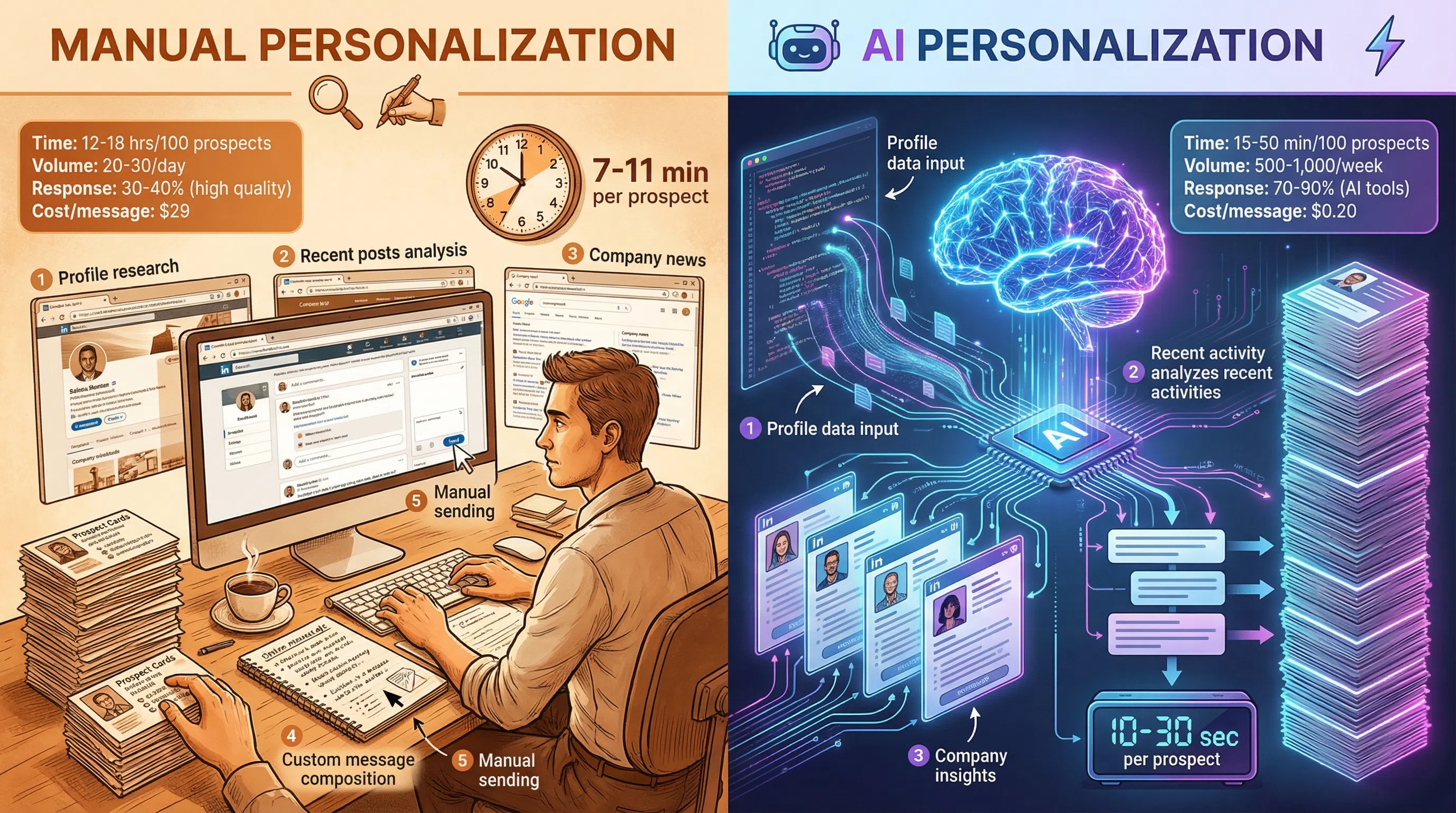
- Research the prospect (3-5 minutes per person): Review their LinkedIn profile, recent posts, company news, mutual connections, and shared interests
- Identify personalization hooks (1-2 minutes): Find specific details to reference—a recent promotion, a shared interest, a mutual connection, or a relevant post they shared
- Craft the message (2-3 minutes): Write a custom connection request or InMail that references your research and explains why you're reaching out
- Review and send (1 minute): Double-check for typos and ensure the message feels natural
Total time per prospect: 7-11 minutes
For 100 prospects, manual personalization takes 12-18 hours of focused work. That's 1.5 to 2 full workdays spent on just the initial outreach.
Manual Personalization Pros
Highest level of authenticity: When done well, manually crafted messages feel genuinely personal because they are. You're making real connections based on genuine research.
Complete control: You decide exactly what to say, how to say it, and what details to emphasize. No algorithms making decisions for you.
Builds real relationships: The research process helps you truly understand your prospects, which pays dividends in later conversations.
Works for complex sales: High-ticket B2B sales with long cycles often require this level of personal attention and research.
No tool dependency: You don't need any specialized software beyond LinkedIn and your CRM.
Manual Personalization Cons
Severe time constraints: At 7-11 minutes per prospect, you can only reach 20-30 prospects per day while maintaining quality.
Doesn't scale: Sales teams need to reach hundreds or thousands of prospects monthly. Manual personalization simply can't keep pace.
Inconsistent quality: Quality drops significantly when reps rush to hit volume targets. Research gets shallow, messages become formulaic.
High cost per message: If an SDR costs $60,000/year and spends 10 hours on 100 messages, each message costs approximately $29 in labor.
Burnout risk: The repetitive research and writing process leads to fatigue, causing quality to degrade over time.
Manual Personalization Benchmarks
Response rates for manual personalization vary widely based on quality:
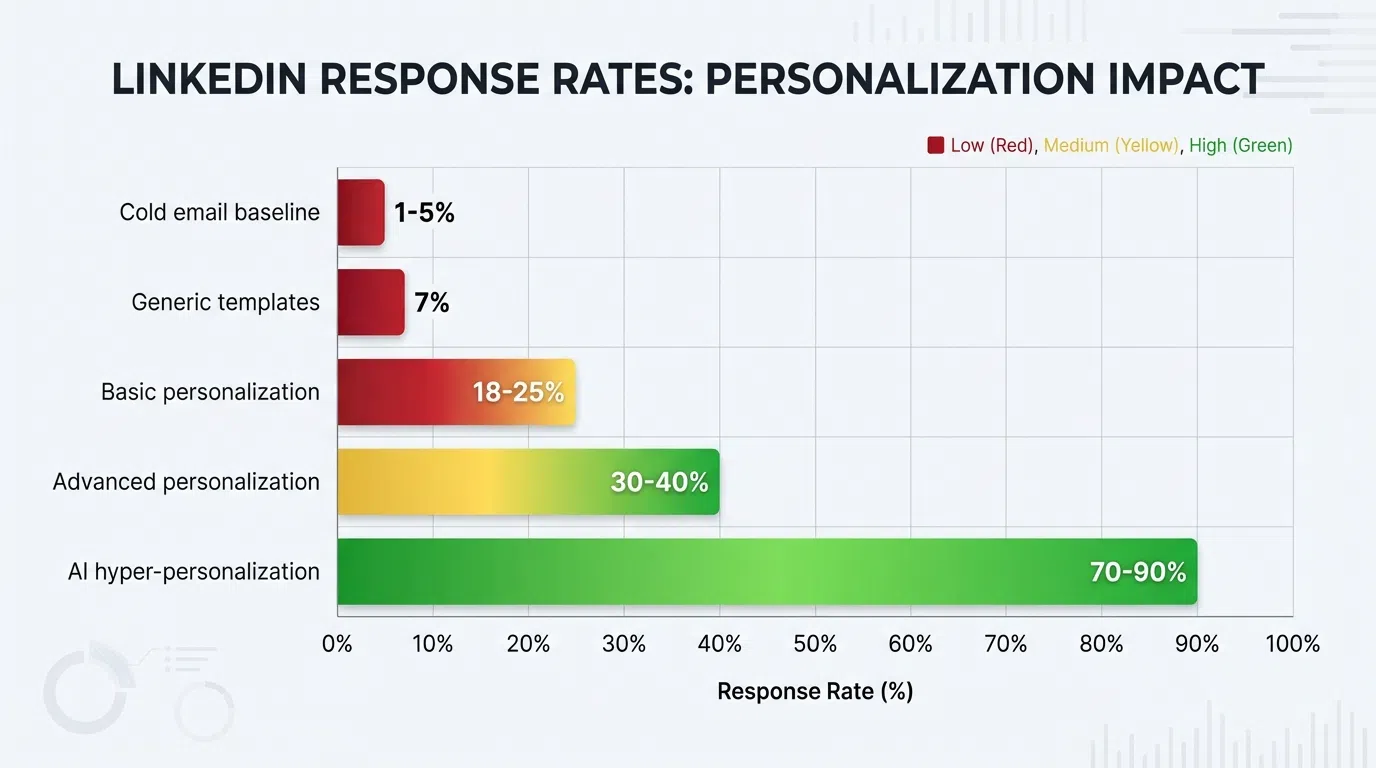
- High-quality manual personalization: 30-40% response rate (when research is thorough and messages are truly custom)
- Average manual personalization: 18-25% response rate (typical for experienced SDRs)
- Rushed manual personalization: 5-10% response rate (when volume pressures compromise quality)
The challenge? Maintaining high-quality manual personalization while reaching enough prospects to hit pipeline targets is nearly impossible for most teams.
The AI Personalization Approach
AI personalization uses machine learning to analyze prospect profiles, recent activity, and company information, then generates customized messages at scale.
How AI Personalization Works
Modern AI personalization platforms like LeadSpark AI follow this workflow:
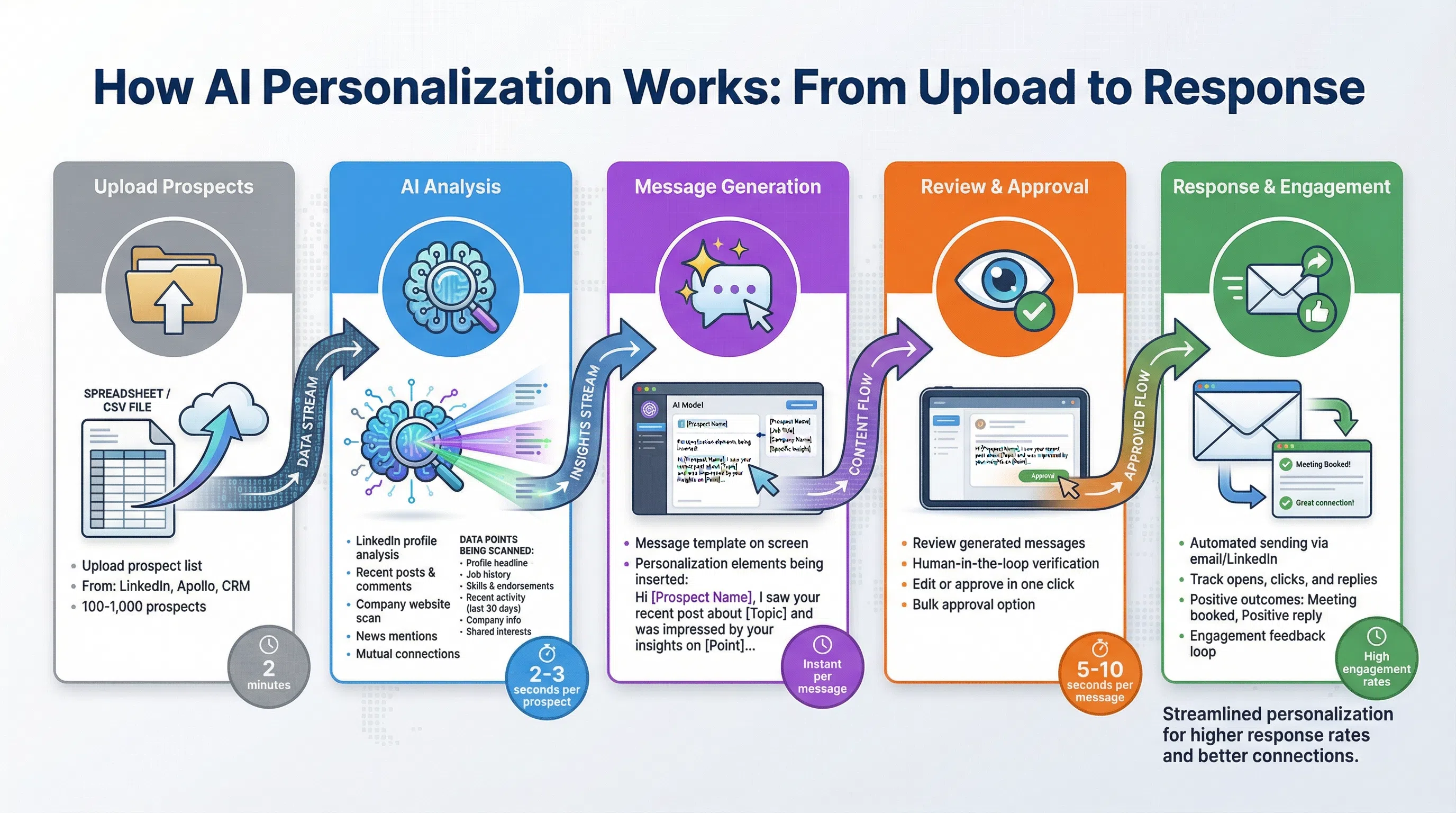
- Upload prospect list: Import prospects from LinkedIn Sales Navigator, Apollo, or your CRM
- AI analysis (automated, seconds per prospect): AI scans LinkedIn profiles, recent posts, company websites, and news mentions to identify personalization opportunities
- Message generation (automated, seconds per prospect): AI creates custom messages referencing specific details from its analysis
- Review and approve (optional, 10-30 seconds per message): Review AI-generated messages and edit if needed, or set to auto-approve based on quality thresholds
- Automated sending: Messages are sent automatically through LinkedIn or your sequencing tool
Total time per prospect: 10-30 seconds of human review (if reviewing), or fully automated
For 100 prospects, AI personalization takes 15-50 minutes of human time compared to 12-18 hours manually.
AI Personalization Pros
Massive scale: AI can analyze and personalize messages for 500+ prospects per week, compared to 100-150 with manual personalization.
Consistent quality: AI doesn't get tired or rush. Every message receives the same level of analysis and personalization.
Time efficiency: Save 20+ hours per week per rep, allowing teams to focus on high-value activities like discovery calls and demos.
Data-driven optimization: AI learns from response patterns and continuously improves personalization strategies based on what works.
Cost efficiency: At $97/month for unlimited messages, AI personalization costs approximately $0.20 per message versus $29 for manual.
Works 24/7: AI can process prospects and generate messages around the clock, not just during work hours.
AI Personalization Cons
Learning curve: Teams need time to learn the platform, set up workflows, and optimize messaging strategies.
Less nuanced for complex sales: Very niche industries or highly complex technical sales may require human judgment that AI can't replicate.
Quality depends on tool: Not all AI personalization tools are equal. Some generate generic messages that feel robotic.
Initial setup required: Takes time to configure voice, tone, and personalization parameters to match your brand.
Can feel impersonal if done poorly: Low-quality AI tools produce obviously automated messages that hurt your brand.
AI Personalization Benchmarks
Response rates for AI personalization have improved dramatically in 2026:
- Leading AI personalization tools: 70-90% response rates (tools like LeadSpark AI that analyze recent posts and craft contextual messages)
- Well-configured AI tools: 30-50% response rate (properly configured AI with good training data)
- Generic AI tools: 10-15% response rate (basic AI that only uses profile data without deeper analysis)
The key differentiator is whether the AI can analyze recent activity (posts, comments, shares) and craft truly contextual messages, not just template-based personalization.
Head-to-Head Comparison
Let's compare manual vs AI personalization across the metrics that matter most:
Time Investment
Manual: 7-11 minutes per prospect = 12-18 hours for 100 prospects
AI: 10-30 seconds review per prospect = 15-50 minutes for 100 prospects
Winner: AI (96% time savings)
Scale & Volume
Manual: 20-30 prospects per day = 100-150 per week (at full capacity)
AI: 500-1,000+ prospects per week with minimal human time
Winner: AI (400-700% volume increase)
Response Rate Quality
Manual (high quality): 30-40% response rate
AI (leading tools): 70-90% response rate
AI (average tools): 30-50% response rate
Winner: AI (leading tools) when using advanced platforms that analyze recent activity
Cost Per Message
Manual: ~$29 per message (based on SDR salary + time invested)
AI: ~$0.20 per message (based on tool cost + minimal review time)
Winner: AI (99% cost reduction)
Personalization Depth
Manual: Can incorporate very nuanced insights and make complex connections between prospect's situation and your offering
AI: Can analyze hundreds of data points but may miss subtle nuances or make assumptions
Winner: Manual (for complex, high-touch sales)
Consistency Over Time
Manual: Quality degrades with volume pressure, fatigue, and burnout
AI: Maintains consistent quality regardless of volume or time of day
Winner: AI
Relationship Building
Manual: Deep research creates genuine connection and understanding
AI: Can reference relevant details but relationship depth depends on follow-up conversations
Winner: Manual (for relationship-first approaches)
The Bottom Line
AI personalization wins for: Scale, time efficiency, cost, consistency, and (with leading tools) response rates
Manual personalization wins for: Complexity, nuance, high-ticket sales, and relationship-first approaches
When to Use Manual Personalization
Manual personalization still makes sense in specific scenarios:
1. Enterprise & High-Ticket Sales ($100K+ deals)
When deal sizes exceed $100K, the time investment in manual personalization (7-11 minutes) is negligible compared to the potential return. A single closed deal justifies hundreds of hours of personalized outreach.
Example: Selling enterprise software to Fortune 500 CIOs requires deep research on company initiatives, recent earnings calls, technology stack, and competitive pressures. This level of research is best done manually.
2. Very Niche Industries or Specialized Roles
Highly specialized industries (medical devices, aerospace, industrial manufacturing) often require technical knowledge and industry context that current AI tools may not fully understand.
Example: Selling specialized laboratory equipment to research scientists requires understanding their specific research focus, recent publications, and technical requirements.
3. Accounts with Existing Relationships
When reaching out to prospects where you have mutual connections, shared history, or existing relationship context, manual personalization allows you to reference these connections authentically.
Example: Reconnecting with a prospect you met at a conference or who was referred by a mutual connection.
4. Ultra-High-Value Strategic Accounts
Named account selling and strategic account targeting justify significant time investment. These are your dream clients that can transform your business.
Example: If landing one specific Fortune 100 company is your top priority for the quarter, invest the time in deep manual research and personalization.
5. Complex Multi-Stakeholder Sales
When selling requires orchestrating outreach to multiple stakeholders within an organization (buyer, influencer, economic buyer, champion), manual coordination ensures messaging consistency and strategy.
Example: Selling a platform that requires buy-in from IT, finance, operations, and executive leadership.
When to Use AI Personalization
AI personalization is the better choice for most modern sales scenarios:
1. High-Volume Prospecting (100+ prospects/week)
When you need to reach hundreds or thousands of prospects monthly, AI is the only practical approach that maintains personalization quality at scale.
Example: SDR teams at fast-growing SaaS companies targeting mid-market accounts need to reach 500-1,000 prospects monthly per rep.
2. Mid-Market B2B Sales ($10K-$100K deals)
The majority of B2B sales fall in this range where deals are significant enough to require personalization but not large enough to justify 7-11 minutes of manual work per prospect.
Example: Selling marketing automation software to marketing directors at companies with 50-500 employees.
3. Consistent Outreach Campaigns
When running ongoing prospecting campaigns that need to maintain quality over weeks and months, AI prevents the quality degradation that comes with manual fatigue.
Example: Running a 90-day prospecting campaign targeting 1,000 prospects across multiple industries.
4. Multi-Channel Sequences
AI can maintain personalization consistency across email, LinkedIn, and follow-up touchpoints, ensuring your entire sequence feels cohesive.
Example: 7-touch sequence with LinkedIn connection → InMail → Email → LinkedIn message → Email → Call → Email.
5. Testing & Optimization
AI allows you to test different personalization approaches, messaging angles, and hooks at scale to identify what works best for different segments.
Example: Testing whether referencing recent posts vs recent company news vs mutual connections drives higher response rates for different industries.
6. Time-Constrained Teams
Small sales teams or solo founders who need to prospect while also handling demos, closing deals, and managing customers don't have 12-18 hours per week for manual prospecting.
Example: Early-stage startup founder who needs to prospect while also building the product and managing existing customers.
The Hybrid Approach: Best of Both Worlds
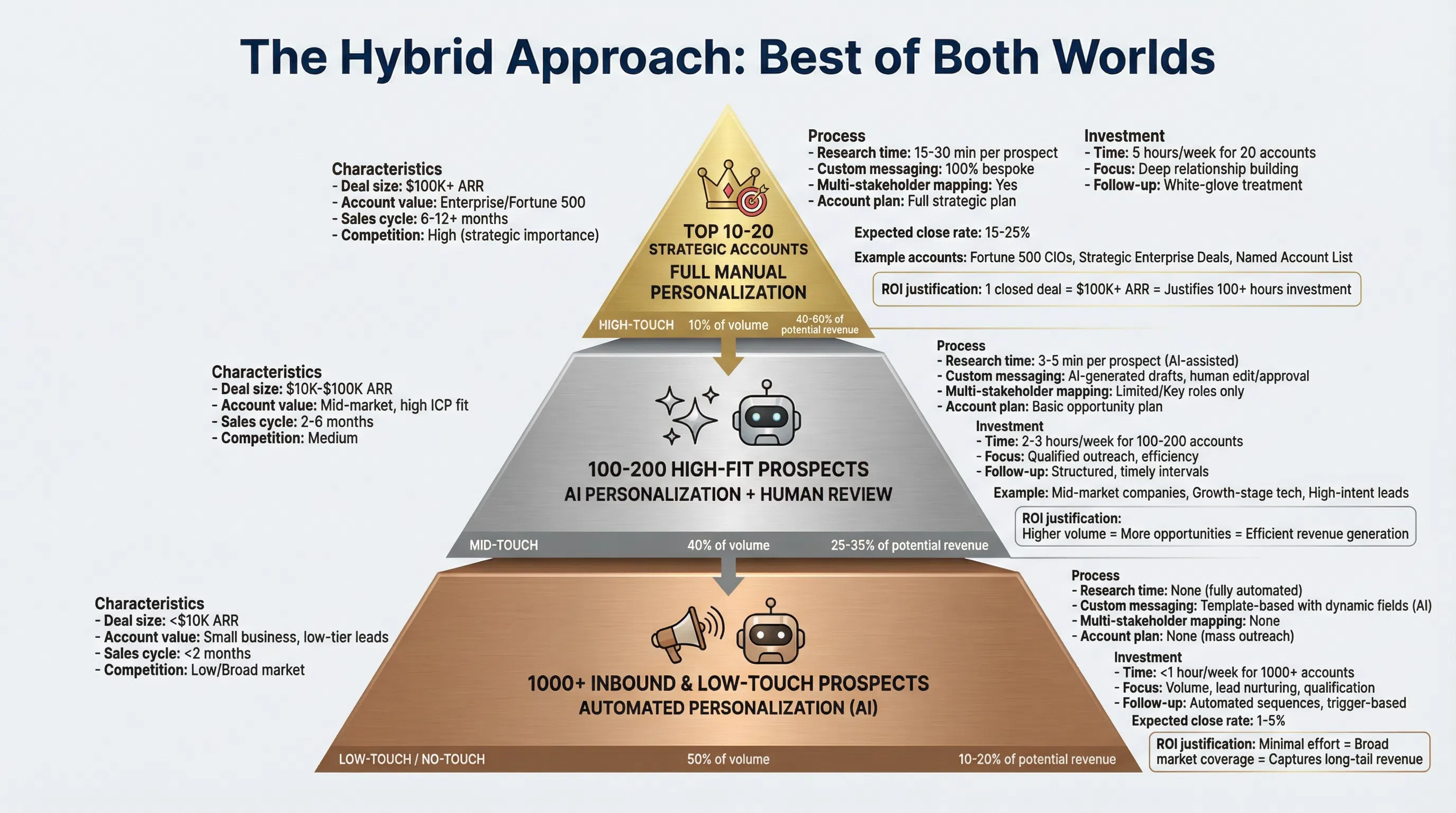
The most effective approach in 2026 combines AI personalization for volume with manual personalization for high-value accounts.
How to Implement a Hybrid Strategy
Tier 1 Accounts (Top 10-20 dream clients): Full manual personalization with 15-30 minutes of research per prospect. These are your strategic accounts worth significant time investment.
Tier 2 Accounts (High-fit prospects): AI personalization with human review. Let AI generate messages but spend 30-60 seconds reviewing and tweaking before sending.
Tier 3 Accounts (Volume prospects): Full AI automation with spot checking. Set quality thresholds and let AI handle the entire process, reviewing a sample of messages weekly.
Example Hybrid Workflow
A typical mid-market SaaS sales team might structure their prospecting as:
- 20 Tier 1 accounts (manual, 5 hours/week): Fortune 500 companies or strategic accounts
- 100 Tier 2 accounts (AI + review, 2 hours/week): High-fit companies meeting ideal customer profile
- 400 Tier 3 accounts (AI automated, 30 minutes/week): Qualified prospects from broader targeting
Total time: 7.5 hours/week to reach 520 prospects with personalization at every level
Without AI: The same team could only reach 60-90 prospects per week (12-18 hours) with pure manual personalization, a 577% volume reduction.
When to Adjust Your Hybrid Mix
Increase manual percentage when:
- Average deal size increases above $75K
- Sales cycle lengthens beyond 6 months
- You're entering new markets requiring more research
- Response rates drop below target thresholds
Increase AI percentage when:
- You need to build pipeline faster
- Team capacity is constrained
- Response rates from AI meet or exceed manual
- Cost per meeting is too high with manual approach
How to Choose: Decision Framework
Use this framework to decide which approach makes sense for your situation:
Choose Manual Personalization If:
✅ Average deal size exceeds $100K
✅ You have fewer than 50 priority prospects per quarter
✅ Your industry is highly specialized or technical
✅ Relationship-first selling is core to your strategy
✅ You have unlimited time for prospecting
Choose AI Personalization If:
✅ You need to reach 100+ prospects per week
✅ Average deal size is between $10K-$100K
✅ You have limited time for prospecting
✅ You need consistent quality across high volumes
✅ Cost per message matters for your business model
Choose Hybrid Approach If:
✅ You have a mix of strategic and volume accounts (most companies)
✅ You want to maximize both quality and quantity
✅ Your team has diverse deal sizes and sales cycles
✅ You need flexibility to adjust based on results
Frequently Asked Questions
Q: Won't prospects know the message is AI-generated?
A: With leading AI tools that analyze recent posts and craft contextual messages, prospects cannot distinguish between AI and manual personalization. The message references specific, relevant details just as a manually researched message would. The key is using advanced AI that goes beyond template filling.
Q: Can AI really match the quality of manual personalization?
A: For 80-90% of prospecting scenarios, yes. AI can analyze hundreds of data points (profile, posts, company news, mutual connections) faster and more comprehensively than manual research. Where AI falls short is in highly nuanced situations requiring deep industry expertise or complex multi-stakeholder dynamics.
Q: How much does AI personalization cost compared to manual?
A: AI personalization costs approximately $0.20 per message versus $29 per message for manual (based on SDR time cost). For a team sending 2,000 messages monthly, that's $400 with AI vs $58,000 in labor cost with manual.
Q: Will my sales team accept using AI for personalization?
A: Initial resistance is common, but teams quickly embrace AI when they see results. The key is showing how AI saves 20+ hours weekly while maintaining or improving response rates. SDRs appreciate spending less time on repetitive research and more time on conversations and deal progression.
Q: What if AI makes mistakes or sends inappropriate messages?
A: Quality AI personalization tools include review workflows, approval thresholds, and guardrails to prevent errors. You can set AI to require human approval above certain confidence levels, and the system learns from corrections over time.
Q: Can I use AI personalization with LinkedIn's terms of service?
A: Yes, legitimate AI personalization tools work within LinkedIn's guidelines. They don't scrape data illegally or send messages that violate LinkedIn's policies. Always choose tools that prioritize compliance and respect platform limitations.
Q: How long does it take to set up AI personalization?
A: Most modern AI personalization platforms can be configured in 1-2 hours. You'll set your messaging voice, define personalization parameters, and configure workflows. After initial setup, the system runs largely on autopilot with optional review steps.
Conclusion: The Future is Hybrid
The debate between manual and AI personalization isn't about choosing one approach forever. The most successful sales teams in 2026 use both strategically.
The reality: You can't manually personalize your way to pipeline goals when you need to reach hundreds of prospects monthly. But you also can't abandon genuine research and relationship-building for your most valuable accounts.
The solution: Use AI personalization for scale and efficiency, and manual personalization where complexity and deal size justify the time investment.
For most B2B sales teams, that means AI handling 80-90% of prospecting volume while sales reps focus manual efforts on strategic accounts that can transform the business.
Ready to Scale Your Personalization with AI?
If you're spending 10+ hours per week on manual prospecting but struggling to reach enough prospects, it's time to explore AI personalization.
LeadSpark AI analyzes prospect profiles, recent posts, and company news to generate hyper-personalized LinkedIn messages at scale. Sales teams using LeadSpark see 70-90% response rates while saving 20+ hours per week on prospecting.
See how AI personalization works:
- Upload your prospect list
- Let AI analyze profiles and recent activity
- Review generated messages (or set to auto-approve)
- Watch response rates climb while time investment drops
Start your free trial and see how AI personalization compares to your current manual process. No credit card required.
Ready to Generate Personalized Icebreakers?
Join sales professionals using LeadSpark AI to create hyper-personalized LinkedIn icebreakers in minutes.