Linkedin Prospecting
Cold LinkedIn Outreach Playbook for B2B Sales [2026 Complete Guide]
Complete cold LinkedIn outreach playbook for B2B sales teams. Proven strategies, templates, and workflows that drive 10-25% response rates in 2026.
14 min read
Cold LinkedIn outreach has become the primary prospecting channel for B2B sales in 2026. According to recent data, LinkedIn accounts for 80% of high-quality B2B social media leads, with properly executed cold outreach achieving 10-25% response rates—a 400-500% improvement over cold email.
But here's the problem: Most SDRs and BDRs are doing cold LinkedIn outreach wrong. They're either sending generic spam that gets ignored, or spending 10 minutes researching each prospect, making outreach unsustainable at scale.
This playbook provides a complete, step-by-step system for cold LinkedIn outreach that balances personalization quality with scalability. You'll learn the exact workflows, templates, and strategies top-performing sales teams use to generate consistent pipeline from LinkedIn.
Table of Contents
- The 2026 Cold LinkedIn Outreach Landscape
- The Complete Cold Outreach Framework
- Phase 1: List Building and Prospect Targeting
- Phase 2: Profile Research and Intelligence Gathering
- Phase 3: Connection Request Strategy
- Phase 4: First Message Framework
- Phase 5: Follow-Up Sequence Architecture
- Phase 6: Multi-Threading and Account Penetration
- Omnichannel Integration: LinkedIn + Email + Phone
- Cold Outreach Templates That Work
- Automation vs Manual: Finding the Right Balance
- Measuring and Optimizing Cold Outreach Performance
- Frequently Asked Questions
The 2026 Cold LinkedIn Outreach Landscape
The cold outreach environment has evolved significantly. Here's what's working in 2026:
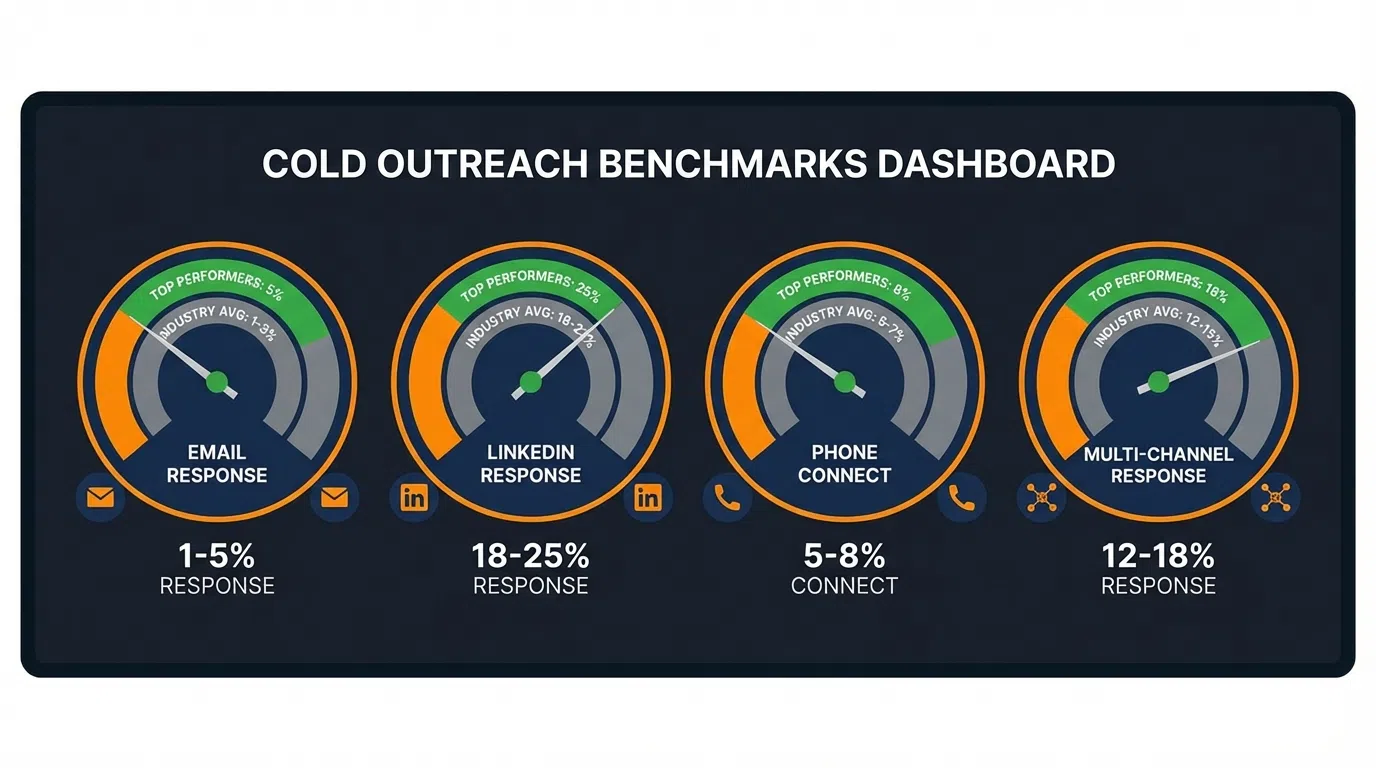
Current Performance Benchmarks:
- Average InMail response rate: 10-25% (Sales So)
- Personalized connection requests: 9.36% acceptance rate
- Generic connection requests: 5.44% acceptance rate
- AI-assisted personalized outreach: 10.3% response rate
- Traditional cold email: 5.1% response rate
What's Changed:
- Decision-makers receive 200+ LinkedIn messages weekly
- Generic personalization tokens are immediately recognized
- LinkedIn algorithm prioritizes authentic engagement
- Multichannel sequences using 3+ touchpoints drive 287% better response rates than single-channel approaches
- Follow-up messages account for 50-70% of total responses
The New Rules:
- Personalization is mandatory, not optional
- Multi-touch sequences outperform single messages
- Timing and context matter more than ever
- Value-first messaging beats product-first pitches
- Automation must be invisible to prospects
In 2026, cold LinkedIn outreach works when it's strategic, personalized, and value-driven—not mass-sent and generic.
The Complete Cold Outreach Framework
The most successful cold LinkedIn outreach follows a six-phase framework:
Phase 1: List Building (Target the right prospects)
Phase 2: Research & Intelligence (Gather personalization insights)
Phase 3: Connection Request (Get accepted into network)
Phase 4: First Message (Start the conversation)
Phase 5: Follow-Up Sequence (Persist without annoying)
Phase 6: Multi-Threading (Reach multiple stakeholders)
Each phase has specific tactics, templates, and metrics. Let's break down the complete system.
Phase 1: List Building and Prospect Targeting
Cold outreach success starts with targeting the right prospects. Poor targeting kills even the best messaging.
Ideal Customer Profile (ICP) Definition
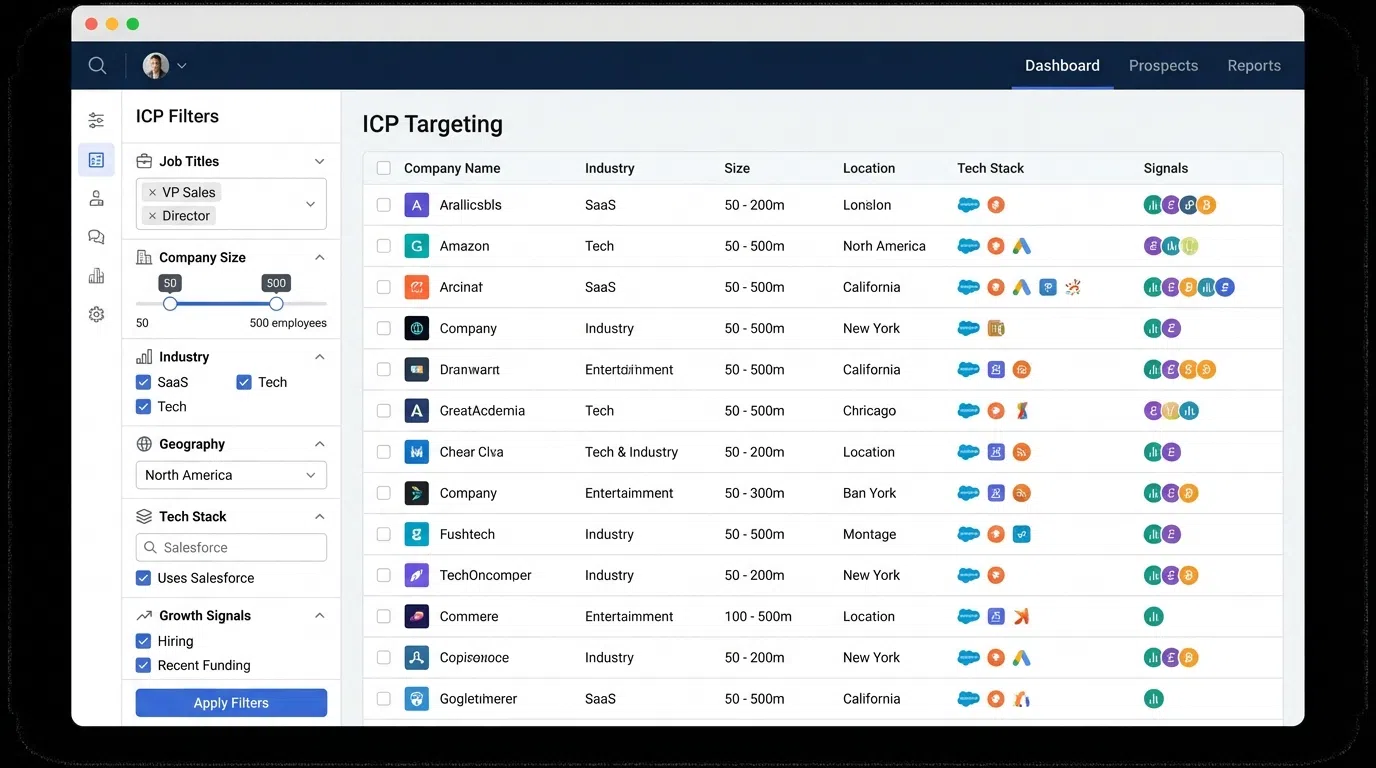
Define your ICP with precision:
Firmographic criteria:
- Company size (employee count)
- Revenue range
- Industry and sub-segments
- Geographic location
- Funding stage (for startups)
- Growth indicators
Technographic criteria:
- Tech stack signals
- Platform usage
- Integration ecosystem
- Digital maturity
Behavioral criteria:
- Recent hiring activity
- Content engagement patterns
- Event participation
- Social selling activity
List Building Methods
Option 1: LinkedIn Sales Navigator
- Advanced search filters by role, seniority, company
- Boolean search for specific keywords
- Lead recommendations based on saved searches
- Account lists for ABM approach
Option 2: LinkedIn Basic Search + Manual Scraping
- Free but time-intensive
- Limited to 3rd-degree connections
- Requires manual export
- Good for testing new segments
Option 3: Third-Party Tools
- Apollo.io, ZoomInfo, Lusha for contact discovery
- Enrichment tools for additional data
- Higher accuracy but additional cost
- Check our best prospecting tools guide
List Segmentation Strategy
Segment your lists for targeted messaging:
Tier 1: High-Value Targets (Deep Personalization)
- Dream accounts and strategic targets
- Executive stakeholders
- 5-10 minutes research per prospect
- Custom, highly personalized messaging
Tier 2: Core ICP (Moderate Personalization)
- Good-fit prospects matching ICP
- Manager to Director level
- 1-2 minutes research per prospect
- Template-based with customization
Tier 3: Volume Plays (AI-Powered Personalization)
- Testing new segments
- Lower-priority targets
- AI research and personalization
- Scale-focused approach
Target list sizes:
- Weekly: 100-200 new prospects
- Daily: 20-40 new connection requests
- Pipeline: 500-1,000 active prospects
Phase 2: Profile Research and Intelligence Gathering
Research separates effective cold outreach from spam. Here's the systematic approach:
The 90-Second Research Method
For Tier 2 prospects, spend 90 seconds gathering:
Must-have insights (30 seconds):
- Current role and tenure
- Company industry and size
- One recent LinkedIn activity (post, comment, share)
Nice-to-have insights (30 seconds):
- Career background pattern
- Mutual connections
- Recent company news
Personalization angle selection (30 seconds):
- Choose strongest personalization hook
- Identify relevant value proposition
- Plan connection request message
The Deep Research Method
For Tier 1 high-value targets, invest 5-10 minutes:
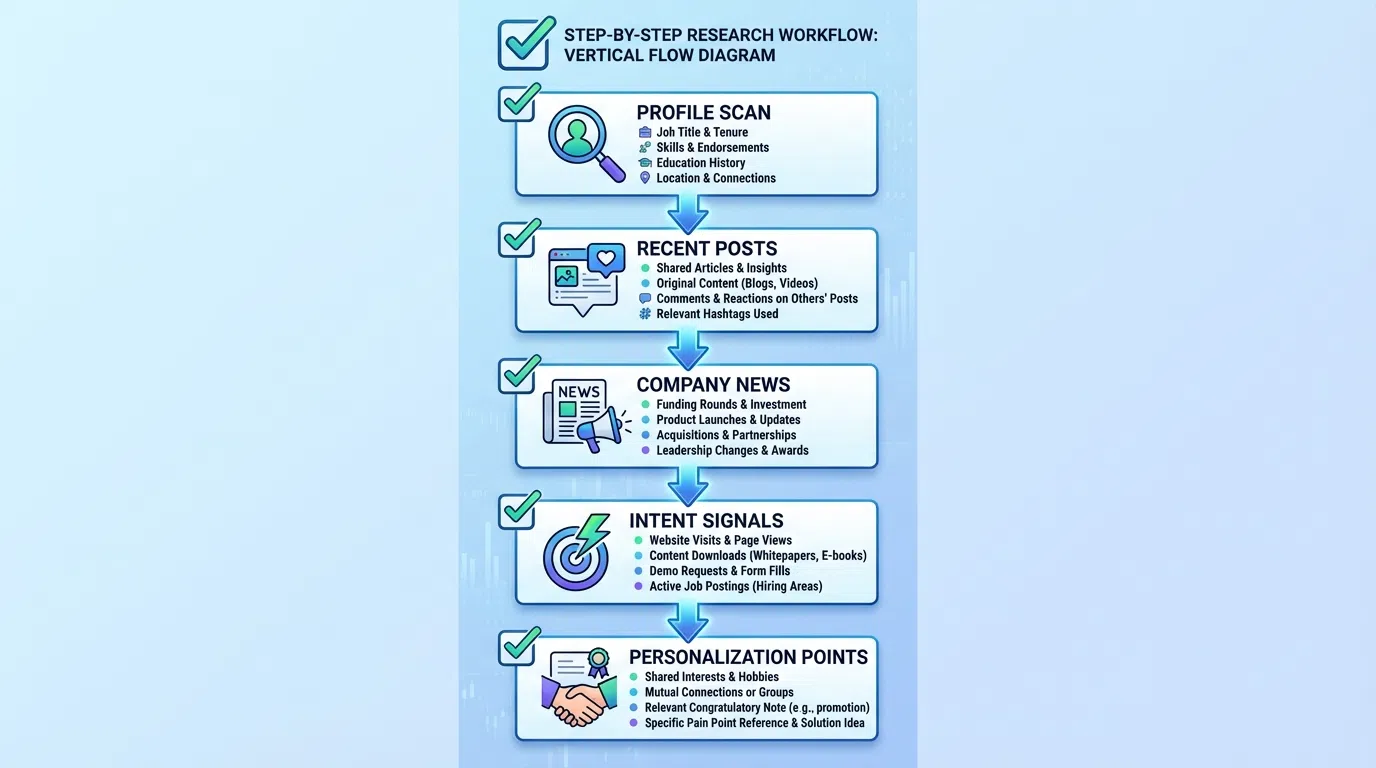
Profile analysis:
- Full career trajectory review
- Skills and endorsements mapping
- Education and certifications
- Recommendations and accomplishments
Activity analysis:
- Last 5-10 LinkedIn posts
- Recent comments and engagement
- Shared articles and content
- Group participation
Company intelligence:
- Recent news and announcements
- Funding and growth signals
- Product launches and expansions
- Leadership changes
Competitive context:
- Current tools and solutions in use
- Pain points based on their content
- Strategic priorities from posts/articles
- Industry challenges affecting them
AI-Powered Research Automation
For scale, leverage AI research tools:
What AI should extract:
- LinkedIn post content and themes
- Profile data and career patterns
- Engagement topics and interests
- Company trigger events
Human verification required:
- Relevance of AI-identified signals
- Accuracy of personalization angles
- Tone and messaging appropriateness
- Strategic approach selection
LeadSpark AI automates LinkedIn post scraping and personalization insight extraction, reducing research time from 5-10 minutes to 15 seconds while maintaining quality.
Research Documentation
Track research insights for sequence planning:
Create a research log:
`
Prospect: John Smith
Company: Acme Corp
Role: VP Sales
Research Notes:
- Posted about scaling SDR team 2 weeks ago (50 to 100 reps)
- Previously scaled sales at two other SaaS companies
- Commented on AI in sales enablement posts
- Company just raised Series C ($80M)
Personalization Angle: Scaling personalization at 2x team size
Follow-Up Angles: AI efficiency, previous scaling experience, Series C growth
`
This log fuels your entire sequence, not just the first message.
Phase 3: Connection Request Strategy
The connection request is your first impression. In 2026, personalized connection requests see 9.36% acceptance rates vs 5.44% for generic requests.
Connection Request Best Practices
Character limits:
- Free LinkedIn: 200 characters
- Premium/Sales Navigator: 300 characters
Optimal structure:
- Personalization hook (specific to them)
- Credibility signal (why you're reaching out)
- Soft value hint (what's in it for them)
- No hard pitch (save for after connection)
Examples:
Post-based personalization:
`
Saw your post about scaling SDR teams while maintaining quality—that's the exact challenge we solve for VP Sales at Series B companies. Would value connecting.
`
Mutual connection:
`
Both connected to Sarah Chen from the Pavilion sales community. Your background scaling enterprise sales teams aligns with what we help sales leaders do. Worth connecting?
`
Company trigger:
`
Congrats on the Series C—scaling to 100 reps brings unique personalization challenges. We've helped several post-Series C companies navigate this. Happy to connect.
`
Connection Request Timing
When you send matters:
Best days: Tuesday-Thursday
Best times:
- 9-11 AM (early morning check-ins)
- 1-3 PM (post-lunch browsing)
- 8-10 PM (evening LinkedIn sessions)
Avoid:
- Monday mornings (inbox overwhelm)
- Friday afternoons (weekend mode)
- Weekends (low LinkedIn activity)
Connection Acceptance Rate Optimization
Track and optimize acceptance rates:
Target benchmarks:
- Good: 25-35% acceptance rate
- Excellent: 35-50% acceptance rate
- Elite: 50%+ acceptance rate
If acceptance rates are low:
- Increase personalization specificity
- Test different connection request angles
- Verify ICP fit (wrong targets = low acceptance)
- Check profile completeness (incomplete profiles get rejected)
- Ensure mutual connections when possible
Phase 4: First Message Framework
Once connected, your first message starts the conversation. This is where most cold outreach fails.
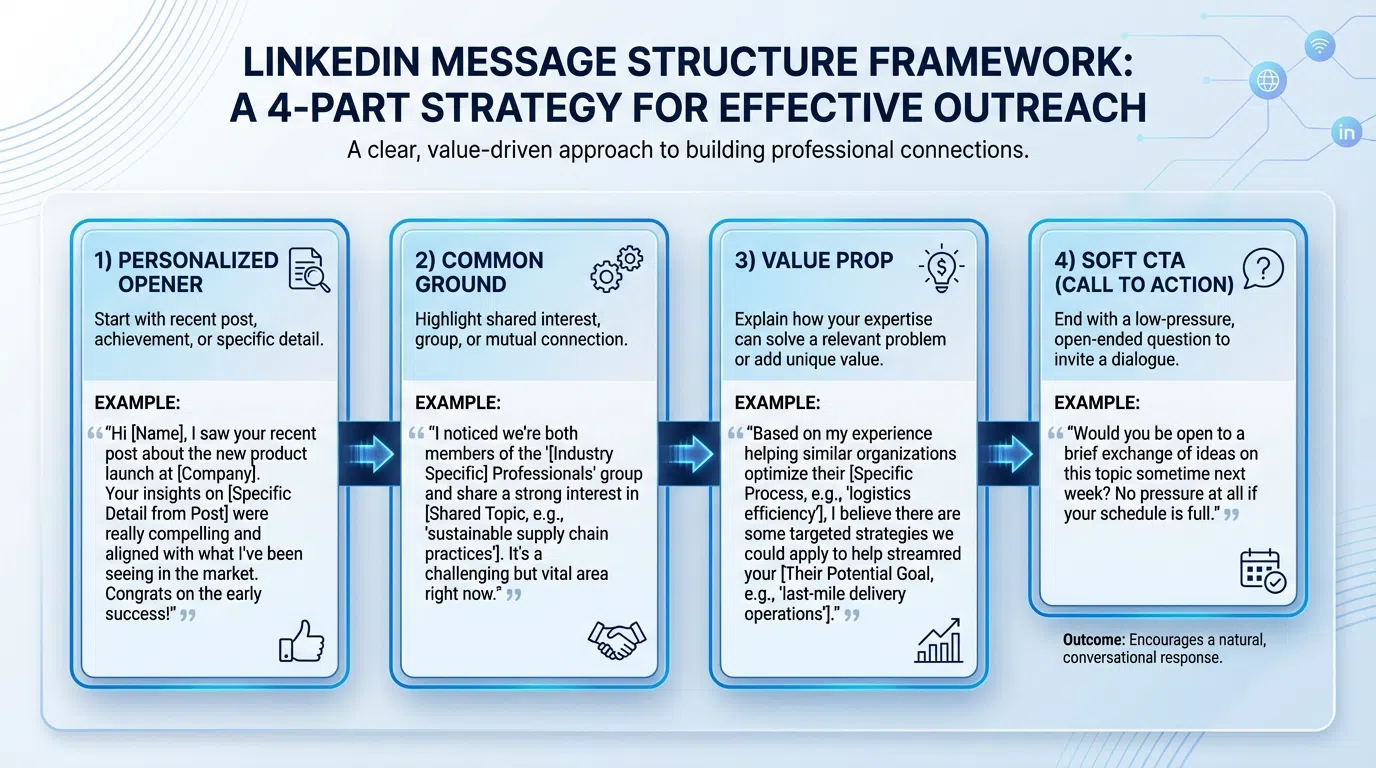
The Value-First Message Framework
Structure:
- Personalized opening (reference research insight)
- Pattern recognition (connect to broader challenge)
- Proof point (establish credibility)
- Specific value (what's in it for them)
- Low-friction CTA (easy to respond)
Example:
`
Hey {{FirstName}},
Your post about maintaining personalization quality while scaling your SDR team to 100 reps resonated—that's the #1 challenge we hear from VP Sales at Series B companies.
We helped Built.io navigate the exact same transition (25 to 85 reps) while actually improving response rates from 12% to 18%.
For someone managing hypergrowth hiring, that's 300+ extra meetings monthly without sacrificing quality.
Worth a quick call to share how they did it?
Best,
{{YourName}}
`
Message Length Optimization
Research shows messages under 400 characters boost response rates by 22%.
Character count guidelines:
- Connection requests: 150-200 characters
- First messages: 300-400 characters
- Follow-ups: 200-300 characters
Read our complete guide on LinkedIn message length optimization for detailed best practices.
Question-Based vs Statement-Based CTAs
Test both approaches:
Question-based (softer, higher response):
- "Worth exploring?"
- "Curious if this resonates?"
- "Should we chat?"
- "Want to see how it works?"
Statement-based (stronger, lower response but higher intent):
- "Let's schedule 15 minutes."
- "I'll send a calendar link."
- "Available Tuesday or Thursday?"
Track which drives better meeting booking rates, not just response rates.
First Message Templates by Scenario
Scenario 1: Recent LinkedIn Post Reference
`
Your point about [specific insight from post] was spot-on, {{FirstName}}.
Most [their role] at [company stage] we talk to share that exact challenge.
We've helped [similar company] [specific result] using [relevant approach].
Worth 15 minutes to explore how?
[Your Name]
`
Scenario 2: Company Trigger Event
`
Congrats on [funding/launch/expansion], {{FirstName}}!
[Specific trigger] usually means [challenge they're facing].
We helped [similar company] navigate [same situation] and [specific outcome].
For someone in your position, that's [quantified value].
Quick call to share the playbook?
`
Scenario 3: Mutual Connection
`
{{MutualConnection}} suggested we connect, {{FirstName}}—your background [specific detail] aligns with what we help [their role] accomplish.
Specifically: [specific value prop for their situation].
Worth exploring?
`
Check out our library of LinkedIn prospecting message templates for more examples.
Phase 5: Follow-Up Sequence Architecture
Here's a critical stat: Follow-up messages account for 50-70% of total responses. Most meetings come from touch 2-4, not your first message.
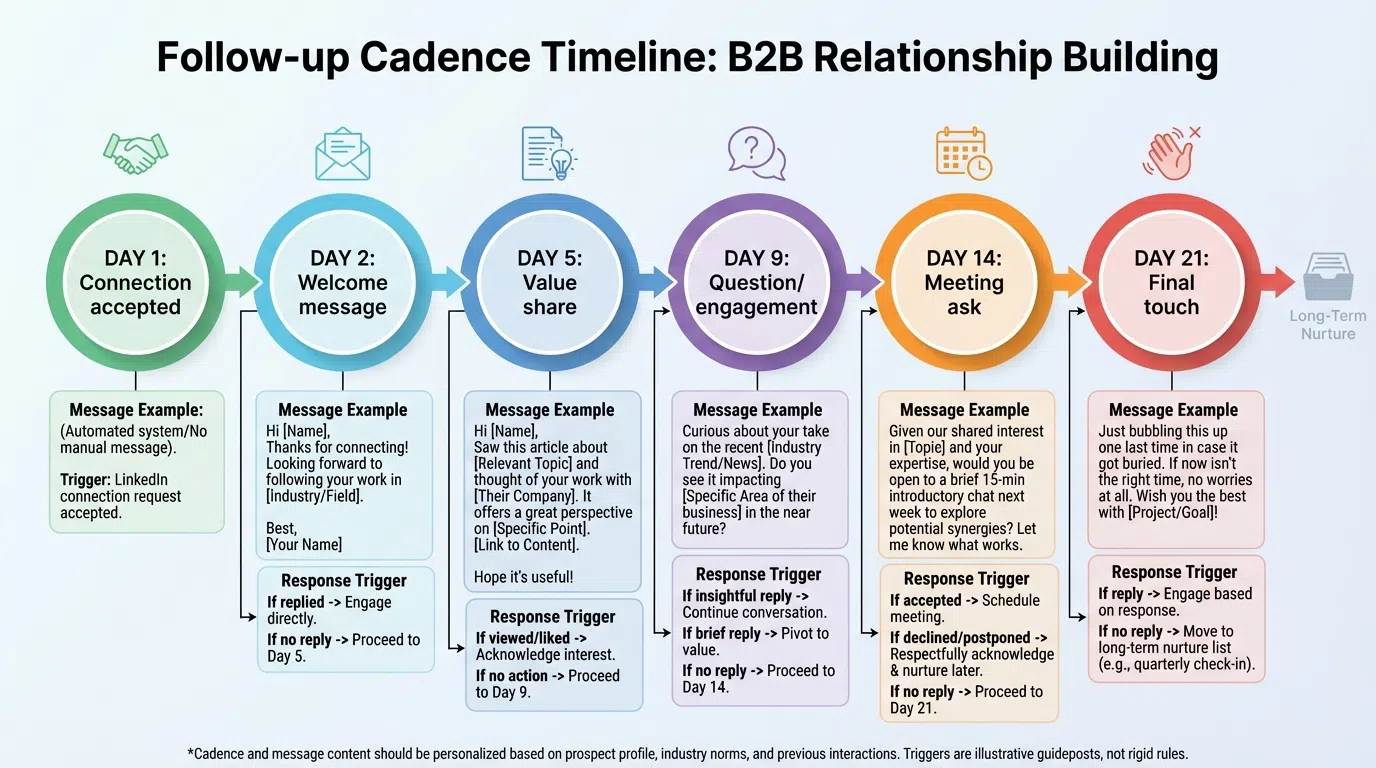
The 7-Touch Follow-Up Framework
Optimal sequence structure:
Touch 1: Connection request (personalized)
Touch 2: First message after acceptance (value-focused)
Wait 3-4 days
Touch 3: Follow-up with different angle
Wait 4-5 days
Touch 4: Share relevant resource/case study
Wait 5-7 days
Touch 5: "Breaking up" message
Wait 7 days
Touch 6: Re-engagement with new trigger
Wait 14-30 days
Touch 7: Quarterly check-in
Follow-Up Message Examples
Follow-Up #1 (Different Angle):
`
{{FirstName}}, following up on my message about [original topic].
Another angle: I saw you [different research insight].
That typically means [different challenge/opportunity].
[Different proof point or value prop]
Still worth discussing?
`
Follow-Up #2 (Resource Share):
`
{{FirstName}}, thought this might be relevant:
We just published a case study on how [similar company] [achieved specific result].
Given your focus on [their priority], figured you'd find it useful: [link]
No pressure—just thought it'd be valuable.
`
Follow-Up #3 (The Breakup):
`
{{FirstName}}, I've reached out a few times about [topic].
Clearly not the right time or not relevant for your priorities—totally understand.
Should I close the loop on this, or worth one quick conversation?
Either way, best of luck with [their initiative].
`
Follow-Up #4 (Re-Engagement with Trigger):
`
{{FirstName}}, saw [new company announcement/post/activity].
This changes the context of our previous conversations about [topic].
Specifically: [new relevant value prop based on trigger].
Worth revisiting now?
`
Follow-Up Timing and Frequency
Optimal timing:
- First follow-up: 3-4 days after first message
- Second follow-up: 4-5 days after first follow-up
- Third follow-up: 5-7 days after second follow-up
- Breakup message: 7 days after third follow-up
- Re-engagement: 14-30 days after breakup
Don't follow up:
- On weekends (unless B2C)
- More than once per week
- After they've engaged but not responded (give space)
- After explicit "not interested" (respect boundaries)
Follow-Up Response Patterns
Track when responses happen:
Typical patterns:
- 20-30% respond to first message
- 25-35% respond to follow-up #1
- 15-20% respond to follow-up #2
- 10-15% respond to breakup message
- 5-10% respond to later re-engagement
Optimize based on your data:
- Which follow-up drives most responses?
- Which approach (question vs. resource vs. breakup) works best?
- Does timing affect response rates?
Phase 6: Multi-Threading and Account Penetration
For target accounts, reach multiple stakeholders simultaneously.
The Multi-Threading Strategy
Why multi-thread:
- Multiple decision-makers involved in most B2B purchases
- Different stakeholders have different priorities
- Increases odds of finding a champion
- Builds organizational awareness
Who to target in parallel:
- Primary decision-maker (VP/Director level)
- End-user champion (Manager/IC level)
- Technical evaluator (if relevant)
- Budget holder (if different from decision-maker)
Multi-Threading Messaging Coordination
Coordinate messages across stakeholders:
Example for 3-person multi-thread:
VP Sales message:
`
Your focus on scaling personalization at 2x team size (saw your recent post) aligns perfectly with what we help VP Sales accomplish post-funding...
`
SDR Manager message:
`
Saw you're hiring 20+ SDRs this quarter. The #1 challenge new SDR managers face during rapid hiring is maintaining personalization quality at scale...
`
RevOps Director message:
`
Your tech stack includes Outreach and SalesLoft—many RevOps leaders we work with integrate LeadSpark AI to add LinkedIn personalization to those workflows...
`
Coordination rules:
- Personalize separately (don't copy-paste)
- Reference different research insights
- Highlight role-specific value props
- Space outreach 2-3 days apart
- Don't mention reaching out to others
Account-Based Outreach Sequences
For strategic accounts, plan comprehensive sequences:
Week 1: Research and connection requests (all 3 stakeholders)
Week 2: First messages after acceptance
Week 3: Follow-up #1 with different angles
Week 4: Share relevant resources/case studies
Week 5-6: Breakup messages or continued follow-ups
Ongoing: Monitor for new triggers and re-engagement
Track account-level engagement, not just individual responses.
Omnichannel Integration: LinkedIn + Email + Phone
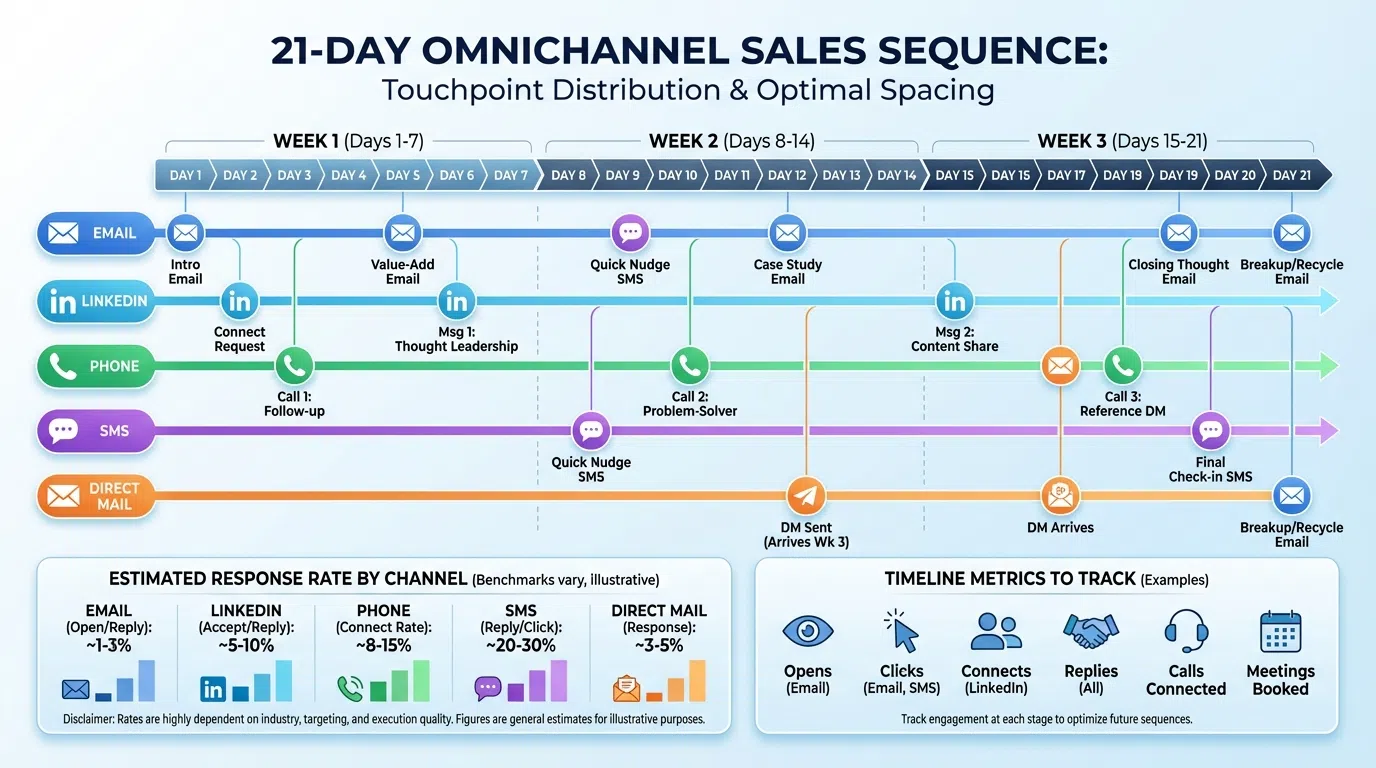
The most effective cold outreach in 2026 combines multiple channels. Using 3+ touchpoints in an omnichannel sequence drives 287% better response rates than single-channel LinkedIn-only approaches.
The Omnichannel Sequence Framework
7-10 touchpoint sequence over 2-3 weeks:
Day 1: LinkedIn connection request
Day 2: Email (if you have verified address)
Day 4: LinkedIn first message (if accepted)
Day 7: Email follow-up
Day 10: LinkedIn follow-up #1
Day 14: Phone call attempt
Day 17: Email with resource
Day 21: LinkedIn breakup message
Day 21: Final email
Day 60: Re-engagement email + LinkedIn
Channel-Specific Messaging
Adapt messaging for each channel:
LinkedIn strengths:
- Personalization based on profile/posts
- Professional context and credibility
- Visual profile information
- Easy to respond (low friction)
Email strengths:
- Longer-form value explanation
- Easier to include links and resources
- Automated sequence integration
- Tracking and analytics
Phone strengths:
- Real-time conversation
- Builds rapport quickly
- Addresses objections immediately
- Cuts through digital noise
Email + LinkedIn Coordination
Example coordinated sequence:
LinkedIn Connection:
`
Your post about scaling SDR teams resonated—exact challenge we solve for VP Sales at Series B companies. Worth connecting.
`
Email (same day):
`
Subject: Scaling personalization @ {{Company}}
{{FirstName}},
Just sent a LinkedIn connection—wanted to also reach out via email.
Saw your recent post about maintaining quality while scaling your SDR team to 100 reps. That's the exact challenge we've solved for [similar companies].
Worth 15 minutes to share the playbook?
[Calendar link]
Best,
{{YourName}}
`
LinkedIn First Message (after acceptance):
`
Thanks for connecting, {{FirstName}}!
Following up on my email about scaling personalization quality—[Company Similar] went from 25 to 85 SDRs while improving response rates 12% to 18%.
For someone managing hypergrowth, that's 300+ extra meetings monthly.
Should we chat this week?
`
Read our guide on email automation for sales teams for email sequence best practices.
Cold Outreach Templates That Work
Here are proven templates for different scenarios:
Template 1: Recent Post Personalization
`
Hey {{FirstName}},
Your post about {{specific topic}} was spot-on—especially the part about {{specific insight}}.
Most {{their role}} at {{company stage}} we talk to share that exact challenge: {{pattern}}.
We helped {{similar company}} {{specific result}}. For someone in your position, that's {{quantified value}}.
Worth exploring how?
Best,
{{YourName}}
`
Template 2: Company Trigger Event
`
{{FirstName}},
Congrats on {{trigger event}}!
{{Specific trigger}} typically means {{challenge they're facing}} becomes a priority.
We've helped {{similar company}} navigate {{same situation}} and achieve {{specific outcome}}.
Worth 15 minutes to share the playbook?
[Calendar link]
Best,
{{YourName}}
`
Template 3: Mutual Connection
`
Hey {{FirstName}},
{{Mutual connection}} suggested I reach out—your background {{specific detail}} aligns with what we help {{their role}} accomplish.
Specifically: helping {{their industry}} companies {{specific value prop}}.
{{Similar company}} saw {{specific result}} in {{timeframe}}.
Worth a quick call?
Best,
{{YourName}}
`
Template 4: Pattern Recognition
`
{{FirstName}},
Most {{their role}} at {{company stage}} companies face this dilemma: {{challenge A}} vs {{challenge B}}.
Based on {{research insight about them}}, I'm guessing you're dealing with something similar.
We helped {{similar company}} {{specific result}} without {{common sacrifice}}.
Worth discussing?
Best,
{{YourName}}
`
Template 5: Breakup Message
`
{{FirstName}},
I've reached out a few times about {{topic}}—clearly not the right time or not relevant.
Last question: should I close the loop on this, or is it worth one quick 10-minute conversation?
Either way, best of luck with {{their initiative}}!
{{YourName}}
`
Template customization checklist:
- [ ] Replace all {{tokens}} with prospect-specific information
- [ ] Ensure personalization is specific and verifiable
- [ ] Keep under 400 characters
- [ ] Include one clear CTA
- [ ] Add your authentic voice and tone
- [ ] Test subject line variations (for InMail)
See our full library of LinkedIn prospecting templates organized by industry and use case.
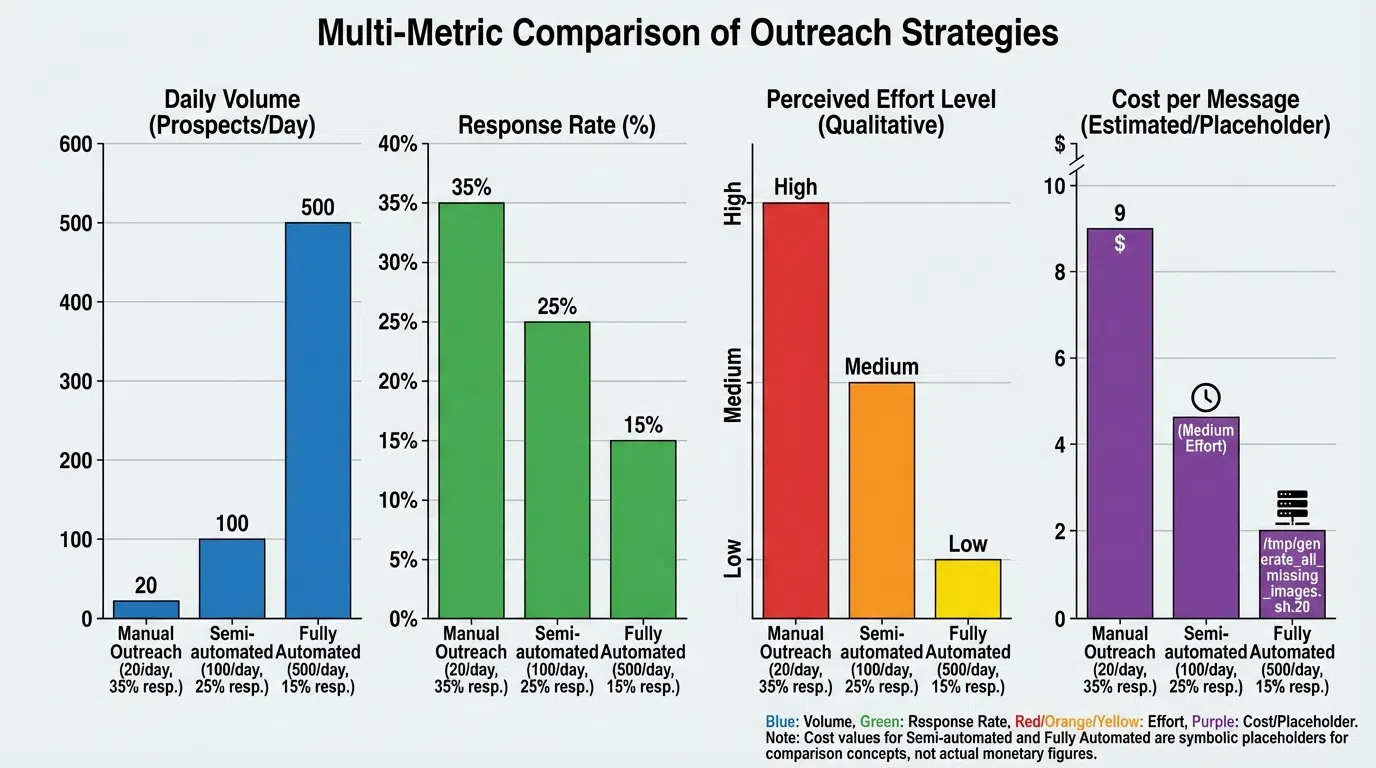
Automation vs Manual: Finding the Right Balance
Cold outreach at scale requires automation, but it must be invisible to prospects. Here's the right balance:
What to Automate
Safe to automate:
- Connection request sending (with daily limits)
- Follow-up sequence timing
- Research data extraction
- Profile visiting (view automation)
- Message delivery scheduling
Automate with caution:
- Message personalization (AI-assisted, human-reviewed)
- Response detection and tagging
- CRM data enrichment
- Activity tracking and logging
Never automate:
- Message content without review
- Responses to prospect replies
- Meeting scheduling confirmations
- Relationship building conversations
LinkedIn Automation Rules and Limits
2026 LinkedIn limits:
- Connection requests: 100-200 per week (stay well below)
- Messages to connections: No hard limit but pace matters
- Profile views: 100-150 per day maximum
- InMails: Based on Sales Navigator plan
Safe automation practices:
- Limit connection requests to 20-30 daily
- Space outreach throughout the day (not bulk)
- Randomize timing between actions
- Use human-like activity patterns
- Monitor for any LinkedIn warnings
Automation tools that work:
- Expandi (cloud-based, safe)
- LinkedHelper (desktop, moderate risk)
- Dripify (cloud-based, safe)
- Octopus CRM (browser-based)
For more details, read our guide on LinkedIn automation vs personalization balance.
The Hybrid Approach
Optimal workflow:
AI automates:
- LinkedIn profile and post scraping
- Personalization insight extraction
- Initial message draft generation
- Research documentation
Humans handle:
- Message review and refinement
- Personalization angle selection
- Sequence strategy decisions
- All conversation responses
- Meeting scheduling
This hybrid approach lets SDRs process 100-200 prospects daily while maintaining quality and authenticity.
LeadSpark AI exemplifies this model: automates research and drafts icebreakers, but SDRs review and send final messages.
Measuring and Optimizing Cold Outreach Performance
Track these metrics to optimize your cold outreach:
Core Metrics to Monitor
Activity metrics:
- Connection requests sent: __ daily
- Connection acceptance rate: __%
- Messages sent: __ daily
- Response rate: __%
- Meeting booking rate: __%
Efficiency metrics:
- Time per prospect research: __ minutes
- Messages per hour: __
- Prospects processed daily: __
- Cost per meeting booked: $__
Quality metrics:
- Response quality (engaged vs. not interested): __
- Meeting show rate: __%
- Pipeline generated: $__
- Closed-won deals from LinkedIn: __
Response Rate Benchmarks
Target response rates by approach:
- Generic outreach: 3-7% (avoid this)
- Basic personalization: 10-15%
- Moderate personalization: 15-22%
- Advanced personalization: 25-35%
- Highly targeted + deep personalization: 35%+
If your response rates are low:
- Increase personalization specificity
- Test different messaging angles
- Verify ICP fit (wrong audience = low response)
- Improve message length (keep under 400 chars)
- Test different CTAs (question vs. statement)
A/B Testing Framework
Run continuous tests:
Variables to test:
- Personalization type (post vs. profile vs. trigger)
- Message length (200 vs. 300 vs. 400 characters)
- CTA style (question vs. statement vs. calendar link)
- Follow-up timing (3 vs. 5 vs. 7 days)
- Subject lines (for InMail)
Testing methodology:
- Test one variable at a time
- Minimum 100 prospects per variation
- Track to meeting booked, not just response
- Document learnings and iterate
Example test:
`
Test: CTA style
Variation A: "Worth exploring?" (question)
Variation B: "Let's schedule 15 minutes." (statement)
Results (200 prospects):
A: 18% response rate, 4% meeting booked
B: 12% response rate, 5% meeting booked
Winner: B (higher meeting booking rate)
`
Pipeline Attribution and ROI
Track LinkedIn-sourced pipeline:
Metrics to calculate:
- LinkedIn-sourced meetings: __ monthly
- Meeting-to-opportunity conversion: __%
- Average deal size: $__
- Win rate: __%
- Sales cycle length: __ days
- Monthly pipeline from LinkedIn: $__
- Annual revenue from LinkedIn channel: $__
ROI calculation:
`
Costs:
- Sales Navigator subscription: $100/month
- LeadSpark AI credits: $50/month
- SDR time allocation (30% to LinkedIn): $2,000/month
Total monthly cost: $2,150
Returns:
- Meetings booked monthly: 40
- Opportunities created: 8 (20% conversion)
- Average deal size: $25,000
- Win rate: 25%
- Deals closed monthly: 2
Monthly revenue: $50,000
ROI: 2,226% or 22.3x
`
For detailed metrics and benchmarking, read our LinkedIn prospecting metrics guide.
Frequently Asked Questions
How many cold LinkedIn messages should SDRs send daily?
Target 20-30 personalized LinkedIn messages daily for sustainable quality. This allows 1-2 minutes of research per prospect while maintaining high personalization standards. High-performing SDRs using AI research tools like LeadSpark AI can scale to 50-100 daily messages by automating research while preserving message quality. Prioritize response rate over volume—30 messages with 20% response (6 conversations) beats 100 messages with 5% response (5 conversations).
What's the best time to send cold LinkedIn messages in 2026?
Tuesday through Thursday between 9-11 AM and 1-3 PM drive the highest response rates based on 2026 outreach data. Avoid Monday mornings (inbox overwhelm) and Friday afternoons (weekend mode). For InMail, 65% of responses come within 24 hours, so timing matters less than for connection requests. Test your specific audience—executive prospects may engage during evening hours (8-10 PM) while IC-level prospects respond during work hours.
Should I use InMail or connection requests for cold outreach?
Connection requests are more effective for most cold outreach: they're free, build your network, and enable ongoing conversation. InMail works best for prospects who won't accept connection requests (executives, competitors, saturated targets) or when you need immediate access. InMail response rates of 10-25% are strong, but connection request + message sequences often outperform with 30%+ total response rates across the sequence. Use InMail strategically for high-value targets when connection requests fail.
How many follow-ups before giving up on cold LinkedIn prospects?
Send 3-4 follow-ups over 2-3 weeks before the final breakup message. Follow-up messages drive 50-70% of responses, so persistence pays off. Structure: first message, wait 3-4 days, follow-up #1, wait 4-5 days, follow-up #2, wait 5-7 days, breakup message. After the breakup, wait 30-60 days for re-engagement with a new trigger or angle. Many deals come from later re-engagement when timing and priorities align.
Can I automate LinkedIn cold outreach without getting banned?
Yes, but automation must mimic human behavior and respect LinkedIn limits. Safe practices: limit connection requests to 20-30 daily, randomize timing between actions, use cloud-based tools (Expandi, Dripify), avoid weekends and off-hours, and never automate responses. Automate research and scheduling, not message content. LeadSpark AI offers a safe middle ground: automates LinkedIn post scraping and personalization research without triggering LinkedIn's automation detection. Read our full guide on LinkedIn automation best practices.
Ready to Scale Your Cold LinkedIn Outreach?
Cold LinkedIn outreach works when you balance personalization quality with scalability. LeadSpark AI helps sales teams execute this playbook at scale:
What LeadSpark AI does:
- Scrapes prospects' LinkedIn posts automatically
- Extracts personalization insights in 15 seconds
- Generates hyper-personalized icebreakers under 25 words
- Processes 100+ prospects in minutes, not hours
- Maintains 25-35% response rates at volume
Sales teams using LeadSpark AI book 40-60% more meetings from the same outreach volume by combining AI research speed with human strategy and message refinement.
Start with 15 free credits and implement this playbook immediately.
Related Posts
Ready to Generate Personalized Icebreakers?
Join sales professionals using LeadSpark AI to create hyper-personalized LinkedIn icebreakers in minutes.