Personalization Strategies
Advanced LinkedIn Message Personalization Strategies for SDRs [2026]
Master advanced LinkedIn message personalization techniques. Data-backed strategies that increase response rates by 27%. For SDRs scaling outreach.
11 min read
Most SDRs know personalization matters. But knowing "personalize your messages" and actually doing it at scale are two entirely different challenges.
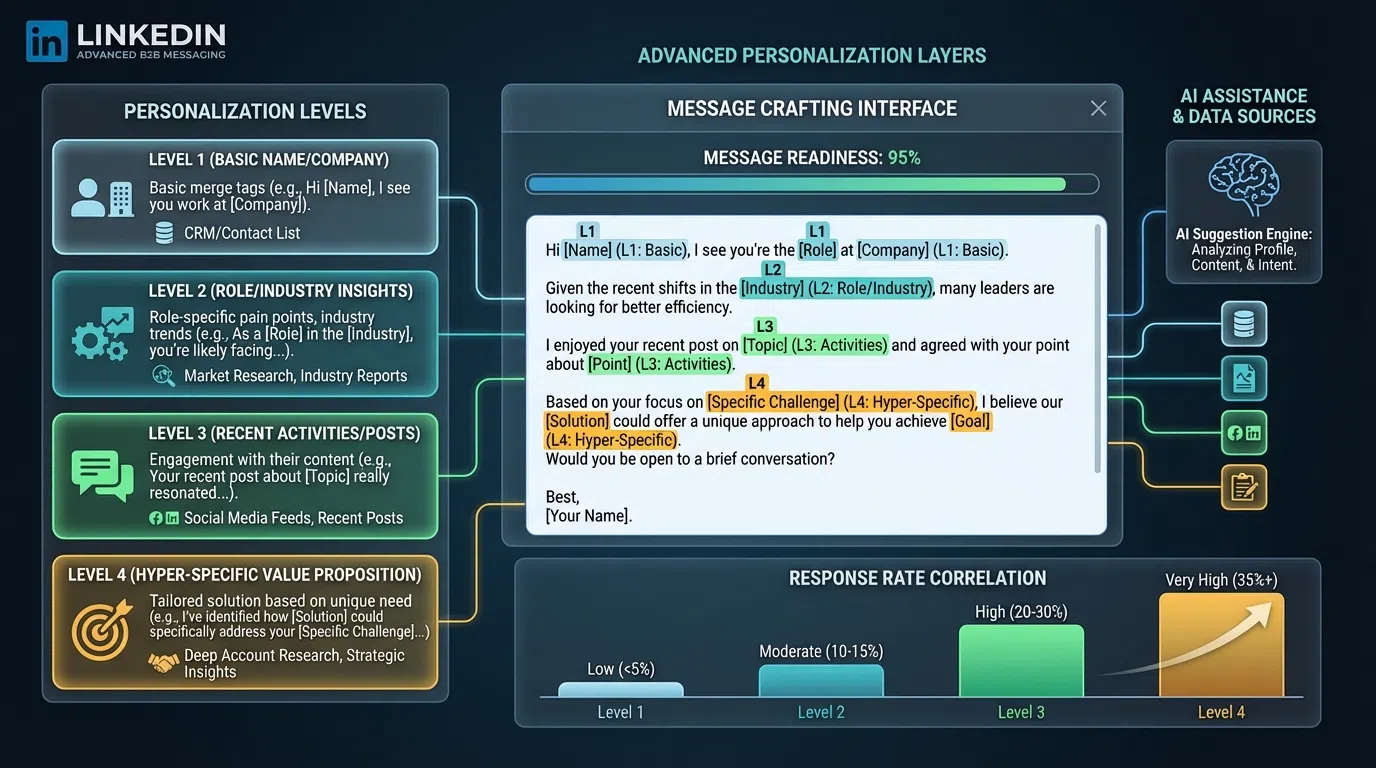
Generic LinkedIn messages get ignored 63% of the time. Meanwhile, personalized messages increase response rates by 27% according to 2026 LinkedIn data. The gap between basic and advanced personalization is the difference between 10% and 30%+ response rates.
This guide reveals advanced LinkedIn message personalization strategies used by top-performing SDRs and BDRs. You'll learn how to move beyond "Hi {{FirstName}}" and craft messages that actually resonate with prospects.
Table of Contents
- The State of LinkedIn Personalization in 2026
- Advanced Personalization Framework: The 3-Layer Approach
- Layer 1: Profile Intelligence Extraction
- Layer 2: Activity-Based Personalization
- Layer 3: Contextual Business Triggers
- Advanced Personalization Techniques That Scale
- AI-Powered Personalization Without Losing Authenticity
- Response Rate Optimization: Advanced Tactics
- Common Advanced Personalization Mistakes
- Measuring Personalization Effectiveness
- Frequently Asked Questions
The State of LinkedIn Personalization in 2026
LinkedIn personalization has evolved dramatically. The data tells a clear story:
Current Benchmarks:
- Average InMail response rate: 10-25% (Sales So, 2026)
- High performers: 18-25% response rate
- Elite tier with advanced personalization: 30-40%
- Generic bulk messages: Response rates below 5%
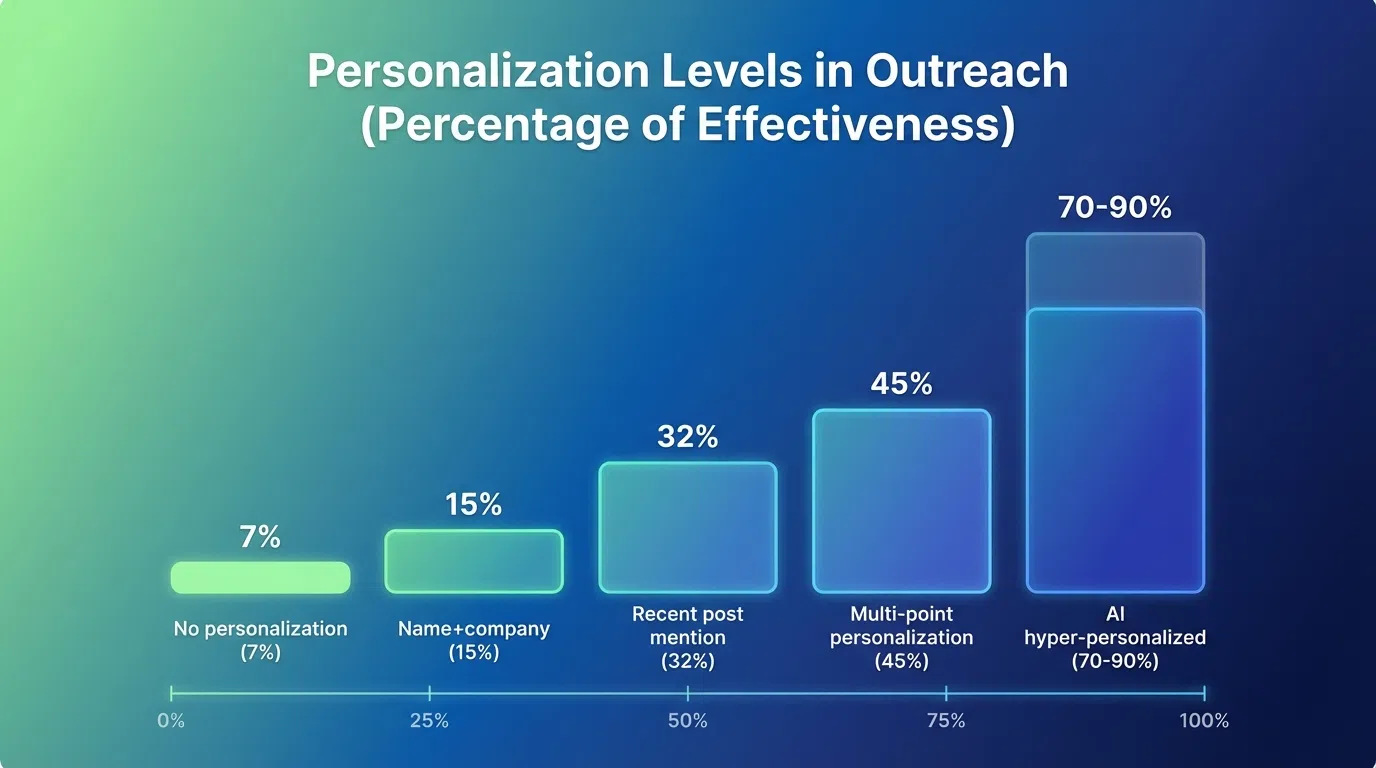
The gap between basic and advanced personalization has never been wider. AI-assisted outreach now achieves 10.3% response rates compared to 5.1% for traditional cold email, but only when personalization is done right.
What Changed in 2026:
- Prospects receive 200+ LinkedIn messages weekly
- Spam filters detect generic personalization tokens
- First-degree connections expect genuine engagement
- LinkedIn algorithm rewards authentic interactions
- Decision-makers ignore templated outreach
The bar for "personalized" has risen. Simply using {{FirstName}} and {{CompanyName}} no longer cuts it.
Advanced Personalization Framework: The 3-Layer Approach
Top-performing SDRs use a three-layer personalization framework that goes far deeper than basic tokens:
Layer 1: Profile Intelligence Extraction
- Job role and responsibilities analysis
- Career trajectory patterns
- Skills and endorsements mapping
- Education and certifications
- Mutual connections leverage
Layer 2: Activity-Based Personalization
- Recent LinkedIn posts and engagement
- Content they've liked or commented on
- Articles they've published
- Groups they participate in
- Topics they discuss
Layer 3: Contextual Business Triggers
- Company news and announcements
- Funding rounds and expansions
- Leadership changes
- Product launches
- Industry trends affecting their business
This framework ensures every message contains at least two layers of personalization, making it impossible to ignore.
Layer 1: Profile Intelligence Extraction
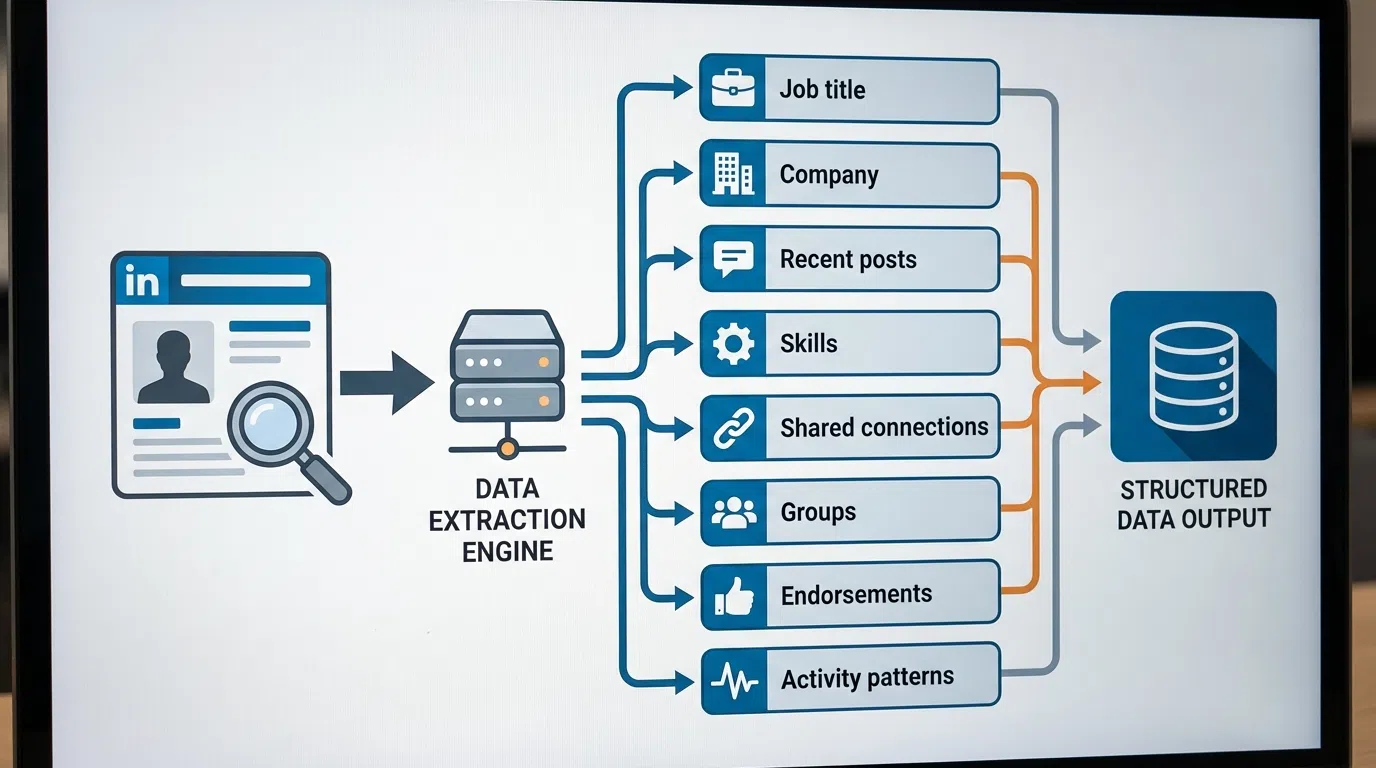
Profile intelligence goes beyond reading the headline. Here's what advanced SDRs extract:
Career Trajectory Analysis
Study their career path for personalization angles:
Example Analysis:
- Started as SDR at startup → moved to Enterprise AE at Fortune 500 → now VP Sales at mid-market SaaS
- Personalization angle: "Your career path from SDR to VP Sales in 6 years mirrors what many of our fastest-growing customers have done..."
Skills and Endorsements Deep Dive
Their top skills reveal what they value:
Basic personalization: "I see you're skilled in SaaS sales..."
Advanced personalization: "Your endorsements in enterprise negotiation and complex deal cycles suggest you're handling strategic accounts..."
Education and Certification Leverage
Education isn't just background—it's common ground:
Examples:
- Same university: "Fellow Wolverine here—saw you got your MBA from Ross..."
- Relevant certification: "Noticed you completed the Sandler Sales training. That methodology probably influences how you..."
- Continued learning: "Saw you recently completed the Revenue Leadership course..."
Mutual Connection Strategy
Mutual connections are personalization gold, but most SDRs waste them:
Poor approach: "We have 5 mutual connections..."
Advanced approach: "I noticed we're both connected to Sarah Chen at Salesforce—I worked with her on the Enterprise team in 2024 when they scaled from 50 to 200 reps..."
LeadSpark AI automatically extracts these profile intelligence signals and suggests personalization angles in seconds, saving hours of manual research.
Layer 2: Activity-Based Personalization
Activity-based personalization is where elite SDRs separate themselves. This layer focuses on what prospects are actively discussing, sharing, and engaging with.
Recent Post Analysis
LinkedIn posts reveal current priorities, challenges, and interests:
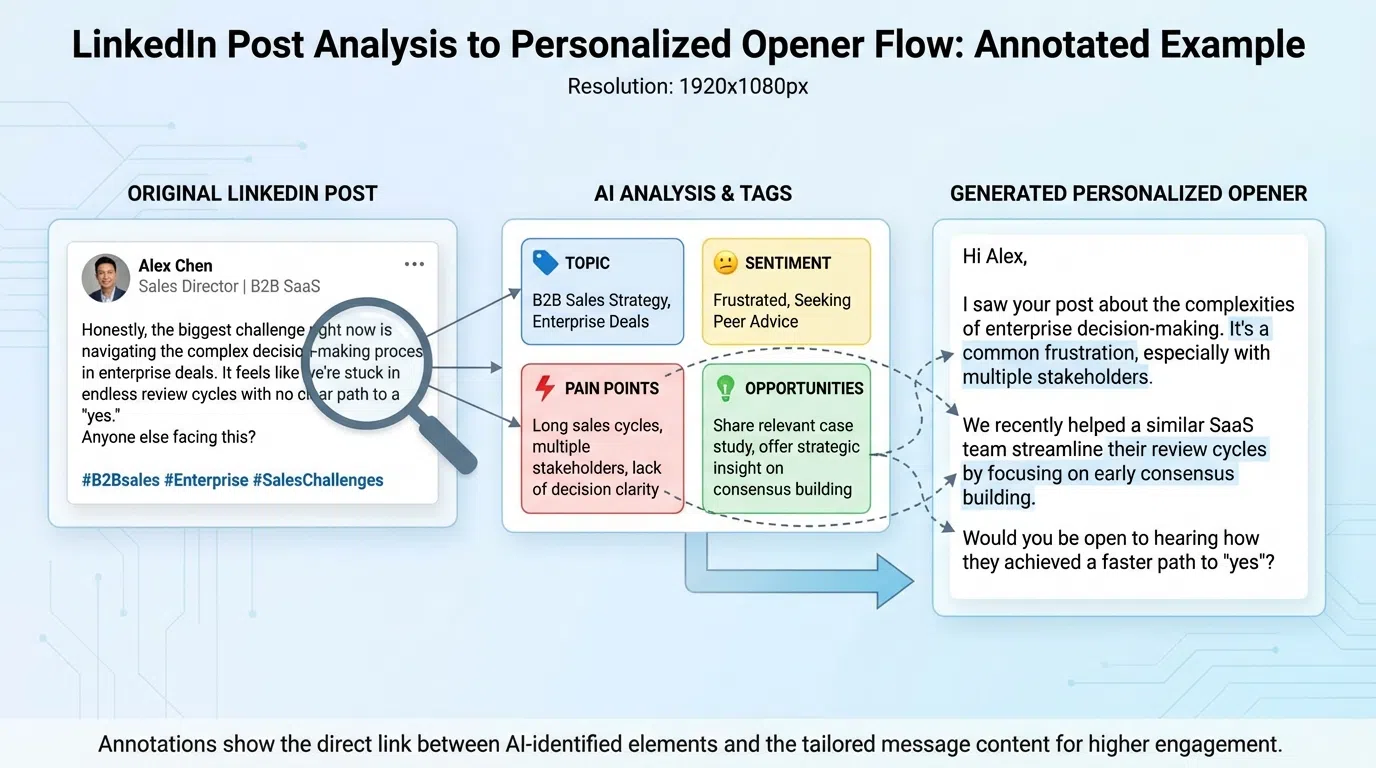
What to look for in posts:
- Pain points they're discussing
- Wins they're celebrating
- Questions they're asking their network
- Topics they're passionate about
- Industry trends they're following
Example transformation:
Basic: "I saw your recent post about sales..."
Advanced: "Your post about scaling from 10 to 50 SDRs while maintaining quality resonated—especially the challenge around personalization at scale. We've helped 3 VP Sales in similar hypergrowth phases..."
Content Engagement Patterns
What they engage with reveals what matters to them:
Analyze:
- Posts they comment on (shows active interests)
- Articles they share (indicates thought leadership areas)
- Topics they consistently engage with
- Voices they amplify
Personalization example:
"I noticed you've commented on several posts about AI in sales enablement—including Marcus Chan's piece on sales automation. That's actually why I'm reaching out..."
Published Articles and Long-Form Content
If they publish on LinkedIn, you have a goldmine:
Advanced tactics:
- Reference specific points from their article
- Add to their argument with data or examples
- Ask thoughtful questions about their perspective
- Share results from implementing their advice
Example message:
"Your article on outcome-based selling versus activity-based metrics challenged how I think about SDR performance. The data point about outcome-focused teams booking 34% more meetings made me rethink our approach..."
Group Participation Insights
Active group members care deeply about those topics:
What to note:
- Groups they're active in (not just joined)
- Questions they ask in groups
- Discussions they start
- Value they provide to other members
Tools like LeadSpark AI scrape LinkedIn posts and activity automatically, identifying personalization opportunities across hundreds of prospects in minutes rather than hours.
Layer 3: Contextual Business Triggers
The most powerful personalization layer combines personal insights with business context.
Company News and Announcements
Recent company news provides perfect personalization hooks:
Trigger types:
- Funding announcements
- New office openings
- Leadership appointments
- Product launches
- Awards and recognition
- Strategic partnerships
Example message:
"Congrats on the $30M Series B—noticed you're hiring 40 sales reps across 3 new regions. That type of rapid scaling while maintaining quality is exactly what LeadSpark AI was built for..."
Funding Rounds and Growth Signals
Post-funding is personalization gold for SDRs:
Why it matters:
- Clear indication of growth priorities
- Budget for new tools and solutions
- Hiring plans often public
- Strategic focus areas disclosed
Advanced approach:
"Series B companies typically scale outbound teams 3-4x in the first 12 months. With your announced plan to grow from 15 to 60 reps by Q4, personalization at scale becomes critical..."
Leadership Changes and Reorganizations
New leaders bring new priorities:
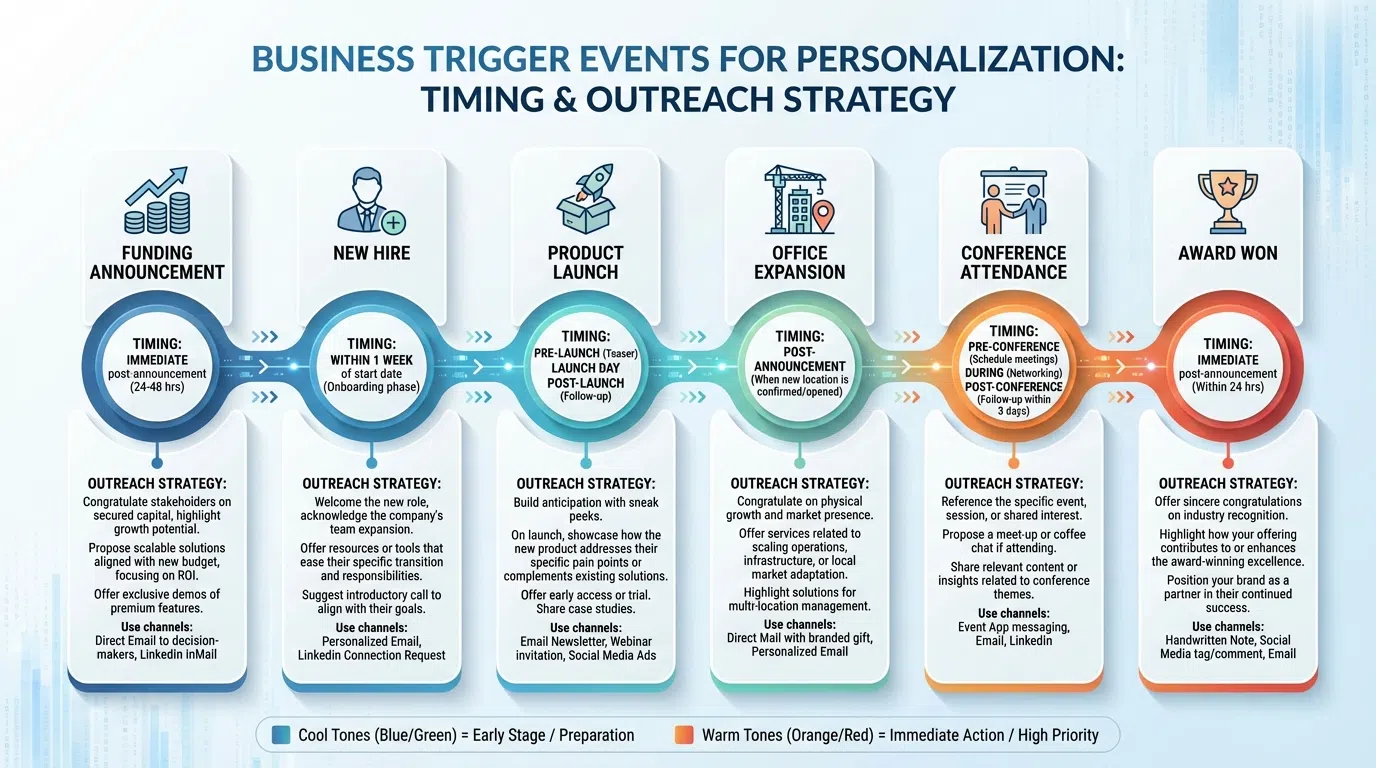
Best timing:
- Week 2-4 in new role (past onboarding, not yet overwhelmed)
- 90-day mark (establishing new initiatives)
- End of first quarter (evaluating what's working)
Example personalization:
"Saw you joined as VP Sales 6 weeks ago—that's typically when leaders start evaluating their tech stack and identifying gaps. Many new VPs we work with prioritize personalization and efficiency..."
Product Launches and Market Expansions
Product launches signal new outbound needs:
Personalization angles:
- New market segments to reach
- Different buyer personas to target
- Increased outreach volume needs
- Messaging and positioning challenges
Example:
"Launching into the enterprise segment changes everything about outbound—especially personalization. Moving from SMB to Enterprise requires deeper research, which is exactly where we've helped companies like..."
External links to LinkedIn best practices and sales industry research provide additional context for these strategies.
Advanced Personalization Techniques That Scale
The challenge: How do you personalize at scale? Here are techniques top SDRs use:
The Pattern Recognition Method
After personalizing 1,000+ messages, you'll notice patterns:
Common patterns by role:
- New VPs Sales (first 90 days): Focus on quick wins, building credibility, stack evaluation
- SDR Managers: Obsessed with efficiency, response rates, team productivity
- Startup Founders: Time-poor, results-focused, data-driven decision makers
- Enterprise AEs: Relationship-focused, long sales cycles, need personalization depth
How to scale it:
- Document patterns by persona
- Create personalization frameworks (not templates)
- Use AI to find signals matching those patterns
- Customize the specific example, not the structure
The Modular Personalization Approach
Build messages from personalized modules:
Module types:
- Opening hook (unique to each prospect)
- Shared challenge (pattern-based, customized)
- Proof point (selected from library based on relevance)
- Specific value proposition (tailored to their role/situation)
- Soft CTA (consistent)
Example breakdown:
`
[UNIQUE HOOK - from post/profile]
Your post about scaling SDR teams while maintaining quality hit home...
[PATTERN-BASED CHALLENGE]
Most VP Sales at Series B companies face the same dilemma: hire fast vs. maintain personalization standards.
[SELECTED PROOF POINT]
We helped Acme Corp scale from 20 to 85 SDRs while actually increasing response rates from 12% to 18%.
[TAILORED VALUE PROP]
For someone managing hypergrowth hiring, that's 300+ extra meetings monthly without sacrificing quality.
[SOFT CTA]
Worth a quick conversation?
`
The Research-Once-Use-Multiple Method
Deep research on a company can fuel multiple touchpoints:
Single research session yields:
- Connection request personalization
- First message angle
- Follow-up #1 reference point
- Follow-up #2 different angle
- Multi-threading personalization (reaching multiple people)
Example sequence from one research session:
- Connection: Reference recent company news
- Message 1: Comment on their LinkedIn post
- Follow-up 1: Share relevant case study based on their industry
- Follow-up 2: Reference different activity or achievement
- Multi-thread: Mention other person's perspective/post
For SDRs targeting 50-100+ prospects daily, AI-powered tools like LeadSpark AI make this scalable by automating the research phase while keeping personalization quality high.
AI-Powered Personalization Without Losing Authenticity
AI personalization is a tool, not a replacement for thinking. Here's how to use it right:
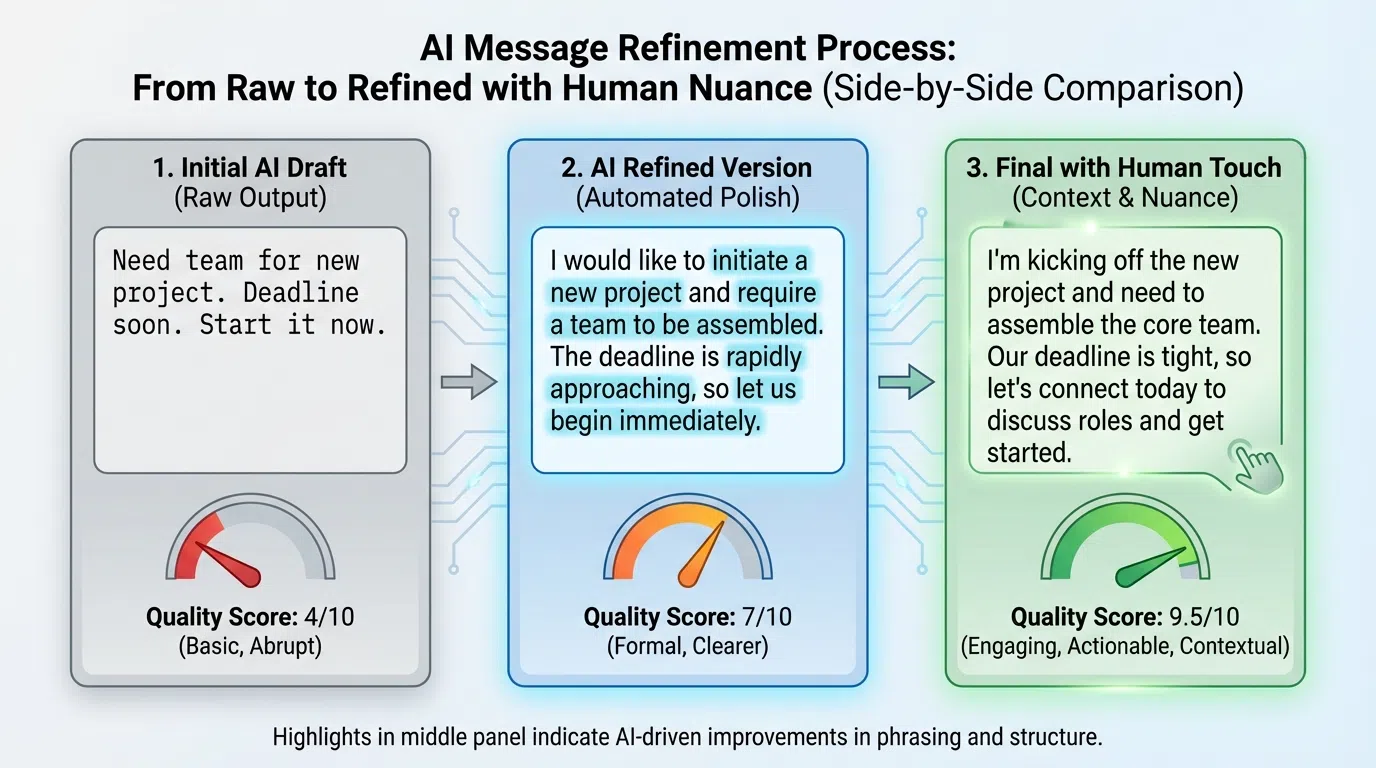
The AI + Human Hybrid Approach
What AI should do:
- Scrape LinkedIn posts and profile data
- Identify personalization signals
- Draft initial personalization angles
- Suggest relevant proof points
What humans should do:
- Review and refine AI suggestions
- Add authentic voice and tone
- Inject genuine curiosity
- Make final relevance judgment
Avoiding "AI Voice" in Personalized Messages
Prospects can spot AI-written messages. Warning signs:
Red flags of AI writing:
- Overly formal language
- Perfect grammar (ironically)
- Generic praise ("impressive background")
- Lack of specific opinions
- No questions or genuine curiosity
How to humanize AI drafts:
- Add contractions (you're, we've, it's)
- Include specific numbers and details
- Ask genuine questions
- Use conversational transitions
- Break grammar rules occasionally
- Add personal observations
AI draft:
"I noticed your recent post about sales productivity. This is an interesting topic that many sales professionals discuss."
Human refinement:
"Your point about activity metrics killing actual productivity—totally agree. We've seen SDRs hit 100 daily activities and still book zero meetings."
Using AI for Research, Humans for Messaging
The optimal division of labor in 2026:
AI handles:
- Profile data extraction
- Post content analysis
- Pattern identification
- Signal detection
- Initial draft generation
Humans handle:
- Final message composition
- Tone and authenticity
- Strategic angle selection
- Relationship building
- Follow-up strategy
LeadSpark AI follows this model: AI scrapes LinkedIn posts and generates personalization insights, but SDRs control the final message and strategy.
Response Rate Optimization: Advanced Tactics
Advanced personalization is only effective if it drives responses. Here's how to optimize:
Personalization Placement Strategy
Where you place personalization matters as much as what you say:
Optimal structure:
- First sentence: Specific, personalized hook (grabs attention)
- Second sentence: Connect their situation to broader pattern (builds credibility)
- Third sentence: Relevant proof point (establishes value)
- Fourth sentence: Tailored value proposition (shows specific benefit)
- Final sentence: Low-friction CTA (makes response easy)
Example:
`
Saw your comment on Marcus's post about AI replacing SDRs—your point about AI augmenting vs replacing was spot-on. [PERSONALIZED HOOK]
Most VP Sales we talk to share that view: AI for research, humans for relationship building. [PATTERN CONNECTION]
We helped Built.com scale their SDR team from 25 to 80 reps while maintaining 22% response rates using that exact philosophy. [PROOF POINT]
For someone managing rapid team growth, that's 450+ extra qualified meetings per quarter. [TAILORED VALUE]
Worth exploring how they did it? [SOFT CTA]
`
Testing Personalization Depth
Not all prospects need the same personalization depth:
Personalization tiers:
- Tier 1 (Deep personalization): Strategic accounts, executive targets, dream customers
- Tier 2 (Moderate personalization): Good-fit prospects, warm leads, second-tier targets
- Tier 3 (Light personalization): Volume plays, testing new segments, lower-priority outreach
Resource allocation:
- Tier 1: 5-10 minutes of research per prospect
- Tier 2: 1-2 minutes of research per prospect
- Tier 3: AI-powered personalization at scale
Multi-Variant Personalization Testing
Test different personalization approaches:
Variables to test:
- Personal vs. business trigger focus
- Post reference vs. profile insight
- Recent activity vs. career background
- Achievement recognition vs. challenge identification
- Question-based vs. statement-based hooks
Track by segment:
- Industry response to different approaches
- Seniority level preferences
- Company size variations
- Geographic differences
According to 2026 LinkedIn data, personalized InMails perform about 15% better than bulk messages, but testing reveals which type of personalization resonates most with your ICP.
Common Advanced Personalization Mistakes
Even experienced SDRs make these personalization errors:
Over-Personalization (Yes, It's Possible)
Too much personalization feels creepy:
Warning signs:
- Referencing information from beyond LinkedIn (Facebook, Twitter stalking)
- Mentioning family or personal details
- Going too deep into old posts (2+ years)
- Knowing too much about non-public information
Rule of thumb: If it's publicly posted on their LinkedIn, it's fair game. If you had to dig elsewhere, skip it.
Fake Personalization
Prospects spot fake personalization instantly:
Examples of fake personalization:
- "I loved your recent post" when they haven't posted in months
- "We have a lot in common" with no specifics
- "I've been following your work" with no evidence
- Generic compliments that could apply to anyone
The test: Could this message be sent to 100 other people with minimal changes? If yes, it's not really personalized.
Personalization Without Relevance
Personalization must connect to your value proposition:
Bad example:
"I see you went to Michigan—go Wolverines! Anyway, we have a sales tool..."
Good example:
"Saw you went to Michigan's Ross School. Their sales methodology courses probably influence how you think about SDR training, which is actually relevant here..."
The personalization should naturally lead to why you're reaching out.
Overwhelming with Research
Don't show all your research in one message:
Too much:
"I saw your post about X, noticed you previously worked at Y, saw you commented on Z's article, and read that your company just announced..."
Right amount:
"Your post about scaling SDR teams while maintaining personalization quality resonated..."
Save research insights for follow-ups and continued conversation.
Ignoring Message Length
Personalization can't save a 500-word message. Research shows keeping messages under 400 characters boosts response rates by 22%.
Personalization discipline:
- One specific personalization point
- One relevant insight or proof point
- One clear call-to-action
- Total: 300-400 characters maximum
Check out our guide on LinkedIn message length optimization for detailed best practices.
Measuring Personalization Effectiveness
Track these metrics to optimize your personalization approach:
Response Rate by Personalization Type
Break down response rates by personalization source:
Track separately:
- Post-based personalization: __%
- Profile-based personalization: __%
- Company trigger-based personalization: __%
- Mutual connection-based personalization: __%
- Multi-layer personalization: __%
This reveals which personalization types resonate with your ICP.
Time Investment vs. Response Rate ROI
Measure whether deeper personalization justifies the time:
Calculate:
- Average research time per prospect: __ minutes
- Response rate at that personalization level: __%
- Meetings booked per 100 messages: __
- Time to book one meeting: __ minutes
- Compare across personalization tiers
Personalization Scalability Metrics
Track how personalization quality scales with volume:
Monitor:
- Daily prospect volume
- Average personalization depth score (1-10)
- Response rate trend
- Quality score (subjective 1-10 rating)
- Time per personalized message
Goal: Maintain response rates while increasing volume through AI assistance and pattern recognition.
A/B Test Results Dashboard
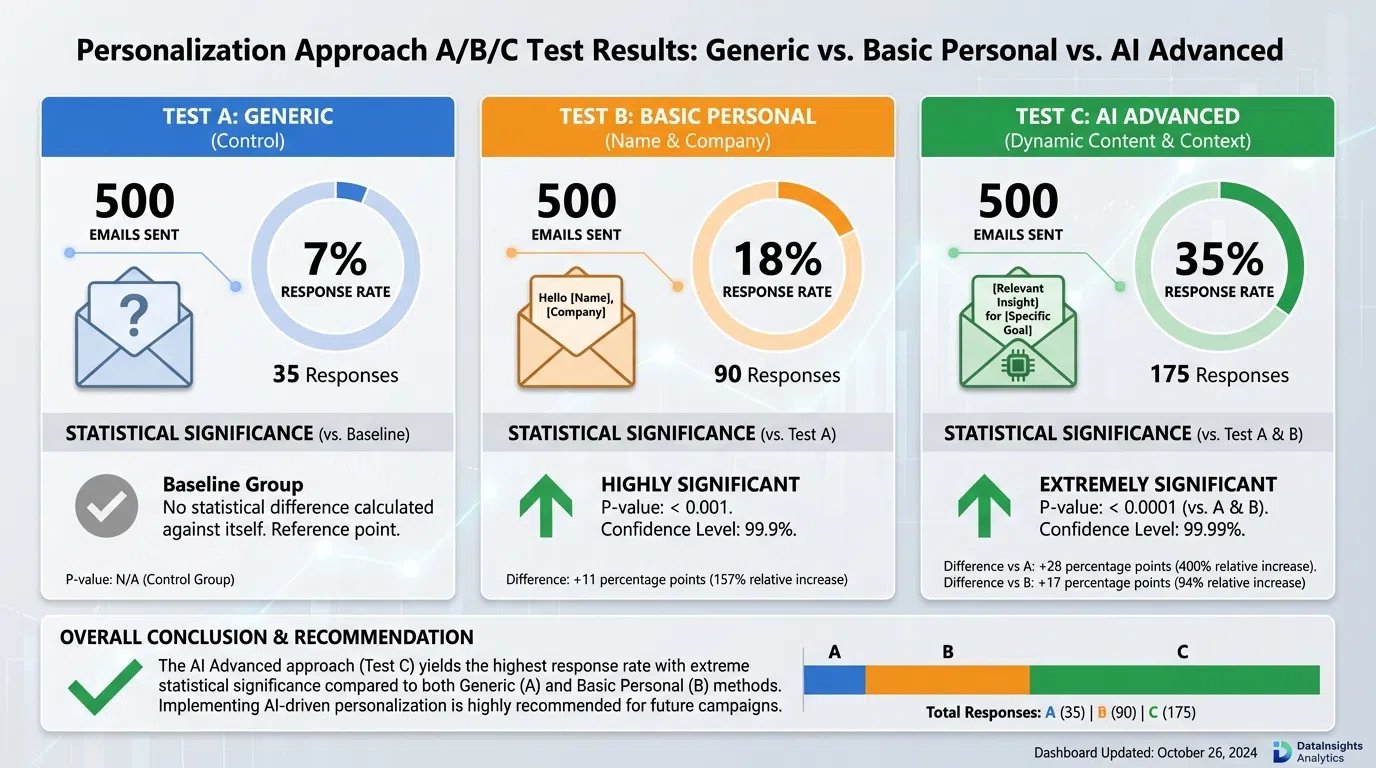
Track ongoing tests:
- Approach A vs. Approach B response rates
- Statistical significance
- Segment-specific performance
- Iteration improvements
Top SDRs run continuous personalization experiments, improving response rates 2-3% quarterly through systematic testing.
For detailed personalization tracking and analytics, tools like LeadSpark AI provide built-in response rate monitoring and personalization effectiveness scoring.
Frequently Asked Questions
How much personalization is enough for LinkedIn messages?
At minimum, include one specific reference to their LinkedIn activity (post, comment, shared content) or profile (career move, achievement, skill). High-value targets deserve 2-3 personalization layers combining activity, profile intelligence, and business context. The key is relevance over volume—one highly relevant personalization point beats three generic ones.
Can AI personalization match human-quality personalization?
AI personalization in 2026 can match human quality for research and insight extraction, but human refinement is still essential for authenticity and tone. The optimal approach uses AI to scrape LinkedIn posts and identify personalization angles (saving 5-10 minutes per prospect), then humans refine the message and add genuine voice. LeadSpark AI users report response rates matching or exceeding manual personalization while processing 10x more prospects.
What's the ROI of advanced personalization for SDRs?
Advanced personalization increases response rates from 10-15% (basic personalization) to 25-35% (advanced multi-layer personalization) based on 2026 LinkedIn data. For an SDR sending 50 messages daily, that's 5-7 extra responses per day or 100-150 additional conversations monthly. With 20-30% of conversations booking meetings, that's 20-45 extra meetings monthly from the same outreach volume.
How do you scale personalization beyond 50 prospects per day?
Scaling personalization requires three elements: pattern recognition (documenting common personalization angles by persona), AI research assistance (automating LinkedIn profile and post scraping), and modular messaging (building personalized messages from customizable components). Use deep personalization (5-10 minutes) for top-tier targets, moderate personalization (1-2 minutes) for good-fit prospects, and AI-powered personalization for volume plays. This tiered approach lets SDRs personalize 100-200+ messages daily while maintaining quality.
Should personalization reference old LinkedIn posts or only recent activity?
Focus on activity from the past 30-60 days maximum. Recent posts and engagement show current priorities and interests, making personalization more relevant. Referencing posts from 6+ months ago can feel like stalking rather than research. If they haven't posted recently, look for recent comments, likes, or shared content. If they're inactive on LinkedIn, shift to profile-based personalization (recent role changes, new certifications, company news).
Ready to Scale Advanced Personalization?
Advanced LinkedIn personalization doesn't have to mean spending 10 minutes researching every prospect. LeadSpark AI automatically scrapes LinkedIn posts, extracts personalization insights, and generates hyper-personalized icebreakers in seconds.
What makes LeadSpark AI different:
- Analyzes prospects' actual LinkedIn posts and activity
- Identifies multi-layer personalization opportunities automatically
- Generates under-25-word icebreakers that feel authentic
- Processes 100+ prospects in the time it takes to manually research 5
- Maintains 25-35% response rates at scale
Sales teams using LeadSpark AI report booking 40-60% more meetings from the same outreach volume by combining AI research speed with human message refinement.
Start with 15 free credits and see how advanced personalization scales.
Related Posts
Ready to Generate Personalized Icebreakers?
Join sales professionals using LeadSpark AI to create hyper-personalized LinkedIn icebreakers in minutes.