Linkedin Prospecting
LinkedIn Lead Generation: Complete Strategy for B2B Sales [2026]
Master LinkedIn lead generation with proven strategies that drive results. Learn organic vs paid tactics, best practices, and tools to generate quality B2B leads.
12 min read
LinkedIn isn't just another social platform—it's the undisputed king of B2B lead generation. With 80% of B2B social media leads coming from LinkedIn, ignoring this channel means leaving serious pipeline on the table.
But here's the challenge: most sales professionals treat LinkedIn like a numbers game, blasting generic connection requests and wondering why response rates hover around 2-5%. The reality? LinkedIn's visitor-to-lead conversion rate is 2.74%—3-4× higher than Facebook or X—but only when you implement a strategic approach.
This guide breaks down the complete LinkedIn lead generation strategy for 2026, from organic relationship-building to strategic paid campaigns, with benchmarks and tactics that actually work.
Table of Contents
- What is LinkedIn Lead Generation?
- Why LinkedIn for B2B Lead Generation
- Organic vs Paid LinkedIn Lead Generation
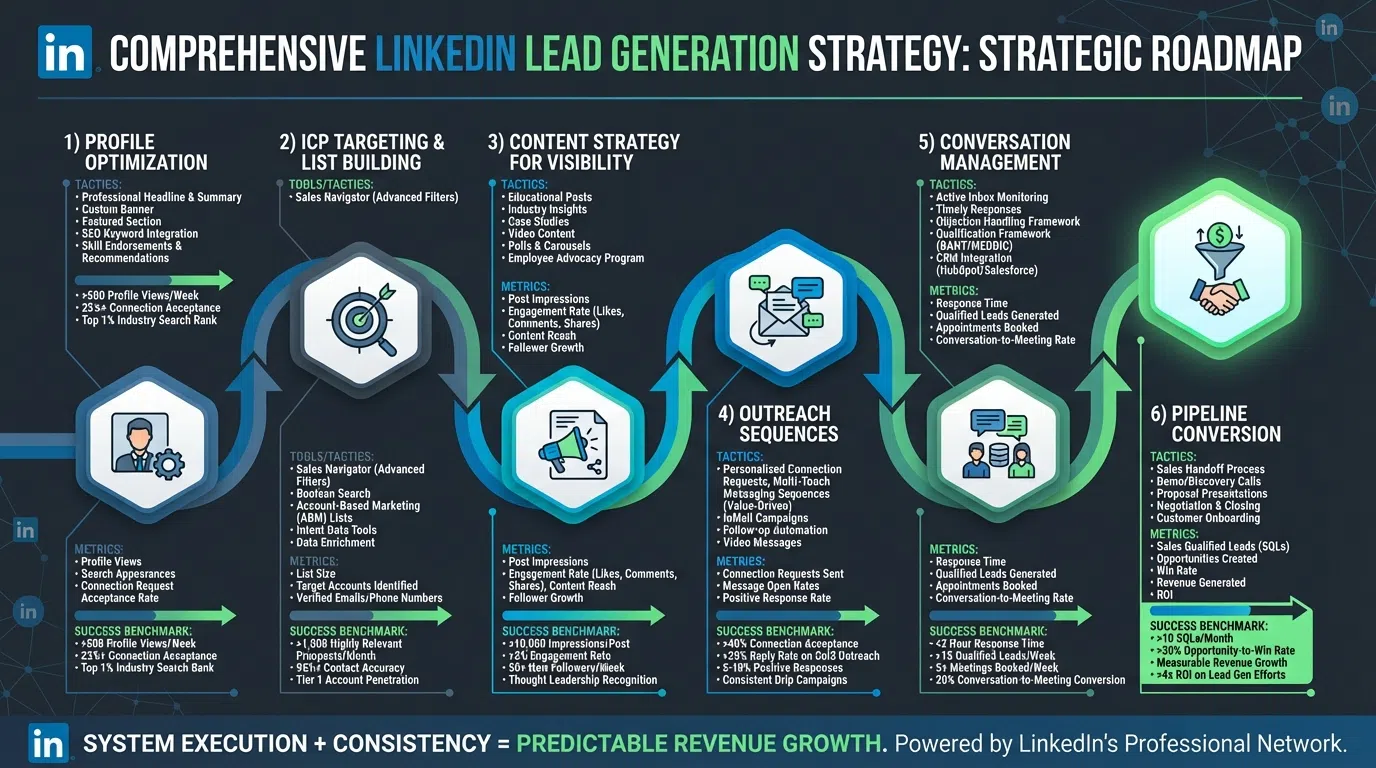
- The 7-Step LinkedIn Lead Generation Framework
- LinkedIn Lead Generation Best Practices
- Tools and Tech Stack for LinkedIn Lead Gen
- Metrics to Track and Optimize
- Common Mistakes to Avoid
- Frequently Asked Questions
What is LinkedIn Lead Generation?
LinkedIn lead generation is the process of identifying, engaging, and converting potential customers through LinkedIn's professional network. Unlike traditional cold outreach, LinkedIn lead gen leverages shared connections, professional context, and rich profile data to build genuine business relationships.
Effective LinkedIn lead generation combines three core elements: strategic profile optimization that positions you as a trusted resource, targeted prospecting that identifies ideal customers using advanced filters, and personalized outreach that demonstrates genuine research and relevant value.
The platform's professional context makes it uniquely powerful—prospects expect business conversations on LinkedIn, eliminating the "cold" feeling that plagues email or phone outreach.
Why LinkedIn for B2B Lead Generation
The numbers tell a compelling story about LinkedIn's dominance in B2B lead generation:
Platform Reach and Engagement:
- 89% of B2B marketers use LinkedIn for lead generation
- 65 million decision-makers active on the platform
- 4 out of 5 LinkedIn members drive business decisions at their companies
Conversion Performance:
- LinkedIn is 277% more effective at lead generation than Facebook and Twitter
- Lead Gen Forms achieve 13% conversion rates—5× the industry average
- B2B ads convert at 2.5-3.5%, significantly higher than other platforms
Quality Over Quantity:
LinkedIn leads close at higher rates because they're based on professional intent and context. When someone responds to your LinkedIn message, they're doing so in a business mindset, not while scrolling vacation photos.
Social Selling Impact:
Sales reps with high Social Selling Index (SSI) scores generate 45% more opportunities and are 51% more likely to hit quota. The platform rewards relationship-building over aggressive selling.
The professional context eliminates the spam filter problem that plagues email—on LinkedIn, prospects expect business conversations and judge outreach by its relevance, not its mere existence.
Organic vs Paid LinkedIn Lead Generation
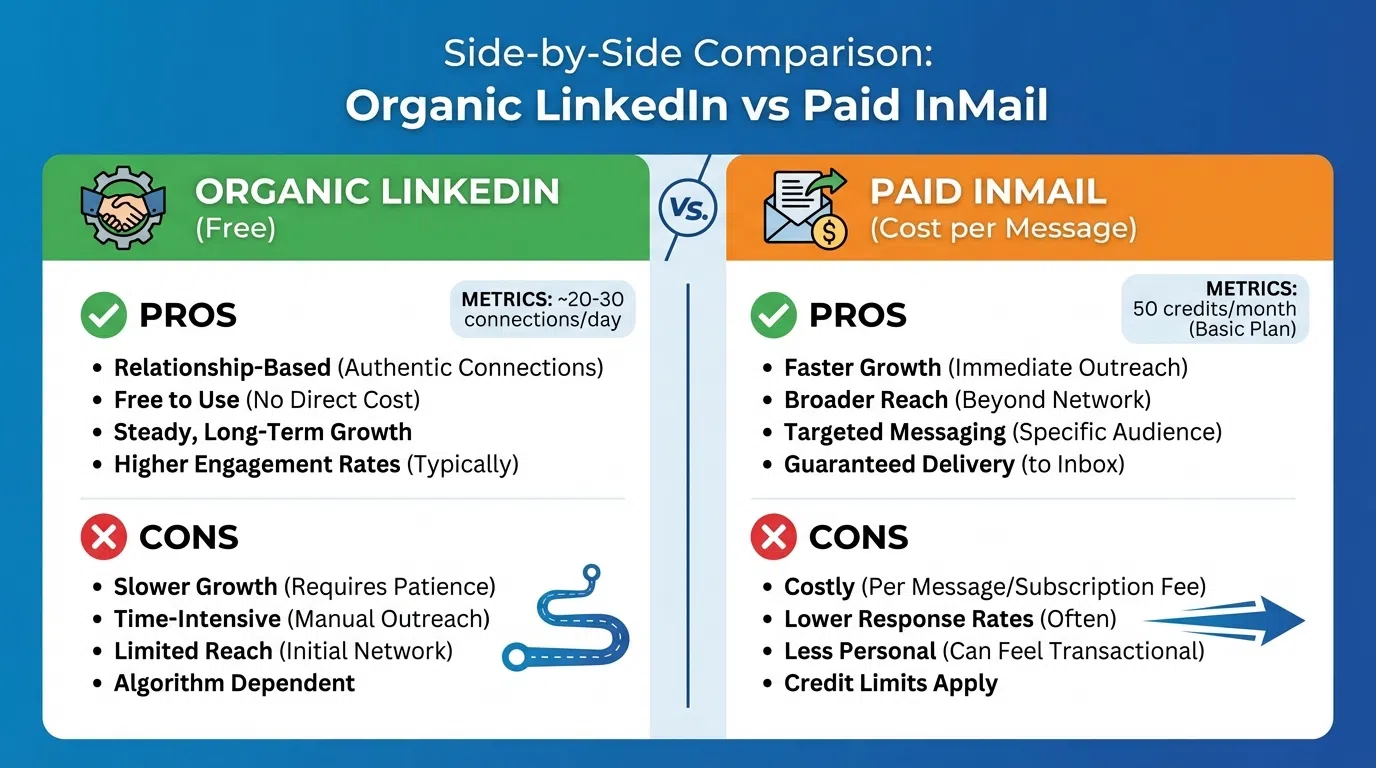
The organic vs paid debate isn't about choosing one over the other—it's about understanding when each approach delivers maximum ROI.
Organic LinkedIn Lead Generation
How It Works:
Organic lead generation builds relationships through consistent content creation, strategic engagement, and personalized outreach. You're leveraging the free features of LinkedIn—posts, comments, connection requests, and messages.
Cost and Timeline:
- Average cost per lead: $164
- Timeline to results: 3-6 months of consistent activity
- Ongoing time investment: 60-90 minutes daily
Strengths:
- Organic posts get 2-6% engagement vs 0.4-0.6% for ads
- Builds long-term brand authority and trust
- Compounds over time as your network grows
- LinkedIn's algorithm prioritizes personal posts (39% of feed) over company pages (1-2%)
Weaknesses:
- Requires consistent effort and patience
- Results depend on content quality and engagement discipline
- Difficult to scale without team involvement
Best For: Long-term relationship building, establishing thought leadership, companies with complex sales cycles (6+ months), bootstrapped startups with more time than budget.
Paid LinkedIn Lead Generation
How It Works:
Paid campaigns use LinkedIn's advertising platform to target specific job titles, companies, and industries with sponsored content, InMail, or Lead Gen Forms that capture contact information.
Cost and Timeline:
- Average cost per lead: $310 for B2B SaaS
- Average CPC: $6-7 globally, $8-10 in the US
- Timeline to results: Immediate (same-day lead flow possible)
Strengths:
- Immediate results—turn the faucet on and leads flow
- Precise targeting by company size, industry, seniority, skills
- Scalable (increase budget = increase leads)
- Lead Gen Forms achieve 10-15% submit rates by eliminating landing page friction
Weaknesses:
- Higher cost per lead than organic ($310 vs $164)
- Stops completely when budget runs out
- Requires ongoing optimization to maintain performance
- Ad fatigue sets in after 30-60 days without creative refreshes
Best For: Product launches, event promotion, time-sensitive campaigns, companies with proven offer-market fit, scaling proven organic strategies.
The Hybrid Approach (Recommended)
A hybrid strategy combines the credibility of organic content with the precision of paid distribution, creating results far greater than either can achieve alone.
How Successful Companies Blend Both:
- Content Creation (Organic): Publish valuable content 2-3× per week to establish expertise
- Engagement Building (Organic): Comment on prospect and industry leader posts to increase visibility
- Targeted Amplification (Paid): Boost top-performing organic posts to reach specific ICPs
- Warm Outreach (Organic): Connect with engaged prospects who liked/commented on content
- Retargeting (Paid): Run ads to people who engaged with organic content but haven't converted
This approach typically delivers 40-60% lower cost per SQL than pure paid strategies while maintaining the relationship foundation that organic builds.
The 7-Step LinkedIn Lead Generation Framework
Step 1: Optimize Your Profile for Lead Generation
Your profile is your storefront—prospects judge credibility in 3-5 seconds. Profile optimization directly supports social selling success because the higher your SSI, the more visibility and trust you gain.
Critical Elements:
- Professional Photo: Clear headshot with good lighting (profiles with photos get 21× more views)
- Headline (220 chars): Target audience + outcome, NOT just job title
- ❌ "Sales Manager at TechCo"
- ✅ "Helping B2B SaaS Companies Generate 50+ Qualified Leads/Month | LinkedIn Lead Gen Specialist"
- About Section: Address prospect pain points in first 3 lines (mobile preview), include social proof and clear CTA
- Featured Section: Case studies, lead magnets, testimonials, demo videos
- Experience: Quantify results with specific metrics
- Recommendations: Minimum 5 from relevant roles (boosts acceptance rates 25-35%)
- Recent Activity: Post/comment within last 7 days (proves you're active)
Pro Tip: Add "Open to connecting with [your ICP]" in your headline to signal availability and increase acceptance rates.
Step 2: Define Your Ideal Customer Profile (ICP)
Spray-and-pray LinkedIn outreach wastes time and damages your sender reputation. Laser-focused ICPs deliver 3-5× better conversion rates.
ICP Framework:
Firmographic Criteria:
- Company size (employees/revenue)
- Industry and sub-industry
- Geography (where they operate)
- Funding stage (for startups)
- Tech stack (tools they use)
Buyer Persona Criteria:
- Job titles and functions
- Seniority level (IC, Manager, Director, VP, C-Level)
- Department responsibilities
- Pain points and goals
- Content they engage with
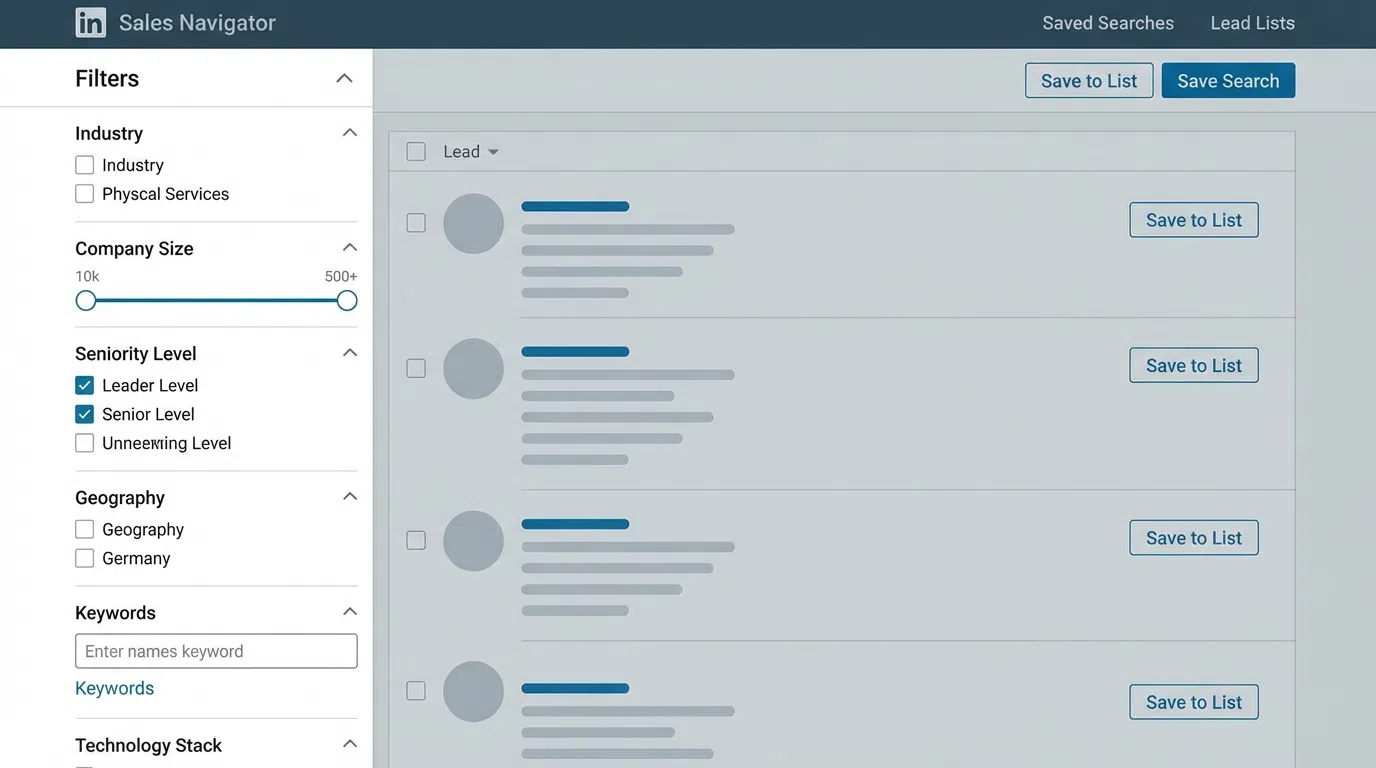
Use LinkedIn Sales Navigator to build Boolean searches that identify your ICP with precision. Save these searches to get weekly alerts when new prospects match your criteria.
Step 3: Build High-Quality Target Lists
Quality beats quantity every time. A list of 100 perfectly-matched prospects outperforms 1,000 loosely-related contacts.
List Building Process:
- Sales Navigator Search: Use 5-10 filters to narrow your audience
- Engagement Signals: Prioritize prospects who:
- Posted in last 7-14 days (active users respond more)
- Changed jobs in last 90 days (open to new solutions)
- Recently announced funding/hiring (growth mode)
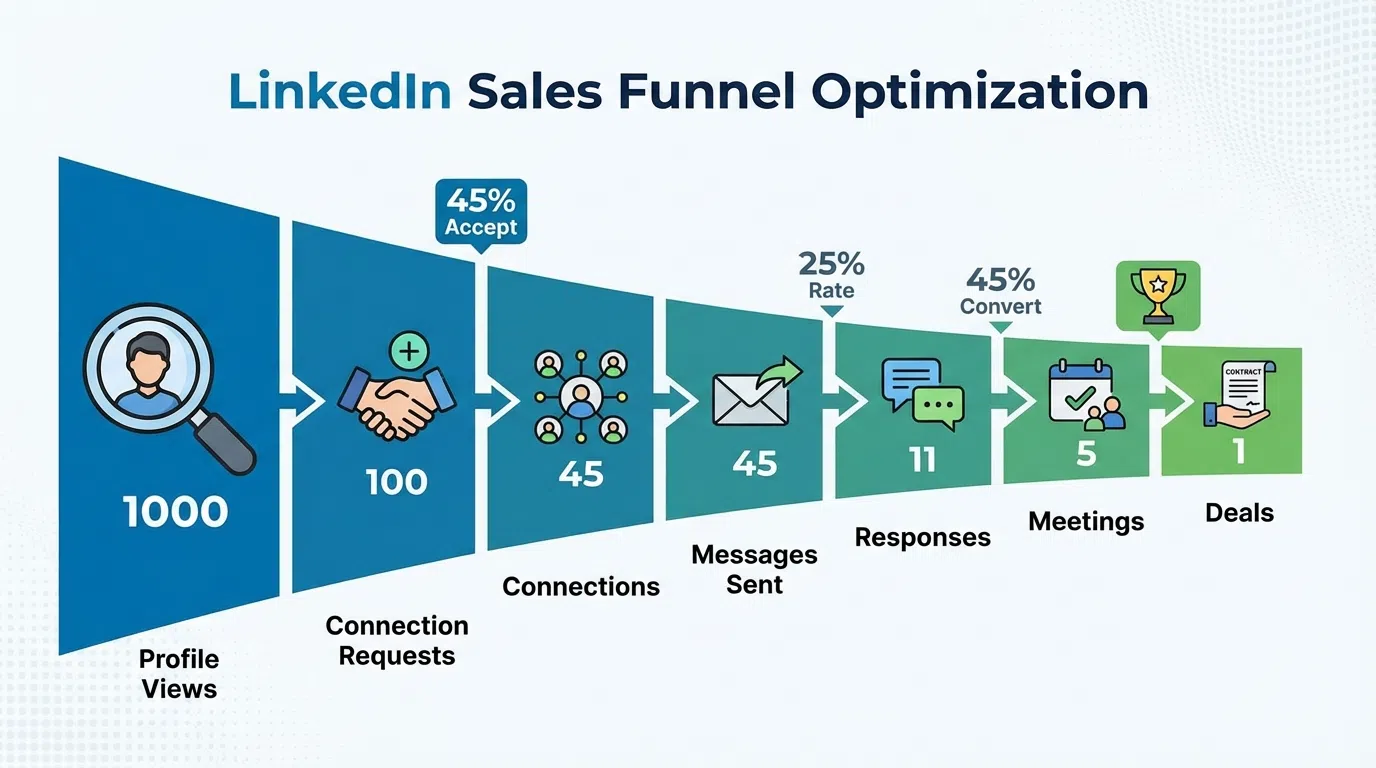
- Connection Degree: Focus on 2nd-degree connections (45% acceptance) over 3rd-degree (20%)
- Company Signals: Target companies showing buying intent (hiring for relevant roles, expanding to new markets, announced initiatives)
- Export and Enrich: Export to CSV, enrich with email/phone using tools like Apollo or ZoomInfo
Segmentation Strategy:
Break lists into tiers based on value:
- Tier 1 (Dream Accounts): 20-30 prospects, high-touch personalization
- Tier 2 (High-Fit): 100-200 prospects, AI-assisted personalization
- Tier 3 (Volume): 500+ prospects, template-based with dynamic tokens
Step 4: Research and Personalize Outreach
Generic messages get 2-5% response rates. Personalized approaches achieve 30-40% or higher with AI-powered tools reaching 70-90%.
Research Checklist (2-3 minutes per prospect):
- Profile Scan: Recent job changes, education, shared connections
- Activity Review: Read last 3-5 posts/comments for interests and pain points
- Company Research: Recent news, funding, hiring, product launches
- Trigger Events: Job changes, company milestones, content they engaged with
Personalization at Scale:
Manual research takes 8-14 minutes per prospect—impossible at scale. AI-powered tools like LeadSpark AI analyze LinkedIn profiles and recent posts in 5-10 seconds, generating hyper-personalized icebreakers that reference specific content and company context.
This enables you to maintain 70-90% response rate quality while processing 500+ prospects per week—a 10-20× productivity increase over manual research.
Step 5: Craft Compelling Outreach Messages
Your message framework determines response rates. Follow this proven structure:
Connection Request (300 characters max):
`
[Specific observation] + [Relevant connection] + [Low-friction ask]
Example: "Saw your post on scaling SDR teams past 10 reps—super relevant given your Series B. I've helped 3 SaaS companies solve the onboarding bottleneck. Worth connecting?"
`
First Message After Connecting:
`
[Genuine thank you] + [Value-first approach] + [Soft CTA]
Example: "Thanks for connecting, Sarah! Loved your take on multi-threading enterprise deals. I published a guide on LinkedIn personalization at scale that might be relevant given your team's growth. Mind if I send it over?"
`
Follow-Up Message (5-7 days later):
`
[Reference previous message] + [New angle/value] + [Specific ask]
Example: "Circling back on the LinkedIn personalization guide—noticed you just posted about SDR productivity challenges. That's exactly what the guide addresses. If you're open to it, I can share how we helped TechCo increase response rates from 8% to 28%. 15-minute call this week?"
`
Key Principles:
- Keep under 400 characters (+22% response vs longer)
- Reference something specific (post, company news, shared connection)
- Lead with value, not features
- Ask one clear question
- Avoid pitch-slapping in first message
For templates and examples, see our LinkedIn Prospecting Messages Guide.
Step 6: Execute Multi-Touch Sequences
80% of sales require 5+ follow-ups, yet 44% of reps quit after one attempt. Systematic follow-up separates top performers from the pack.
14-Day LinkedIn Sequence:
- Day 1: Send personalized connection request
- Day 3-4: Connection accepted → send value-first message
- Day 7: Follow-up with different angle (case study, resource)
- Day 10: Share relevant content/insight
- Day 14: Breakup message ("Should I close your file?")
Multi-Channel Integration:
LinkedIn works best when combined with email and phone:
- Day 1: LinkedIn connection
- Day 2: Email to same prospect (mention LinkedIn request)
- Day 4: LinkedIn message after connection
- Day 7: Follow-up email
- Day 10: Phone call + voicemail
- Day 14: LinkedIn breakup message
Multi-channel sequences deliver 287% higher purchase rates than single-channel approaches.
Step 7: Track, Analyze, and Optimize
What gets measured gets improved. Track these metrics weekly:
Activity Metrics:
- Connection requests sent
- Acceptance rate (target: 40-60%)
- Messages sent
- Profile views generated
Outcome Metrics:
- Response rate (target: 15-30% for personalized)
- Meeting booking rate (target: 30-50% of responses)
- Show-up rate (target: 70%+)
- SQL conversion (target: 40-60% of meetings)
Optimization Cycle:
- Daily: Review responses, reply within 3 hours
- Weekly: Analyze what messages/angles worked best
- Bi-weekly: A/B test new message frameworks
- Monthly: Refresh ICP based on highest-converting personas
For comprehensive metrics guidance, see LinkedIn Prospecting Metrics: What SDRs Should Track.
LinkedIn Lead Generation Best Practices
1. Focus on Quality Over Quantity
The average B2B conversion rate is 2.6%. Targeting the wrong audience drops this to 0.5-1%. Tight ICP targeting can push it to 5-10%.
Quality Indicators:
- Specific job titles vs broad functions
- Company size matches your sweet spot
- Recent activity on LinkedIn (last 30 days)
- Shared connections or groups
- Engagement with industry content
What This Looks Like:
- 50 perfectly-matched prospects with 40% response > 500 loosely-matched with 5% response
- Both scenarios generate ~20 responses, but the quality differs dramatically
- Perfectly-matched prospects convert to meetings at 50% vs 20% for loose matches
2. Leverage Content for Inbound Lead Flow
LinkedIn's algorithm prioritizes personal posts (39% of feed) over company pages (1-2%). Publishing valuable content attracts prospects to you.
Content Strategy:
- Post 2-3× per week on topics your ICP cares about
- Share original insights, not generic advice
- Use storytelling and specific examples
- Engage with your own post in first 60-90 minutes (3× reach)
- Repurpose customer wins, product insights, industry trends
Content Formats by Engagement:
- Multi-image carousels: 6.60% engagement
- Native documents: 5.85%
- Video: 5.60%
- Text posts: 4-5%
Lead Capture:
Mention resources in posts ("I created a guide on X, comment 'GUIDE' for the link") to identify interested prospects for warm outreach.
3. Engage Before You Pitch
Comment on prospect posts 3-5 days before sending connection requests. This warm-up increases acceptance rates by 27-35%.
Engagement Framework:
- Find prospect's recent post
- Read thoroughly and add thoughtful comment (not just "Great post!")
- Reference specific point they made
- Add complementary insight or question
- Wait 24-48 hours
- View their profile
- Send personalized connection request referencing the post
This approach signals genuine interest vs transactional outreach.
4. Implement a Full-Funnel Strategy
Break campaigns into three stages: Top of Funnel (TOFU), Middle of Funnel (MOFU), and Bottom of Funnel (BOFU).
TOFU (Awareness):
- Goal: Build brand awareness and thought leadership
- Tactics: Educational content, industry insights, trend reports
- Ungated resources to maximize reach
- Target: Broad ICP audience
MOFU (Consideration):
- Goal: Generate qualified leads
- Tactics: Case studies, comparison guides, webinars, calculators
- Lead magnets that demonstrate expertise
- Target: Engaged audience from TOFU
BOFU (Decision):
- Goal: Convert to meetings and pipeline
- Tactics: Demos, free trials, ROI calculators, consultations
- Direct response offers
- Target: Warm leads from MOFU
Why This Matters:
Jumping straight to BOFU (demo requests) from cold traffic wastes budget. Prospects need awareness and consideration before they're ready to buy.
5. Use LinkedIn Lead Gen Forms for Lower Costs
LinkedIn Lead Gen Forms achieve 13% conversion rates—5× the industry average—by pre-filling prospect information and eliminating landing page friction.
Benefits:
- Mobile-optimized (70% of LinkedIn traffic is mobile)
- Pre-filled with LinkedIn profile data
- No page load time or form friction
- Lower cost per lead than sending to external landing pages
- Better data quality (verified LinkedIn information)
Best Practices:
- Keep forms to 3-4 fields maximum
- Offer high-value gated content (guides, templates, tools)
- Set up auto-response thank you message
- Sync directly to CRM for instant follow-up
- Follow up within 5 minutes (100% increase in conversion vs 30+ min delay)
For more on lead generation strategies across channels, see B2B Lead Generation Strategies That Work.
Tools and Tech Stack for LinkedIn Lead Gen
Core Tools
1. LinkedIn Sales Navigator ($99-149/month)
- Advanced search with 40+ filters
- Lead and account saving
- InMail credits (50/month)
- CRM integration
- Real-time sales updates
Who Needs It: Anyone doing serious LinkedIn prospecting. The ROI justifies itself after 5-10 closed deals.
See our detailed comparison: LinkedIn Sales Navigator vs Regular LinkedIn.
2. LeadSpark AI ($97-297/month)
- AI-powered profile and post analysis in 5-10 seconds
- Generates hyper-personalized icebreakers under 25 words
- Bulk processing: 100-500 prospects per session
- 70-90% LinkedIn response rates
- Team plans for agencies and sales teams
Who Needs It: SDRs, BDRs, founders, and agencies who need to personalize at scale without sacrificing quality. Learn more about LeadSpark AI.
3. CRM (HubSpot, Salesforce, Pipedrive)
- Track all LinkedIn interactions
- Automate follow-up reminders
- Measure LinkedIn-sourced pipeline
- Sync with Sales Navigator
Who Needs It: Everyone. You can't optimize what you don't measure.
Supporting Tools
4. Apollo.io / ZoomInfo / Cognism
- Email and phone enrichment for LinkedIn contacts
- Company intelligence and technographics
- Multi-channel contact data
5. Waalaxy / Expandi (Use Carefully)
- LinkedIn automation for connection requests and messages
- Warning: Violates LinkedIn ToS if detected, risk of account restriction
- Use conservatively (20-30 requests/day max) with heavy personalization
For safer alternatives, see our guide: LinkedIn Automation vs Personalization.
6. Phantombuster
- Extract LinkedIn data at scale
- Export search results, group members, post engagers
- API for workflow automation
Tech Stack by Company Stage:
Startup ($200-400/month):
- Sales Navigator Basic ($99)
- LeadSpark AI Starter ($97)
- HubSpot Free CRM
- = 500-1K prospects/month, 1-2 SDRs
Growth ($600-1.5K/month):
- Sales Navigator Team ($447 for 3 users)
- LeadSpark AI Team ($147 for 3 members)
- Apollo Pro ($99) or ZoomInfo
- HubSpot Pro ($800)
- = 2K-5K prospects/month, 3-10 SDRs
Enterprise ($3K-10K+/month):
- Sales Navigator Enterprise (10+ users, $1,490+)
- LeadSpark AI Agency ($297 for 10+ members)
- ZoomInfo Enterprise ($2K-5K/mo)
- Salesforce + Outreach/Salesloft
- = 10K-50K prospects/month, 10-50+ SDRs
For complete tech stack guidance, see Building an SDR Tech Stack in 2026.
Metrics to Track and Optimize
Leading Indicators (Activity)
These metrics predict future pipeline:
- Connection Requests Sent: 20-30/day sustainable
- Acceptance Rate: Target 40-60% (lower = poor targeting or weak requests)
- Messages Sent: 30-50/day for active prospectors
- Content Engagement: Likes, comments, shares on your posts
- Profile Views Generated: Indicator of visibility and interest
Lagging Indicators (Outcomes)
These metrics show actual business impact:
- Response Rate: 15-30% for personalized outreach (benchmarks)
- Meeting Booking Rate: 30-50% of responses should book meetings
- Show-Up Rate: 70%+ (lower indicates poor qualification)
- SQL Conversion: 40-60% of completed meetings
- LinkedIn-Sourced Pipeline: Track revenue attributed to LinkedIn
- Cost Per SQL: Focus on this, not just CPL
Benchmarks by Strategy
Organic LinkedIn:
- Response rate: 15-25% with personalization
- Time to first meeting: 14-21 days average
- Cost per lead: ~$164
- Monthly meetings per SDR: 15-25
Paid LinkedIn:
- CTR: Target 0.5%+
- Conversion rate: 2.5-3.5% (10-15% for Lead Gen Forms)
- Cost per lead: $200-400 average
- Cost per SQL: Track your own baseline
Hybrid Approach:
- Response rate: 25-40% (warm + paid amplification)
- Cost per lead: $120-250 (40-60% lower than pure paid)
- Monthly meetings per SDR: 25-40
Track everything in your CRM with "Source: LinkedIn" tagging to prove ROI. Most LinkedIn lead gen fails not from poor tactics but from poor measurement.
Common Mistakes to Avoid
1. Pitch Slapping Immediately After Connecting
Sending a sales pitch within minutes of connection acceptance is the fastest way to get ignored or blocked. This is the most hated LinkedIn behavior.
Why It Fails:
- Feels transactional, not relationship-driven
- No trust established
- Prospect hasn't experienced any value from you
Fix:
Wait 24-48 hours after connection, then lead with value (share resource, offer insight, ask thoughtful question). Sales conversations happen after 2-3 value exchanges.
2. Using Generic Templates at Scale
"Hi [FirstName], I noticed [Company] does [Generic Thing]. Let's chat!" gets 2-5% response because it screams automation.
Why It Fails:
- Prospects receive 20+ identical messages weekly
- Generic tokens (firstName, company) fool no one
- No genuine research evident
Fix:
Reference something specific: recent post they wrote, company news from last 30 days, shared connection, content they engaged with. AI tools like LeadSpark can automate this research while maintaining specificity.
3. Ignoring LinkedIn's Daily Limits
Exceeding LinkedIn's connection and messaging limits triggers restrictions or account suspension.
Safe Limits (2026):
- Connection requests: 20-30/day (100/week old limit no longer applies)
- Messages: <100/day
- InMails: 50/month (Sales Navigator)
- Profile views: 200-300/day
Fix:
Implement daily quotas. Quality over quantity. Better to send 25 highly personalized requests than 100 generic ones.
4. Not Following Up Persistently
80% of sales need 5+ touches, yet 44% quit after one. Most LinkedIn leads convert on touch 3-5, not touch 1.
Why It Fails:
- Prospects are busy and might miss your first message
- Single touchpoint doesn't build enough familiarity
- Timing matters—they might not be ready on day 1
Fix:
Plan 4-5 touch sequence over 14-21 days with varied angles. Different value propositions, resources, and approaches. Track in CRM to never miss follow-ups.
5. Measuring Vanity Metrics Over Revenue
Celebrating "500 connections added this month!" means nothing if zero turned into pipeline.
Vanity Metrics:
- Total connections
- Messages sent
- Profile views
- Content impressions
Revenue Metrics:
- SQLs generated
- Pipeline created
- Revenue influenced
- Cost per SQL
- LinkedIn ROI (revenue ÷ tool cost + time invested)
Fix:
Build attribution in your CRM. Tag every LinkedIn opportunity with source, track through to close, calculate true ROI. Cut tactics that don't generate revenue, double down on those that do.
6. Neglecting Profile Optimization
Sending prospects to a half-empty profile with no posts, recommendations, or clear value proposition kills conversion.
Why It Fails:
- Prospects check your profile before responding (80%+ do this)
- Empty profile signals you're not serious or credible
- No social proof or authority signals
Fix:
Treat your profile like a landing page. Optimize headline, about, featured section. Get 5+ recommendations. Post 1-2× per week minimum. Show you're an active, credible professional.
For more mistakes to avoid, see Common LinkedIn Outreach Mistakes.
Frequently Asked Questions
How long does LinkedIn lead generation take to work?
Organic LinkedIn lead generation typically takes 3-6 months to generate consistent lead flow. The first month focuses on profile optimization and list building. Months 2-3 involve testing messaging and building your network. By months 4-6, you should see steady meeting flow.
Paid LinkedIn campaigns deliver immediate results—leads flow within 24-48 hours of launching. However, expect 2-4 weeks of optimization to improve cost per lead and quality.
What's a good LinkedIn response rate?
Average LinkedIn response rates are 18-25% for personalized outreach, 30-40% for high performers, and 70-90% for AI-hyper-personalized approaches using tools like LeadSpark AI. Generic messages get 2-5% response. For detailed benchmarks, see our LinkedIn Response Rate Guide.
Should I use LinkedIn automation tools?
Use with extreme caution. LinkedIn's Terms of Service prohibit automation, and accounts using aggressive automation face restrictions. If you use automation, stay conservative (20-30 connections/day max), heavily personalize every message, and combine with manual activity to appear human. Safer alternatives include AI-assisted tools like LeadSpark AI that help you work faster without violating ToS.
How many connection requests should I send daily?
Aim for 20-30 personalized connection requests per day in 2026. LinkedIn's old "100 per week" limit is outdated, and the platform now monitors daily velocity and acceptance rates. If your acceptance rate drops below 15%, LinkedIn may restrict your account. Quality and personalization matter more than volume.
Is LinkedIn Sales Navigator worth the cost?
Yes, if you're doing serious B2B prospecting. Sales Navigator's advanced search filters, InMail credits, and lead tracking capabilities typically pay for themselves after 5-10 closed deals. The $99-149/month investment is justified by the time saved and precision targeting. See our detailed analysis: Sales Navigator vs LinkedIn.
What's the difference between organic and paid LinkedIn leads?
Organic leads come from free activities—posting content, commenting, sending connection requests, and messages. They're lower cost (~$164/lead) but require more time (3-6 months to ramp). Paid leads come from LinkedIn ads and cost more (~$310/lead) but deliver immediately. Hybrid approaches combining both typically deliver the best ROI.
Ready to Transform Your LinkedIn Lead Generation?
LinkedIn lead generation works—80% of B2B social media leads prove it. But success requires strategic execution, not spray-and-pray tactics.
The key differentiator? Personalization at scale. Manual research limits you to 20-30 quality prospects per day. AI-powered tools like LeadSpark AI let you maintain 70-90% response rate quality while processing 500+ prospects per week.
Stop choosing between personalization and scale. Try LeadSpark AI free and generate your first 15 hyper-personalized icebreakers in minutes.
Related Posts
- LinkedIn Prospecting Messages: 50+ Templates That Work
- How to Generate Leads on LinkedIn: Complete Process
- B2B Lead Generation Strategies That Actually Work
- LinkedIn Response Rate Benchmarks: What's Good in 2026?
Sources:
- LinkedIn Statistics 2026: Global Trends & Social Selling Data
- Lead Generation Statistics 2026: Trends, Benchmarks & Insights
- LinkedIn Ad Benchmarks 2026 - An Always Up-to-date Guide
- LinkedIn Ads vs Organic Content: Which Strategy Wins in 2025?
- LinkedIn Organic Growth Strategy 2026: Zero Ads, High Authority
- LinkedIn Lead Generation: Advanced Strategies for 2026
Ready to Generate Personalized Icebreakers?
Join sales professionals using LeadSpark AI to create hyper-personalized LinkedIn icebreakers in minutes.